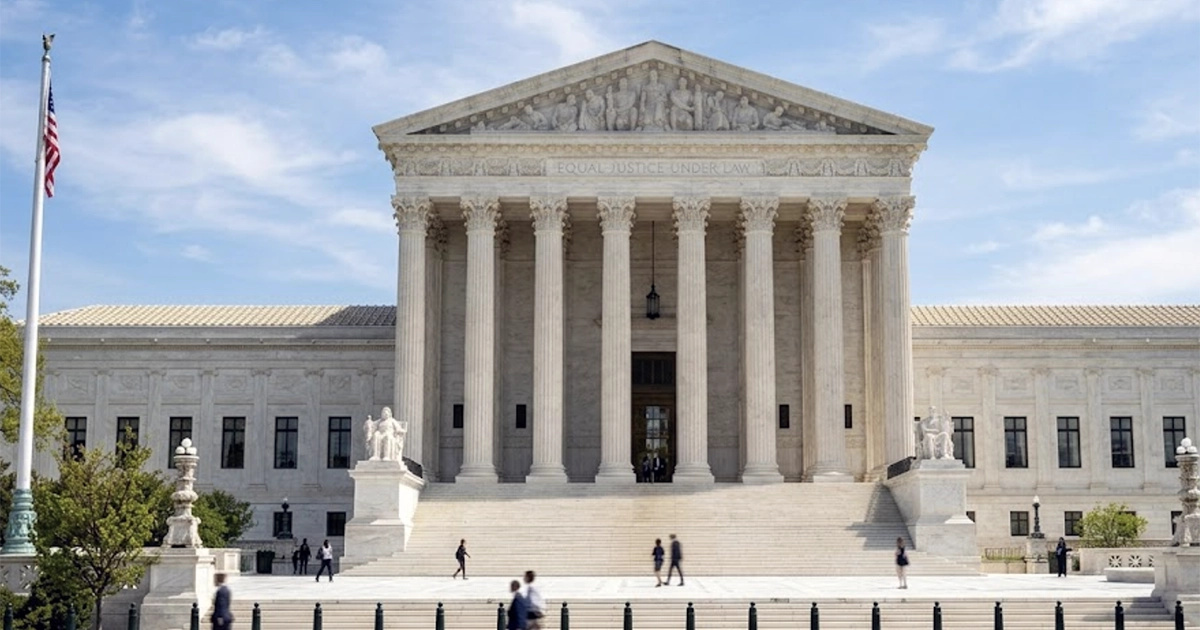
States that count mail ballots arriving after Election Day can keep doing so. On June 29, 2026, a divided Supreme Court ruled that federal law sets a deadline for when voters must cast their ballots — not for when election officials must receive them.

What the Court Decided
In a 5-4 decision in Watson v. Republican National Committee (No. 24-1260), the Supreme Court held that the three federal election-day statutes do not preempt a Mississippi law allowing absentee ballots to be counted when they are postmarked on or before Election Day and received by the registrar within five business days afterward. The Court reversed a 2024 ruling from the U.S. Court of Appeals for the Fifth Circuit, which had found Mississippi's deadline incompatible with federal law.Justice Amy Coney Barrett wrote the majority opinion, joined by Chief Justice John Roberts and Justices Sonia Sotomayor, Elena Kagan, and Ketanji Brown Jackson. Justice Samuel Alito filed a dissent joined by Justices Clarence Thomas and Neil Gorsuch, with Justice Brett Kavanaugh joining most of it. The decision was issued during the Court's October 2025 term after argument in March 2026.
The Question in the Case
Three federal statutes fix a single national Election Day — the Tuesday after the first Monday in November — for choosing the President, Senators, and Representatives. Mississippi, like roughly 30 states, counts at least some absentee ballots that are mailed by Election Day but arrive afterward. In 2024, the Republican National Committee, the Mississippi Republican Party, and individual plaintiffs sued state election officials, arguing that the word "election" in the federal statutes refers to both casting and receiving ballots, so the receipt of a ballot must also happen by Election Day.The Justices framed the question narrowly. The plaintiffs did not challenge absentee voting generally, early voting, the use of the Postal Service to carry ballots, or the practice of counting and certifying votes in the days after the election. The only issue was whether counting a ballot postmarked by Election Day but received up to five days later violates the federal election-day statutes. The Court also said it was not deciding the broader constitutional scope of Congress's power over federal elections.
Free settlement alerts
Get notified when new class actions open to claims
Join thousands of readers who get the latest class action settlements you may qualify for — delivered straight to your inbox.
The Majority's Reasoning
Writing for the majority, Justice Barrett concluded that the defining feature of an "election" has always been the electorate's choice of a candidate — and that choice is made when voting is complete, not when the last ballot lands in an official's hands. Dictionaries from the era the statutes were enacted, the Court's own precedent, and the Constitution's treatment of the Electoral College all point in the same direction, the majority reasoned: the Constitution requires electors to vote on a uniform day but says nothing about when their votes must be received, leaving receipt to happen "down the line."The majority leaned heavily on a related federal law, the Uniformed and Overseas Citizens Absentee Voting Act (UOCAVA), which repeatedly assumes that the deadline for receiving ballots is set by state law. If the election-day statutes already imposed a nationwide receipt deadline, the Court said, UOCAVA's references to state receipt deadlines "would make little sense." The majority also rejected the plaintiffs' reliance on 19th-century practice, writing that statutes do not "trap in amber" every contemporary practice on the same subject.
The Dissent
Justice Alito's dissent argued that because the electorate is a collective body, its choice is not authoritatively expressed until the full set of ballots is collected — so the statutes' command that the election occur on a fixed date requires that ballots be received by that date. The dissent pointed to legal dictionaries, 19th-century state statutes, and the practice of states during the Civil War, which it read as requiring soldiers' ballots to be received by Election Day. Justice Alito also warned that the majority's rule leaves open hard questions about how late ballots may arrive and who may carry them, and argued that counting ballots that trickle in for days after the election could deepen public distrust when reported results appear to shift.What It Means for Voters and States
For the roughly 18 states and territories that currently accept ballots postmarked by Election Day and received within a set window, the ruling means no scramble to rewrite their systems or to warn voters about an unfamiliar earlier deadline before the next federal election. According to a review of 2024 voting records, hundreds of thousands of ballots were postmarked by Election Day but arrived within the legal window afterward — votes that could have been at risk had the Court ruled the other way.The decision settles the narrow statutory question but not the larger political fight. The plaintiffs framed their concerns about election integrity and voter confidence as policy arguments — and the majority responded that such arguments belong to legislatures, not courts. If states' varied receipt deadlines call for a national rule, the Court said, that choice must come from Congress and the democratic process, not from the bench.
Read the Full Opinion
You can read the Supreme Court's slip opinion in Watson v. Republican National Committee — including Justice Barrett's majority opinion and Justice Alito's dissent — below.Frequently Asked Questions
What did the Supreme Court decide in Watson v. RNC?
The Court held 5-4 that the federal election-day statutes do not prevent a state from counting absentee ballots postmarked by Election Day but received up to five days later. Mississippi's late-arriving ballot law was upheld, and the Fifth Circuit's contrary decision was reversed.
Does this ruling change how I vote by mail?
No. The decision leaves existing state mail-ballot deadlines in place. Voters in the states and territories that count ballots postmarked by Election Day and received within a set window do not face any new federal deadline because of this ruling.
Is there anything to claim from this case?
No. Watson v. RNC is a dispute over election law, not a class action settlement. There is no fund, no claim form, and no payment associated with the decision.
How did the Justices line up?
Justice Barrett wrote the majority opinion, joined by Chief Justice Roberts and Justices Sotomayor, Kagan, and Jackson. Justice Alito dissented, joined by Justices Thomas and Gorsuch, and by Justice Kavanaugh in part.
Sources
- Supreme Court of the United States — Slip Opinions, October Term 2025
- Watson v. Republican National Committee, No. 24-1260 (U.S. June 29, 2026) — slip opinion (embedded above)
- National Conference of State Legislatures — Receipt and Postmark Deadlines for Absentee/Mail Ballots