If Duke Health’s records show you logged into Duke MyChart or the MyDuke Health app between 2019 and 2022, you can file for a pro rata cash share of the $3.74 million privacy settlement — no medical records needed.

What Is the Duke Health MyChart Privacy Settlement About?
Did you log into the Duke MyChart patient portal or the MyDuke Health mobile app between February 2019 and June 2022? You may be eligible for a pro rata cash payment from a $3.74 million class action settlement that alleges Duke University Health System used the Meta Pixel and other tracking tools to disclose patient information to a third-party vendor. The Duke Health claim deadline is August 16, 2026, and the final approval hearing is August 27, 2026.The lawsuit, captioned Afrika Williams v. Duke University Health System, Inc., Case No. 1:22-cv-00727, is pending in the U.S. District Court for the Middle District of North Carolina before Judge William L. Osteen, Jr., with Magistrate Judge Joi Elizabeth Peake. Named plaintiff Afrika Williams alleges that Duke Health installed the Meta Pixel and other Internet tracking technologies on its website and patient portal, and that those technologies caused personal or health-related information to be transmitted to a third-party vendor when patients used the Duke Health website.
Duke Health denies any wrongdoing and is settling the Duke Health class action without admitting liability. The Court granted Preliminary Approval of the Settlement on March 19, 2026, conditionally certifying the Settlement Class for settlement purposes. The Settlement Administrator is Epiq. The official Settlement Website is at duhssettlement.com.
30-Second Self-Test: Do I Qualify for the Duke Health Settlement?
If you can answer yes to the question below, you are likely a Settlement Class Member.• Did you log into the Duke MyChart patient portal or the MyDuke Health mobile app at least once between February 18, 2019 and June 17, 2022, while residing in the United States? If yes, and if Duke Health's records identify you as a portal or app user during that 28-month window, you are within the Settlement Class.
The Settlement Administrator (Epiq) mailed or emailed notices to identified class members starting after the Court's March 19, 2026 Preliminary Approval Order. If you received an "Afrika Williams v. Duke University Health System" notice by mail or email, you are on the class list. If you used Duke MyChart or MyDuke Health during the class period but did not receive a notice, the official Settlement Website provides a way to confirm your class membership and request a Claim Form.
Free settlement alerts
Get notified when new class actions open to claims
Join thousands of readers who get the latest class action settlements you may qualify for — delivered straight to your inbox.
What Is Duke University Health System? (A Common Question)
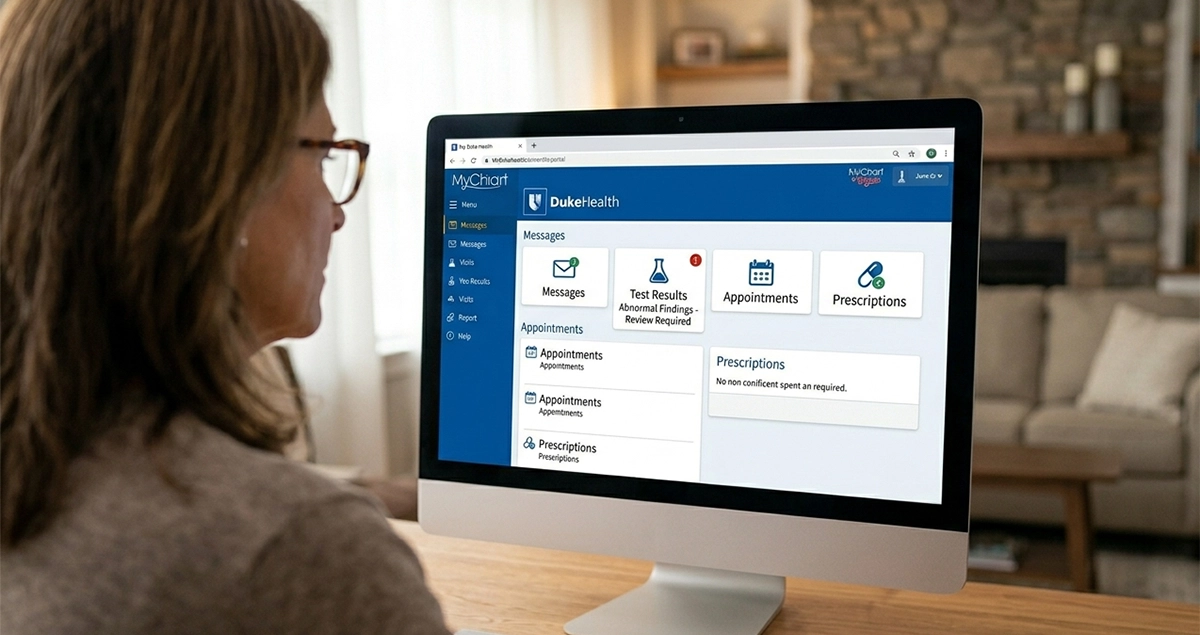
Duke University Health System, also known as Duke Health or DUHS, is a major academic health care system based in Durham, North Carolina. It is the clinical health care arm of Duke University and one of the largest hospital systems in the Southeast.The Duke Health network includes Duke University Hospital (the main academic medical center in Durham), Duke Regional Hospital, Duke Raleigh Hospital, plus a broad network of specialty clinics and primary care practices across the Triangle region of North Carolina (Raleigh-Durham-Chapel Hill) and beyond. Patients interact with Duke Health digitally through the Duke MyChart patient portal (the web-based portal built on Epic's MyChart platform) and the MyDuke Health mobile app. These are the platforms patients use to schedule appointments, view test and lab results, message providers, request prescription refills, and access medical records.
The Duke Health MyChart portal and app are at the center of this lawsuit because those are the platforms where patients allegedly accessed personal and health-related information that the lawsuit alleges was transmitted to a third-party vendor via tracking technologies.
What Did Duke Health Allegedly Do With the Meta Pixel?
The Williams lawsuit and similar healthcare Meta Pixel cases follow a comparable pattern, but the Duke Health case has heightened sensitivity because the alleged disclosure involved the patient portal, where personal medical information lives.What is the Meta Pixel? The Meta Pixel is a snippet of JavaScript code that thousands of websites embed to track visitor behavior. When the Pixel fires, it transmits data about what the visitor is doing (which pages they view, which forms they fill out, sometimes individual button clicks) back to Meta (Facebook and Instagram) for advertising, analytics, and audience-building purposes.
What did the lawsuit allege? The Williams lawsuit alleges that Duke Health installed the Meta Pixel and other Internet tracking technologies on its website and the MyChart patient portal between February 18, 2019 and June 17, 2022. When patients used the Duke Health website (including logging into the patient portal or app), the tracking technologies allegedly caused certain personal or health-related information to be transmitted to a third-party vendor without patient consent. The original Class Action Complaint included legal claims for breach of contract, invasion of privacy, violation of the Electronic Communications Privacy Act (federal wiretap act), negligent misrepresentation, and negligence.
What about the original Meta defendant? The original complaint named both Duke Health and Meta Platforms, Inc. as defendants. On December 28, 2022, Magistrate Judge Joi Elizabeth Peake granted a Joint Motion to Transfer and Sever the claims against Meta, transferring them to the U.S. District Court for the Northern District of California for coordination with the broader In re Meta Pixel Healthcare Litigation, Case No. 3:22-cv-03580-WHO. This settlement resolves only the claims against Duke Health, not the separate claims against Meta.
Duke Health denies all allegations and is settling without admitting wrongdoing or liability. The Court has not ruled that Duke Health did anything wrong.
How Many People Are in the Duke Health Settlement?
The Settlement Notice does not publicly state a specific class size. The class includes all U.S. residents whom Duke Health identified as having logged into the Duke MyChart patient portal or the MyDuke Health mobile app at least once during the 28-month class period from February 18, 2019 through June 17, 2022. Given Duke Health's size as a major regional academic medical system serving the Triangle region of North Carolina and surrounding areas, the class likely includes hundreds of thousands of patients.The Settlement Administrator's CAFA notice filings and notice administration reports on the case docket would contain the exact class size figure used for notice planning purposes. Class members who want to confirm the figure can review the public court docket for Case No. 1:22-cv-00727 (M.D.N.C.) or check the official Settlement Website for notice administration filings.
What Benefits Does the Duke Health Settlement Provide?
The Settlement establishes a $3,743,600 Settlement Fund. The Net Settlement Fund (what gets distributed to class members) is what remains after court-approved deductions:• Notice and Settlement Administration Costs — the costs of sending mail and email notices, the Settlement Administrator's services, and related expenses
• CAFA Notice Costs — the costs of sending the Class Action Fairness Act notices to state and federal officials
• Class Representative Service Award — $7,500 to Afrika Williams
• Attorneys' Fees and Expenses Award — up to 33% of the Settlement Fund or $1,235,388, plus expenses up to $30,000
Whatever remains is the Net Settlement Fund, which is divided pro rata among class members who submit valid Claim Forms. Per-claimant payment depends on how many class members submit valid claims; the smaller the claim rate, the larger each individual payment.
Do I Need Proof to File a Duke Health Claim?
No purchase receipts, medical records, or supporting documentation are required. Class membership is established by Duke Health's own records. Here is how the proof structure works.• Notice receipt is your proof of eligibility. If you received a notice of the Settlement from the Settlement Administrator (Epiq) by U.S. mail or email, Duke Health's records show you logged into MyChart or MyDuke Health during the class period. That is the only proof required.
• No medical records or test results are involved. The Claim Form asks for basic identifying information so the Settlement Administrator can match your claim to your record and process the payment. Do not send medical records, test results, or sensitive health information with your claim; they are not required and the Settlement Administrator does not need them.
• If you did not receive a notice but believe you used Duke MyChart or MyDuke Health during the class period, the official Settlement Website provides a way to verify your class membership and request a Claim Form. The Settlement Administrator can look up your record using basic identifying information.
How to File a Duke Health Settlement Claim Online or by Mail in 2026
Two methods are available, both with the same August 16, 2026 deadline.Method 1: Online (recommended for speed). Visit duhssettlement.com and click "Submit a Claim." Complete the Claim Form with your identifying information and select your payment preference. Online submissions must be completed by August 16, 2026.
Method 2: U.S. Mail. Download the printable Claim Form from the Settlement Website. Complete it with your identifying information and mail it to the Settlement Administrator at the address printed on the form. Mailed claims must be postmarked by August 16, 2026.
One claim per Settlement Class Member. Only one valid and timely Claim Form per class member is allowed. Duplicate submissions will be rejected.
Key Duke Health Settlement Deadlines
• Court Preliminary Approval Order: March 19, 2026
• Opt-out deadline (exclusion): Monday, July 20, 2026
• Objection deadline: Monday, July 20, 2026
• Claim Form deadline: Sunday, August 16, 2026 (online or postmarked by mail)
• Final Approval Hearing: Thursday, August 27, 2026 at 9:30 a.m. Eastern Time, before Judge William L. Osteen, Jr., in Greensboro, North Carolina (may be held remotely; instructions on the official Settlement Website)
• Class period covered: February 18, 2019 through June 17, 2022
The hearing may be postponed without further notice, so class members planning to attend should check the official Settlement Website for the current hearing arrangements.
When Will I Get My Duke Health Settlement Payment?
Payment timing depends on the Court's final approval and any appeals.• Final Approval Hearing: August 27, 2026. The Court considers whether the settlement is fair, reasonable, and adequate.
• Settlement becomes final: after the Court enters final approval and any appeal period passes with no appeals filed (typically 30 days after the Final Approval Order).
• Payment distribution: typically begins several weeks to several months after the settlement becomes final.
• Best case (no appeals): first payments could reach class members in late 2026 or early 2027.
• If appeals are filed: distribution can be delayed by 12 to 36 months.
Pro rata distribution means the exact per-claimant amount depends on how many class members submit valid claims. Class members who selected electronic payment options typically receive payment faster than those who selected a paper check.
What Happens If I Do Nothing?
If you do nothing, you will not receive any settlement benefits, and you will be bound by the settlement release. The release means you cannot sue, continue to sue, or be part of any other lawsuit against Duke Health relating to the alleged Pixel Disclosure or Duke Health's use of Tracking Tools during the class period.For eligible class members, doing nothing leaves a cash payment unclaimed. The Claim Form takes only a few minutes online with your identifying information. The trade-off for receiving the settlement payment is releasing your individual claims against Duke Health for the tracking-technology allegations in this case.
How to Opt Out or Object to the Settlement
Class members who do not want to be bound by the settlement have two alternatives, both with the same July 20, 2026 deadline.Opting out (excluding yourself). Opt-out means receiving no settlement benefits but preserving your right to file your own lawsuit against Duke Health over the alleged Pixel Disclosure. Opt-out requests must be in writing, postmarked by July 20, 2026, and mailed to the Settlement Administrator at the address printed on the Settlement Notice. Your written request must include the case name and number, your full name, address, telephone number, your original personal signature, and a clear statement that you want to be excluded. Only individual exclusion requests are accepted; one person cannot opt out for another.
Objecting. Objection means staying in the class (and remaining eligible for the settlement payment) but asking the Court to reject or modify the settlement. Written objections must be filed with the Court and a copy mailed to Class Counsel and Defendant's Counsel at the addresses on the Settlement Notice, all postmarked by July 20, 2026. Objections must include the case name and number, your name and contact information, the basis for your class membership, the specific grounds for your objection with any supporting evidence or legal argument, identification of any attorneys helping you, a statement of whether you intend to appear at the Final Approval Hearing, and your original personal signature.
Watch Out for Settlement Scams
Settlement scams targeting class action class members tend to increase around high-profile cases. The Duke Health case has additional scam exposure because the class involves patients, and patient identifiers are valuable to bad actors. A few common-sense guidelines:• Use the official Settlement Website only: duhssettlement.com. Bookmark it. Be cautious of any email or text linking to a "Duke Health Settlement" or "MyChart Settlement" page from a different domain.
• Never pay a fee to receive your payment. Legitimate class action settlements never require an activation fee, release fee, or tax payment to release benefits.
• Never share medical records or your MyChart login. The Settlement Administrator does not need your MyChart username, password, medical record number, or any test results. The Claim Form asks for basic identifying information only.
• Be skeptical of phone calls. The Settlement Administrator does not need to call you to process your claim. Be cautious of unsolicited phone calls claiming to be from the Duke Health Settlement, especially calls requesting sensitive personal or medical information.
Other Active Healthcare Privacy & Meta Pixel Settlements
The Duke Health settlement is part of a broader wave of class action lawsuits and settlements targeting healthcare providers and hospital systems that used the Meta Pixel or similar tracking technologies on websites and patient portals. The broader In re Meta Pixel Healthcare Litigation, Case No. 3:22-cv-03580-WHO, pending in the U.S. District Court for the Northern District of California, consolidates many of the related claims against Meta itself. Individual hospital and health system defendants like Duke Health are typically litigated separately and have produced multi-million-dollar settlements over the past several years.Class membership in one healthcare privacy case does not affect eligibility for any other unrelated settlement. Many patients qualify for multiple healthcare privacy and consumer privacy settlements simultaneously.
Other related OCA coverage:
• WISP / hellowisp.com Meta Pixel Privacy Class Action Settlement — women's telehealth platform with similar tracking-technology allegations and a $18 flat cash payment
• OCA database of open class action settlements — complete list of active consumer cases
• Latest class action news and updates
• Active class action investigations
Claim Form Website: DUHSSettlement.com
Submit Claim
Frequently Asked Questions About the Duke Health Settlement
Who qualifies for the Duke Health MyChart privacy settlement?
U.S. residents whom Duke Health identified as having logged into the Duke MyChart patient portal or the MyDuke Health mobile app at least once between February 18, 2019 and June 17, 2022 qualify as Settlement Class Members.
How much will I get from the Duke Health settlement?
Class members who submit valid Claim Forms receive a pro rata share of the Net Settlement Fund (the $3,743,600 Settlement Fund minus court-approved attorneys' fees, expenses, the $7,500 service award, and administrative costs). Per-claimant payment depends on how many class members file valid claims.
What is Duke University Health System?
Duke Health is a major academic health care system based in Durham, North Carolina, including Duke University Hospital, Duke Regional Hospital, Duke Raleigh Hospital, and a network of specialty and primary care clinics across the Triangle region.
What did Duke Health allegedly do?
The lawsuit alleges Duke Health installed the Meta Pixel and other tracking technologies on its website and the MyChart patient portal between February 2019 and June 2022, and that those technologies caused personal or health-related information to be transmitted to a third-party vendor without patient consent. Duke Health denies the allegations and is settling without admitting liability.
Do I need proof to file a Duke Health claim?
No. No purchase receipts, medical records, or supporting documents are required. If you received a notice of the Settlement from the Settlement Administrator (Epiq), you have been identified as a class member based on Duke Health's own records.
What is the claim deadline?
All Claim Forms must be submitted online or postmarked by mail no later than August 16, 2026.
How many people are in the Duke Health settlement?
The Notice does not publicly state a specific class size. The class includes all U.S. residents whom Duke Health identified as MyChart or MyDuke Health users during the 28-month class period; given Duke Health's size, the class likely includes hundreds of thousands of patients.
When will I get my payment?
If the Court grants final approval at the August 27, 2026 hearing and no appeals are filed, payments typically begin several weeks to several months later. Electronic payments arrive faster than paper checks. Appeals can delay distribution by 12 to 36 months.
Official Settlement Notice
Sources
• Official Settlement Website: DUHSSettlement.com• Afrika Williams v. Duke University Health System, Inc., Case No. 1:22-cv-00727, U.S. District Court for the Middle District of North Carolina, Hon. William L. Osteen, Jr. presiding; Magistrate Judge Joi Elizabeth Peake
• Long-Form Notice of Proposed Class Action Settlement
• Order Granting Preliminary Approval of Class Action Settlement (March 19, 2026)
• Settlement Agreement and Release (dated May 2, 2025)
• Class Counsel: CR Legal Team, LLC (Peter H. Burke, James R. Harrell) and Lockridge Grindal Nauen P.L.L.P. (Karen Hanson Riebel, Kate M. Baxter-Kauf, Maureen Kane Berg)
• Defendant's Counsel: Baker & Hostetler LLP (Elizabeth A. Scully)
• Settlement Administrator: Epiq
• Related case: In re Meta Pixel Healthcare Litigation, Case No. 3:22-cv-03580-WHO, U.S. District Court for the Northern District of California (consolidated Meta defendant claims)