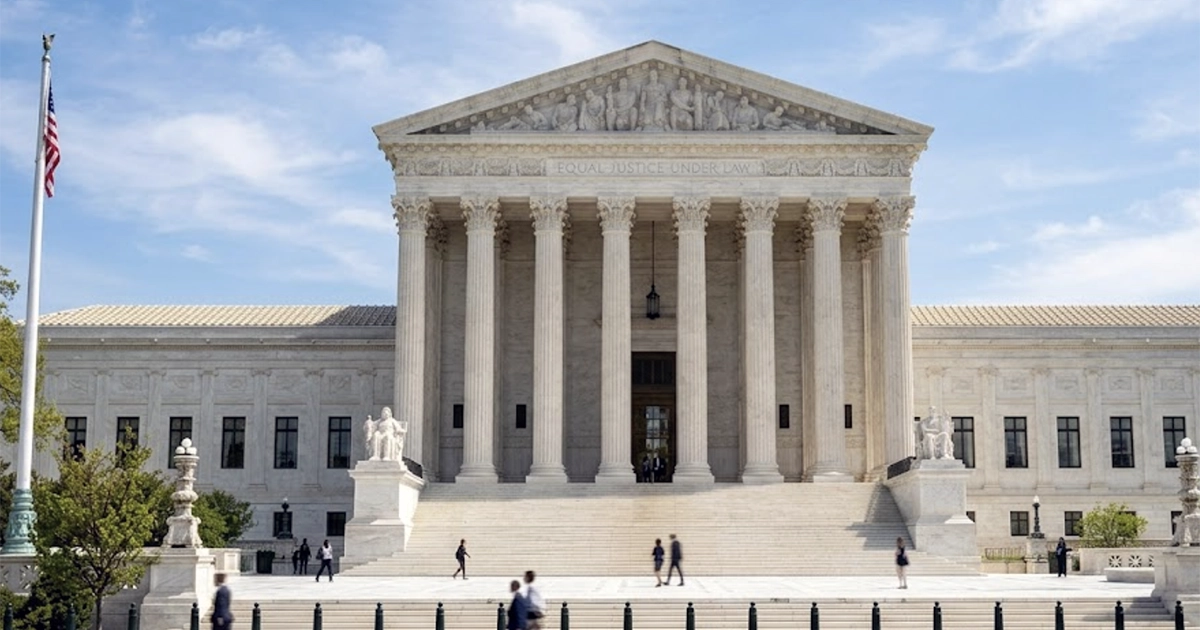
The U.S. Supreme Court heard argument on October 14, 2026 in Salazar v. Paramount Global, which will decide whether a person who subscribes to a free newsletter from a company that offers videos is a “consumer” protected by the 1988 Video Privacy Protection Act. The ruling, expected by mid-2027, will shape the many Meta Pixel video privacy class actions; it does not create anything to claim.

Allegations Only · No Settlement Yet
This article describes a pending Supreme Court case. The facts of the underlying lawsuit are unproven allegations. Paramount Global has not been found liable, no class has been certified in this case, and there is nothing to claim. This page is informational and is not legal advice.
What Is the Supreme Court Deciding?
The Supreme Court heard argument on Wednesday, October 14, 2026 in Salazar v. Paramount Global, No. 25-459. The case asks a narrow question about the Video Privacy Protection Act of 1988, or VPPA, the law Congress passed after a newspaper published a list of Judge Robert Bork’s video rentals. The VPPA bars a “video tape service provider” from knowingly disclosing a “consumer’s” video-viewing history without consent, and it allows a court to award actual damages but not less than $2,500 in liquidated damages. The Court granted review on January 26, 2026.The law defines a “consumer” as a “renter, purchaser, or subscriber of goods or services from a video tape service provider.” The question presented is whether “goods or services” means all of a provider’s goods or services, or only its audiovisual ones. If it means everything, someone who signs up for a free newsletter from a company that also offers videos can be a protected consumer. If it means only audiovisual goods or services, that person is not.
Michael Salazar subscribed to a free online newsletter from 247Sports.com, a site owned by Paramount. He alleges that while he was logged into Facebook, he watched videos on 247Sports.com and the Meta Pixel on the site sent Facebook his Facebook ID and the titles of the videos he watched, without his consent. Paramount disputes that the law covers him. Those facts are allegations; no court has found them true.
Free settlement alerts
Get notified when new class actions open to claims
Join thousands of readers who get the latest class action settlements you may qualify for — delivered straight to your inbox.
How Did the Case Get Here?
A federal district judge in the Middle District of Tennessee, Eli Richardson, dismissed Salazar’s lawsuit, ruling that he was not a “consumer” because the newsletter was not audiovisual content. A divided panel of the U.S. Court of Appeals for the Sixth Circuit affirmed on April 3, 2025. Judge John Nalbandian wrote for the majority and Judge Rachel Bloomekatz dissented.The federal appeals courts had split. The Second Circuit, in an earlier case Salazar brought against the National Basketball Association, and the Seventh Circuit, in Gardner v. Me-TV, read “goods or services” broadly to cover any purchase or subscription, including a newsletter. The Sixth Circuit in this case and the D.C. Circuit in Pileggi v. Washington Newspaper Publishing Co. read it narrowly to require audiovisual goods or services. The Supreme Court declined to hear the NBA’s appeal on December 8, 2025, then took Salazar’s case against Paramount.
Both lower courts assumed, without deciding, that Paramount is a “video tape service provider” and that a Facebook ID paired with video titles is “personally identifiable information.” Those two questions are not before the Supreme Court, so defendants in other cases can still contest them.
What Did the Justices Ask?
Joshua Hammack of Bailey & Glasser argued for Salazar, saying the wave of VPPA suits came with “the advent of pixel technology” and that the law allows disclosure with consent. Paul Clement of Clement & Murphy argued for Paramount that, read in context, the phrase reaches only the kind of audiovisual material a customer could rent, buy or subscribe to, comparing it to “goods or services from a medical service provider,” which would not mean a cup of coffee or valet parking. The United States did not file a brief or take part in the argument, according to the Court’s docket.According to the official transcript, Justice Ketanji Brown Jackson told Clement that Paramount’s reading created “a line-drawing problem.” Justice Elena Kagan asked whether this case could be “the paradigmatic case” and said businesses going forward could get consent or stop selling people’s private information; Justice Sonia Sotomayor put it as “get consent, or just don’t do it.” Justice Brett Kavanaugh asked how to weigh “the sky-is-falling concern in the amicus briefs” when the other defenses remain available, and asked whether getting consent was “a very easy solution” going forward. Justice Samuel Alito described the VPPA as “a law that is based on the technology of the 1980s,” Justice Clarence Thomas asked whether streaming is closer to cable TV than to a Blockbuster rental, Chief Justice John Roberts raised the “no pets in the park” problem of reading a statute apart from its purpose, and Justice Amy Coney Barrett asked about the plaintiff’s standing to sue.
Coverage of the argument read the bench differently. SCOTUSblog wrote that the Court appeared likely to let the suit go forward on the “consumer” question, while other outlets emphasized the justices’ doubts about stretching the 1988 law to modern websites. The outcome is uncertain until the Court rules.
Why It Matters for Video Privacy Class Actions
Many recent VPPA class actions involve websites and apps that offer videos and use the Meta Pixel or similar tools, and in several of the cases behind the circuit split, the plaintiffs had signed up for a free newsletter rather than paying for videos. A broad reading of “consumer” would keep those claims alive in every circuit; a narrow one would limit the law to people who rent, buy or subscribe to audiovisual goods or services. Because the statute allows liquidated damages of $2,500 per person, the definition affects how large these cases can be and how they settle.The ruling will not decide whether an ordinary website counts as a “video tape service provider,” or whether Pixel data identifies a person, so those defenses will keep being litigated. Meta Platforms, the U.S. Chamber of Commerce, retail and media trade groups filed briefs on Paramount’s side; the Electronic Privacy Information Center filed one supporting Salazar.
What Happens Next?
The Court has not announced a decision date. Cases argued in October are typically decided before the term ends in late June or early July, so a ruling is expected by mid-2027. The Supreme Court case does not change the deadlines in open VPPA settlements, which are set by the courts overseeing them.Questions
What is Salazar v. Paramount Global about?
Salazar v. Paramount Global, No. 25-459, asks the Supreme Court whether a person who subscribes to any good or service from a video provider, such as a free newsletter, is a “consumer” under the Video Privacy Protection Act, or only a person who subscribes to audiovisual goods or services. The plaintiff alleges that the Meta Pixel on 247Sports.com sent his Facebook ID and video titles to Facebook without consent; Paramount disputes that the law covers him.
When will the Supreme Court decide the VPPA case?
The Court heard argument on October 14, 2026 and has not announced a decision date. Cases argued in the fall are usually decided before the term ends in late June or early July, so a ruling is expected by mid-2027.
Does the Salazar case affect open video privacy settlements?
The Supreme Court case does not change the claim and objection deadlines in open VPPA settlements, which are set by the courts overseeing them. The ruling could affect pending VPPA lawsuits that have not settled, depending on how the Court defines who counts as a consumer.
Is there anything to claim from the Supreme Court VPPA case?
No. The Supreme Court is deciding a question of law in one lawsuit. There is no settlement, fund or claim form connected to the case.
Sources
• Supreme Court docket No. 25-459, Salazar v. Paramount Global — certiorari granted January 26, 2026; argued October 14, 2026; amicus filings• Question presented, No. 25-459
• Official transcript of oral argument, October 14, 2026
• Petition for a writ of certiorari (October 10, 2025), describing the circuit split; Salazar v. Paramount Global, 133 F.4th 642 (6th Cir. 2025)
• Video Privacy Protection Act, 18 U.S.C. § 2710
• SCOTUSblog argument preview (October 12, 2026) and recap (October 14, 2026)