A pro se litigant is a person who files or defends a lawsuit without a lawyer, a right federal law has guaranteed in civil cases since the Judiciary Act of 1789. About 30 percent of the civil cases filed in U.S. district courts in fiscal 2025 were filed pro se, and each one moved through the same stages as a lawyer-filed case, from the complaint and filing fee to service, discovery, trial and appeal.

What Does Pro Se Mean?
Pro se is Latin for “for oneself” or “on one’s own behalf.” In court, a pro se litigant is a party who handles their own case instead of hiring a lawyer. That covers a plaintiff who files a lawsuit and a defendant who answers one. The litigant drafts and signs the papers, meets the deadlines and argues to the judge.“Self-litigation” is not a term courts use. The accepted vocabulary is:
- Pro se: the standard term in federal courts and most state courts. It is pronounced “pro say” and often written in court papers as “Plaintiff, pro se.”
- Self-represented litigant (SRL): the plain-English term many state court systems and self-help centers now prefer.
- In propria persona, or “pro per”: the term used in California and some other western states. It means the same thing.
- Litigant in person: the term in England and Wales.
OpenClassActions’ pro se glossary entry gives the short definition. This article covers the mechanics: what the law allows, who is excluded, and how a self-represented civil case moves through court from start to finish.
Is It Legal to Represent Yourself in Court?
Yes. In federal court the right comes from statute. 28 U.S.C. § 1654 provides that “in all courts of the United States the parties may plead and conduct their own cases personally or by counsel.” The provision traces back to Section 35 of the Judiciary Act of 1789. Every state also allows individuals to represent themselves, through its constitution, statutes or court rules.In criminal cases the right is constitutional. In Faretta v. California (1975), the Supreme Court held that the Sixth Amendment gives a defendant the right to refuse a lawyer and conduct their own defense, as long as the waiver of counsel is knowing and voluntary. A judge can appoint “standby counsel” to assist a defendant who chooses self-representation. This article focuses on civil cases, where there is generally no right to an appointed lawyer, so self-representation is often a matter of cost rather than choice.
How Common Are Pro Se Cases?
More common than most people expect. Federal judiciary statistics (Table C-13) show that in the 12 months ending September 30, 2025, 89,971 of the 303,563 civil cases filed in U.S. district courts were filed pro se, about 30 percent. Prisoners filed 48,183 of those, mostly habeas petitions and civil rights complaints about prison conditions. The other 41,788 were non-prisoner cases such as employment, civil rights, consumer and contract disputes. The year before, pro se filings were 99,647 of 290,896 civil cases, about 34 percent.The share is higher on appeal. Pro se litigants filed 20,878 of the 41,824 appeals opened in the federal courts of appeals in fiscal 2025, about half (Table B-19).
State courts see even more self-representation, mostly on the defense side. A 2015 National Center for State Courts study of nearly a million non-family civil cases in 10 urban counties found at least one self-represented party in 76 percent of them. In most of those cases the unrepresented party was a defendant in a debt-collection, landlord-tenant or small claims matter.
Who Can’t Proceed Pro Se?
The right to self-representation is personal. It lets a person represent themselves, not anyone else. Several groups regularly run into that limit:- Corporations, LLCs, partnerships and associations. In Rowland v. California Men’s Colony (1993), the Supreme Court said it has been the law “for the better part of two centuries” that a corporation may appear in federal court only through licensed counsel. Lower courts apply the same rule to LLCs and partnerships, even when there is a single owner. A filing signed by a non-lawyer owner on the company’s behalf is typically struck. A sole proprietorship is not a separate legal entity, so its owner can proceed pro se.
- Parents suing for a child. Most federal circuits hold that a non-lawyer parent can bring their own claims pro se but cannot litigate a minor child’s claims without a lawyer. The Second Circuit’s decision in Cheung v. Youth Orchestra Foundation of Buffalo (1990) is a leading example. Narrow exceptions exist, such as appeals of Social Security benefit denials in some circuits.
- Estates and trusts. Courts generally do not allow a non-lawyer executor or trustee to litigate pro se on behalf of an estate that has other beneficiaries or creditors.
- Spouses, relatives and friends. One non-lawyer cannot appear for another adult, even with that person’s written permission. Doing so can amount to the unauthorized practice of law.
- Class representatives. A pro se plaintiff cannot represent a class (see “Pro Se and Class Actions” below).
How Do People File a Lawsuit Without a Lawyer? The Ten Stages
The stages below follow a typical civil case in a U.S. district court under the Federal Rules of Civil Procedure. State courts follow the same basic sequence but use their own rules, forms, fees and deadlines, and those differ from state to state. The descriptions explain how the process works. They are not instructions for any particular case.Stage 1: Identifying the Legal Claim and the Deadline
A lawsuit has to rest on a legal claim, meaning a recognized cause of action such as breach of contract, negligence, or a violation of a specific statute like the Fair Debt Collection Practices Act or Title VII. Each claim has elements a plaintiff has to allege and eventually prove.Every claim also has a statute of limitations, the deadline for filing. Limitation periods are set claim by claim and state by state, commonly ranging from one year to six years. Some federal statutes require an administrative step before a lawsuit is allowed at all. An employment discrimination claim under Title VII, for example, generally requires a charge with the Equal Employment Opportunity Commission and a right-to-sue letter, after which the lawsuit has to be filed within 90 days. A claim filed after its deadline is usually dismissed no matter how strong it is.
Stage 2: Choosing the Right Court
The court has to have authority over the type of case (subject-matter jurisdiction) and over the defendant (personal jurisdiction), and the case has to be filed in a proper location (venue).- Small claims court handles disputes below a dollar cap with simplified procedures designed for people without lawyers. The cap varies widely: $12,500 for individuals in California, for example, and $20,000 in Texas justice courts.
- State trial courts hear most civil disputes, including contract, injury, landlord-tenant and family cases, with no upper limit on the amount.
- Federal district courts hear only the cases Congress allows. The two main routes are a claim arising under federal law (federal question jurisdiction, 28 U.S.C. § 1331) and a dispute between citizens of different states with more than $75,000 at stake (diversity jurisdiction, 28 U.S.C. § 1332). Venue is generally proper where a defendant resides or where a substantial part of the events happened (28 U.S.C. § 1391).
A case filed in a court without jurisdiction gets dismissed or transferred, which costs time against the statute of limitations. OpenClassActions’ explainer on federal versus state court covers the distinction in more depth.
Stage 3: Drafting the Complaint
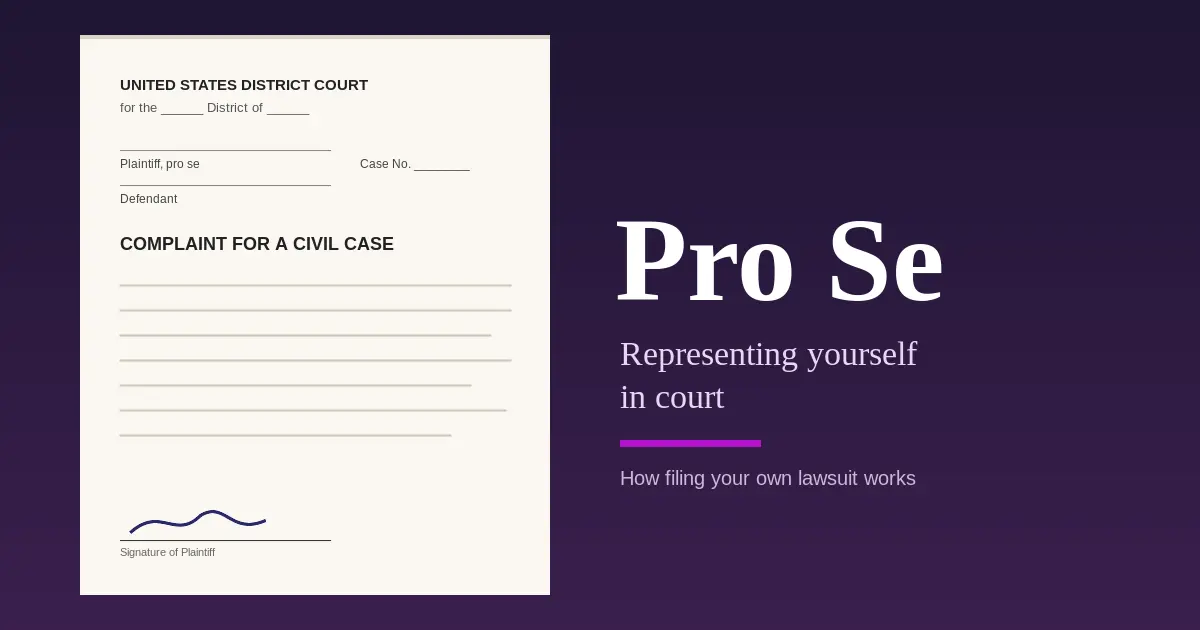
The complaint is the document that starts the case. Federal Rule of Civil Procedure 8(a) requires three things: a short and plain statement of why the court has jurisdiction, a short and plain statement of the claim showing the plaintiff is entitled to relief, and a demand for the relief sought, such as money damages or an injunction. Rule 10 requires a caption naming the court and the parties, and allegations set out in numbered paragraphs.The federal judiciary publishes a fill-in-the-blank complaint, form Pro Se 1, Complaint for a Civil Case. It walks through the parties, the basis for jurisdiction, a statement of the claim, the relief requested, and a signed certification. The judiciary’s civil pro se forms page also has specialized complaints for employment discrimination, civil rights violations and prisoner cases. Many district courts publish their own versions, and some require them.
A complaint has to do more than state a conclusion. Under Bell Atlantic Corp. v. Twombly (2007) and Ashcroft v. Iqbal (2009), it must allege enough facts to make the claim plausible, not merely possible. Courts do read pro se complaints generously. Haines v. Kerner (1972) holds them to “less stringent standards than formal pleadings drafted by lawyers,” and Erickson v. Pardus (2007) repeated that a pro se filing “is to be liberally construed.” But liberal construction does not supply missing facts, and a judge will not invent a claim the complaint does not describe.
Federal Rule 5.2 limits what personal information can appear in a public court filing. Only the last four digits of a Social Security or financial account number, the year of birth rather than the full date, and a minor’s initials rather than their name.
Stage 4: Filing the Case and Paying the Fee
The complaint is filed with the clerk of court, in person, by mail, or electronically where the court allows it. Filing a civil action in a federal district court costs $405: the $350 statutory fee under 28 U.S.C. § 1914 plus a $55 administrative fee, a total in effect since December 1, 2023, according to the judiciary’s miscellaneous fee schedule. State court filing fees vary by state and case type.A person who cannot afford the fee can apply to proceed in forma pauperis (IFP), meaning without prepaying fees, under 28 U.S.C. § 1915. Federal courts use form AO 240 (the short form) or AO 239 (the long form, which many judges require in non-prisoner cases). Both are on the judiciary’s fee waiver forms page. The application lists income, assets, expenses and debts under penalty of perjury. If it is granted, the filing fee is waived and the $55 administrative fee does not apply. Prisoners are treated differently. They still owe the full $350, collected through an initial partial payment of 20 percent of their average monthly deposits or balance, followed by monthly payments of 20 percent of the prior month’s income.
IFP status comes with screening. Under § 1915(e)(2), the court must dismiss an IFP case at any time if the claim of poverty is untrue, or if the case is frivolous or malicious, fails to state a claim, or seeks money from a defendant who is immune. Some pro se cases end at this stage, before the defendant is ever served. A prisoner who has had three prior cases or appeals dismissed on those grounds loses IFP eligibility under the “three strikes” rule of § 1915(g), unless the prisoner is in imminent danger of serious physical injury.
Electronic filing works differently for self-represented parties. Lawyers file through the federal courts’ CM/ECF system, but a pro se party generally needs a judge’s permission to use it, and that permission usually covers only the one case. Prisoners generally cannot e-file. Without permission, filings go to the clerk on paper. Anyone can view the docket through PACER.
Stage 5: Serving the Defendant
Filing a complaint does not notify the defendant. The plaintiff has to arrange formal service of process, delivering a court-issued summons and a copy of the complaint in the way Federal Rule 4 allows. Service can be made by any adult who is not a party to the case, often a professional process server. It cannot be made by the plaintiff personally.Under Rule 4(m), if a defendant is not served within 90 days after the complaint is filed, the court must dismiss the case against that defendant without prejudice or order service by a set date. A plaintiff who shows good cause for the delay gets more time. Rule 4(d) offers a cheaper route: the plaintiff can mail the defendant a request to waive service. A defendant who agrees gets 60 days from the date the request was sent to respond, instead of the usual 21. A defendant who refuses without good cause can be ordered to pay the cost of formal service.
For a plaintiff proceeding IFP, the court arranges service. Section 1915(d) directs court officers to serve process, so the U.S. Marshals Service typically serves the summons once the case passes screening. Suing the federal government, a federal agency or a federal employee requires extra steps under Rule 4(i), including service on the U.S. Attorney’s office and the Attorney General.
Stage 6: The Defendant’s Response
A served defendant has 21 days to respond (Rule 12(a)), or 60 days after a waiver request was sent. The response is usually one of two things:- An answer, which admits or denies each numbered paragraph of the complaint and raises defenses, such as the statute of limitations.
- A motion to dismiss under Rule 12(b), which argues the case should end before it starts. The most common ground is Rule 12(b)(6), failure to state a claim. Others include lack of jurisdiction and improper service. The plaintiff files a written opposition, and the judge decides.
A plaintiff can usually amend the complaint once as a matter of course within 21 days after a motion to dismiss is served (Rule 15(a)), and courts often give pro se plaintiffs at least one chance to fix a defective complaint. If the defendant does not respond at all, the plaintiff can ask the clerk to enter a default and then ask the court for a default judgment under Rule 55. Courts generally prefer deciding cases on the merits and often set aside defaults when the defendant shows up promptly.
Stage 7: Discovery
If the case survives the pleadings, the parties exchange information. Under Rule 26 they meet to plan discovery, make initial disclosures listing witnesses and documents, and follow a scheduling order the judge enters under Rule 16. The main discovery tools are:- Interrogatories: written questions answered under oath, limited to 25 per party unless the court allows more (Rule 33).
- Requests for production of documents and electronically stored information (Rule 34).
- Requests for admission, which ask the other side to admit specific facts (Rule 36). A party that fails to answer within 30 days is deemed to have admitted them.
- Depositions: sworn, recorded questioning, limited to one day of seven hours per witness unless the court orders otherwise (Rule 30). The party taking the deposition pays for the court reporter.
Discovery is often the most expensive and time-consuming stage, especially against a corporate defendant with lawyers. Deadlines in the scheduling order are enforced, and missing them can lead to sanctions or bar a party from using evidence.
Stage 8: Motions and Summary Judgment
After discovery, either side can move for summary judgment under Rule 56. The argument is that the material facts are not genuinely disputed, so the case can be decided without a trial. The opposing party has to respond with evidence, such as declarations, deposition excerpts and documents, not just allegations from the complaint. Many cases that are not settled or dismissed earlier are decided at this stage. Courts also hear other motions throughout the case, such as motions to compel discovery responses or to extend a deadline. Each motion has its own briefing schedule under the court’s local rules.Stage 9: Settlement, Mediation or Trial
Most civil cases settle. Many federal courts require or encourage mediation or a settlement conference with a magistrate judge, and some districts run volunteer mediation programs specifically for pro se cases. A settlement is a contract. It typically requires a signed release of claims, and in federal court the case then ends with a stipulated dismissal.Cases that do not settle go to trial. A party who wants a jury has to demand one in writing no later than 14 days after the last pleading is served (Rule 38(b)). Otherwise the right is waived and the judge decides the case (a bench trial). At trial, a pro se party gives an opening statement, questions witnesses, offers exhibits under the Federal Rules of Evidence, makes objections and delivers a closing argument, all without help from the judge, who has to remain neutral.
Stage 10: Judgment and Appeal
The case ends with a final judgment. Under Rule 54(d), the winning side is generally entitled to recover its court costs, such as filing fees, transcript and copying charges, from the losing side. That rule can apply against a pro se plaintiff who loses. Attorneys’ fees are a separate matter and shift only where a statute or contract provides for it. Some civil rights and consumer protection statutes let a prevailing plaintiff recover fees, but courts generally do not award attorneys’ fees to non-lawyer pro se litigants for their own time.A party who loses can appeal. In federal civil cases, the notice of appeal is due within 30 days after the judgment is entered, or 60 days when the United States or a federal agency or officer is a party (Federal Rule of Appellate Procedure 4(a)). Filing an appeal costs $605, unless the court grants IFP status for the appeal. The appeal is decided on the written record and briefs, and the court of appeals does not retry the facts.
Rules That Apply to Pro Se Litigants the Same Way They Apply to Lawyers
The liberal reading courts give pro se pleadings has limits. It applies to how a complaint is interpreted, not to the procedural rules. Courts routinely hold that self-represented parties must:- Sign every filing and certify it under Rule 11. Rule 11(a) requires an unrepresented party to sign personally and list an address, email address and phone number. Rule 11(b) certifies that the filing is not for an improper purpose, that its legal arguments are warranted, and that its factual claims have or are likely to have evidentiary support. Violations can bring sanctions, including monetary penalties.
- Meet every deadline in the rules and the scheduling order. A missed response deadline can mean a motion is decided without the pro se party’s side, or that the case is dismissed for failure to prosecute under Rule 41(b).
- Follow the court’s local rules, which set page limits, formatting, motion procedures and judges’ individual practices. They are posted on each district court’s website.
- Serve every filing on the other side and keep the court informed of a current address. Mail returned as undeliverable is a common reason pro se cases get dismissed.
- Avoid private contact with the judge. Communications about the case go through filings on the docket, with copies to the other side. The rule against one-sided (ex parte) contact applies to everyone.
Courts can also restrict litigants who file repeated frivolous cases. Federal courts use the All Writs Act (28 U.S.C. § 1651) to enter pre-filing orders requiring court approval before a “vexatious litigant” can file anything new. Several states, including California, Texas and New York, keep formal vexatious litigant lists.
Where Self-Represented Litigants Get Help
Proceeding pro se does not have to mean proceeding with no help at all. Common resources include:- The clerk’s office, which explains procedures, fees and forms but cannot give legal advice about what to file or argue.
- Federal pro se clinics. Many district courts host or partner with clinics, often run by bar associations, law schools or legal aid groups, that give free limited assistance to self-represented parties. Each district’s website lists what it offers, usually on a page for people without lawyers.
- State court self-help centers, such as California’s statewide self-help guide, which publish plain-language guides and court-approved forms.
- Legal aid organizations, which represent low-income clients for free in some civil matters, most often housing, family, benefits and consumer debt.
- Law libraries. Courthouse and law school libraries are often open to the public and carry practice guides and form books.
- Limited-scope representation. Most states allow a lawyer to take on one piece of a case, such as drafting a complaint, coaching for a hearing or reviewing a settlement, while the client otherwise stays pro se. ABA Model Rule of Professional Conduct 1.2(c) permits this when the limit is reasonable and the client gives informed consent. Some courts require disclosure when a lawyer “ghostwrites” a filing for a pro se party.
- Contingency-fee lawyers. Many injury, employment and consumer cases are taken on contingency, meaning the lawyer is paid a percentage of any recovery and nothing if the case is lost. Some statutes also make the defendant pay the plaintiff’s attorneys’ fees, which makes smaller cases viable for lawyers. OpenClassActions’ guide on how to find a lawyer covers how those arrangements work.
Small Claims Court: The System Built for Self-Representation
For disputes under the dollar cap, small claims court is the forum designed for people without lawyers. Filing fees are lower, the forms are short, the rules of evidence are relaxed, and hearings are often scheduled within weeks rather than years. Some states restrict lawyers in small claims. California, for example, does not let attorneys represent parties at the hearing in most cases. Many states let a business appear through an owner or employee.The tradeoffs are a limit on how much can be recovered, limited or no discovery, and, in some states, limited appeal rights for the plaintiff. Splitting one claim into several to stay under the cap is generally not allowed. A plaintiff whose claim exceeds the limit can usually file in small claims anyway and give up the excess, or file in the regular civil court.
Pro Se and Class Actions
A self-represented plaintiff can sue a company over their own losses, but cannot bring a class action on behalf of others. Rule 23(a)(4) requires that the class representative “fairly and adequately protect the interests of the class,” and federal courts consistently hold that a non-lawyer cannot do that, because a pro se litigant has no authority to represent anyone else. Pro se class allegations are routinely stricken or the class is denied certification, while the individual claim may continue. OpenClassActions’ guide on how class actions start explains the role class counsel plays.Self-representation still matters inside class actions, from the class member’s side. A class member does not need a lawyer to:
- File a claim for a share of a settlement. Claim forms are designed to be completed by individuals, and class counsel already represents the class.
- Object to a settlement. Class members can file a written objection and, in most cases, ask to speak at the fairness hearing. Pro se objections are common in large settlements.
- Opt out, meaning ask to be excluded so as to keep the right to sue the defendant individually, including pro se or in small claims court.
OpenClassActions’ settlement listings track open claim deadlines, and each settlement page explains its claim, objection and opt-out dates.
The Risks of Going Without a Lawyer
Self-represented cases often end on procedural grounds before the merits are ever reached. Common ways that happens:- Dismissal at screening or on a motion to dismiss, because the complaint does not allege facts that state a plausible claim.
- A missed statute of limitations or administrative-exhaustion requirement, which no amount of later effort can fix.
- Failure to serve the defendant correctly within 90 days.
- Missed deadlines and dismissal for failure to prosecute.
- Summary judgment for the defendant, because the opposition offered argument instead of admissible evidence.
There are financial risks too: court costs taxed to a losing party, Rule 11 sanctions, and in some states fee-shifting statutes or contracts that let a winning defendant recover its attorneys’ fees. A dismissal “with prejudice” bars the same claim from being refiled.
None of that makes self-representation unusual or improper. Courts exist to resolve disputes for people who cannot afford a lawyer as well as those who can, and the federal judiciary’s forms, clinics and fee-waiver procedures are built on that assumption.
Free settlement alerts
Get notified when new class actions open to claims
Join thousands of readers who get the latest class action settlements you may qualify for — delivered straight to your inbox.
Frequently Asked Questions
Is “self-litigation” the right term for representing yourself in court?
No. Courts do not use “self-litigation.” The standard terms are pro se (Latin for “for oneself”), self-represented litigant, and, in California and some other states, in propria persona or “pro per.” Courts in England and Wales use “litigant in person.” All of them describe a party who appears in a case without a lawyer.
Does a pro se litigant have to pay the court filing fee?
The fee applies whether or not a lawyer is involved. Filing a civil case in a U.S. district court costs $405, which is the $350 statutory fee plus a $55 administrative fee. A person who cannot afford it can ask to proceed in forma pauperis under 28 U.S.C. § 1915 using form AO 240 or AO 239. If the judge grants the request, the fee is waived, except for prisoners, who still owe the full $350 in installments.
Can a parent represent a child in court without a lawyer?
In federal court, generally not on the child’s own claims. Most federal circuits hold that a parent who is not a lawyer can bring the parent’s own claims pro se but cannot litigate a minor child’s claims without counsel. Some narrow exceptions exist, such as appeals of Social Security benefit decisions in some circuits. State rules vary.
Can a business or LLC file a lawsuit pro se?
Not in federal court. In Rowland v. California Men’s Colony (1993), the Supreme Court described it as long-settled law that a corporation may appear in federal court only through licensed counsel, and lower courts apply the same rule to partnerships, associations and LLCs. A sole proprietor is treated as an individual. Many state small claims courts let an owner or employee appear for a business.
Can a class action be filed pro se?
Federal courts consistently refuse to certify a class represented by a pro se plaintiff, because a non-lawyer cannot adequately represent the legal interests of absent class members under Rule 23(a)(4). A pro se plaintiff can still bring an individual case. Class members can also file claims, object to a settlement or opt out without a lawyer.
Will the court clerk help a self-represented litigant fill out forms?
Clerks can explain filing procedures, fees, formatting requirements and where to find forms, but they cannot give legal advice. That means they cannot say which claims to bring, what to write in a complaint or how to respond to a motion. Many courts refer self-represented litigants to pro se clinics, self-help centers or law libraries for that kind of help.
Are pro se litigants held to the same rules as lawyers?
Mostly. Under Haines v. Kerner (1972) and Erickson v. Pardus (2007), courts read pro se pleadings liberally and hold them to less stringent standards than those drafted by lawyers. But self-represented parties must still meet filing deadlines, follow the Federal Rules of Civil Procedure and the court’s local rules, and comply with Rule 11, which applies to every signed filing.
How many federal lawsuits are filed pro se?
In the 12 months ending September 30, 2025, 89,971 of the 303,563 civil cases filed in U.S. district courts were filed pro se, about 30 percent, according to Table C-13 of the federal judiciary’s caseload statistics. Prisoner petitions accounted for 48,183 of the pro se cases and other civil cases for 41,788.
Sources
• 28 U.S.C. § 1654, Appearance personally or by counsel• 28 U.S.C. § 1915, Proceedings in forma pauperis
• Federal Rules of Civil Procedure 4, 5.2, 11 and 12; Federal Rule of Appellate Procedure 4
• Rowland v. California Men’s Colony, 506 U.S. 194 (1993)
• Haines v. Kerner, 404 U.S. 519 (1972); Erickson v. Pardus, 551 U.S. 89 (2007)
• Faretta v. California, 422 U.S. 806 (1975)
• U.S. Courts, Civil Pro Se Forms, Fee Waiver Application Forms and District Court Miscellaneous Fee Schedule
• U.S. Courts, Table C-13, Civil Pro Se and Non-Pro Se Filings (12 months ending Sept. 30, 2025) and Table B-19, Courts of Appeals Pro Se Cases Commenced
• National Center for State Courts, The Landscape of Civil Litigation in State Courts (2015)
• Judicial Council of California, Small Claims in California