Minnesota bans the tip credit outright, made wage theft a crime in 2019, and gives a fired worker the right to their final check 24 hours after they ask for it — a rule that only starts running once you actually ask.

Attorney Advertising · Time-Sensitive
OpenClassActions.com is an attorney-advertising and informational resource — not a law firm. It does not provide legal advice and does not recommend or endorse any particular lawyer. Submitting a form on this page does not create an attorney-client relationship, file a lawsuit, or pause any legal deadline, and it does not guarantee that an attorney will review or respond to your case.
These claims are time-sensitive. Legal deadlines (statutes of limitations) vary by state and can permanently bar a claim once they pass — so don't wait for a callback. You are free to choose any attorney you wish, and if you are considering a claim you should speak with a qualified attorney of your choosing as soon as possible. Prior results do not guarantee a similar outcome. This page explains how Minnesota wage rules generally work. It is not advice about your situation, and only a lawyer who knows your facts can tell you what you are owed or what to do next.
Minnesota at a Glance
Minnesota is among the more protective states in the country, and unusually so in a specific way: it puts weight on documentation. The 2019 wage theft law requires a written notice at hire and detailed earnings statements every pay period, and it attached criminal exposure to intentional underpayment. The practical effect is that in a Minnesota wage dispute, the employer's own required paperwork is usually the first evidence, and its absence is itself a problem.The other headline features: no tip credit is permitted, so tipped workers receive the full minimum wage in cash; a discharged employee can demand final wages and have them due within 24 hours; and an unlawful deduction for damage or theft costs the employer twice what it took.
The 2019 Wage Theft Law
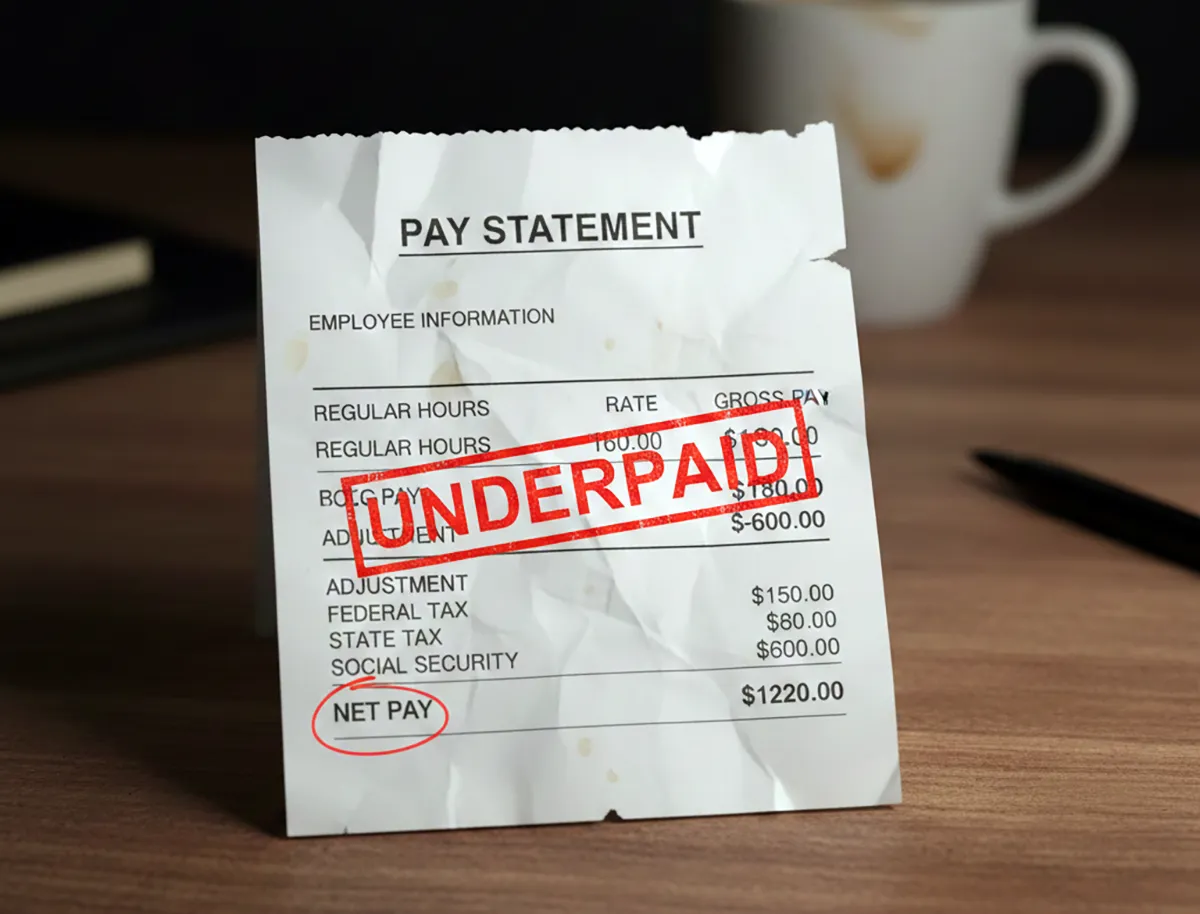
Minnesota's wage theft legislation is the backbone of the state's current wage regime, and it works on two fronts at once.Documentation. Employers must give every employee a written notice at the start of employment stating the rate of pay and the basis on which it is calculated, allowances claimed, paid time off accrual and terms of use, the employee's employment status, the employer's legal name and any operating name, the physical address of the main office and a mailing address if different, and the date of the first payment. Any change has to be communicated in writing before it takes effect. Employers must also provide an earnings statement each pay period showing hours worked, rates, gross and net pay, deductions and the allowances claimed.
Criminal exposure. The same legislation made wage theft a crime where an employer intentionally fails to pay what is owed, with the level of offense scaling with the amount involved. That is separate from the civil claim and pursued by prosecutors rather than by the employee.
The reason this matters to an ordinary worker with an ordinary pay problem is evidentiary. A required notice that was never given, or earnings statements missing the hours and rates they are supposed to show, are documented failures in themselves — and they make it much harder for an employer to later argue about what the agreed rate was or how many hours were worked.
Free settlement alerts
Get notified when new class actions open to claims
Join thousands of readers who get the latest class action settlements you may qualify for — delivered straight to your inbox.
Minimum Wage, No Tip Credit, and Two City Rates
Minnesota sets a statewide minimum wage that is adjusted annually for inflation. A 2024 change simplified the structure by eliminating the long-standing split between large and small employers, so a single rate now applies to most employers, with narrow exceptions including a training wage for employees under 20 during an initial period and a rate for certain hotel and resort employees on seasonal work authorizations.Two cities set higher local minimum wages of their own:
- Minneapolis. A local minimum wage above the state figure, on its own adjustment schedule.
- Saint Paul. A separate local minimum wage, phased by employer size and also independently adjusted.
The rule that most distinguishes Minnesota is that there is no tip credit. An employer may not count tips toward its minimum wage obligation, so tipped employees receive the full applicable minimum in cash wages and keep tips on top. Minnesota also restricts employer control of tips: an employer generally cannot require employees to share or pool tips, although employees may agree among themselves to do so. A mandatory tip pool imposed by management is a live claim here in a way it is not in tip-credit states.
Confirm the operative rate for your worksite with the Minnesota Department of Labor and Industry, since the state figure and both city figures move on separate schedules.
Overtime — 40 or 48, Depending on Coverage
Minnesota's own overtime statute sets the premium at one and a half times the regular rate after 48 hours in a workweek. The federal Fair Labor Standards Act sets it after 40.That is not a contradiction so much as a coverage question. Most Minnesota employees are covered by the FLSA, and where both laws apply the more protective one governs — so for the large majority of workers the operative threshold is 40 hours. The state's 48-hour rule does real work only for employees outside federal coverage, which is a narrower group than it sounds but not an empty one.
The failure patterns are the usual federal ones and they drive most Minnesota overtime cases:
- Misclassification as exempt. Actual duties measured against the tests decide it, not a salary or a title.
- Independent contractor labels. Employee status turns on the economic reality of the relationship. Minnesota also has industry-specific misclassification rules, notably in construction, with substantial penalties.
- The regular rate. Non-discretionary bonuses, shift differentials and most commissions belong in it; time and a half on the base rate alone understates the premium.
- Off-the-clock work and rounding. Pre-shift setup, post-shift closing, mandatory training and rounding that consistently favors the employer produce identical shortfalls across a whole crew.
Breaks, Sick Time and Paid Leave
Minnesota's break rules were made more specific effective January 1, 2025. Employees are entitled to a rest break of at least 15 minutes — or adequate paid time to use the nearest restroom, whichever is longer — for every four consecutive hours worked, and to a meal break of at least 30 minutes when working six or more consecutive hours. Rest breaks are paid working time. A meal break is unpaid only where the employee is genuinely relieved of duties, so an automatic 30-minute deduction applied to a shift worked straight through is unpaid wages.Earned Sick and Safe Time has been in effect statewide since January 1, 2024. Employees accrue at least one hour for every 30 hours worked, up to an annual cap, and it applies to employers of any size with at least one employee in the state. It can be used for the employee's own illness or preventive care, a family member's, certain safety-related absences, and closures caused by weather or a public emergency. Unused hours carry over subject to the statutory limits.
Minnesota's separate Paid Leave program began paying benefits on January 1, 2026, funded by payroll premiums shared between employers and employees. It provides partial wage replacement for qualifying medical and family leave and is administered by the state rather than by employers, so it operates differently from earned sick and safe time and does not replace it.
Final Paychecks, Deductions and Vacation
Minnesota splits final pay by how the job ended, and the discharge rule is the one to know:- Discharged. Wages earned and unpaid become due immediately on demand, and Minn. Stat. 181.13 requires payment within 24 hours of that demand. If the employer does not pay, the wages continue as a penalty at the employee's average daily earnings rate for each day the failure continues, up to 15 days.
- Quit. Under Minn. Stat. 181.14, wages are due on the next regular payday, and where that payday falls within five days of the last day worked, on the following payday instead, subject to an outer limit.
The discharge rule rewards acting rather than waiting. The 24-hour clock runs from the employee's demand, so a worker who never makes one may never start the penalty — the same structural trap Missouri sets with its written request, in a different form.
On deductions, Minn. Stat. 181.79 bars an employer from deducting for lost or stolen property, damage to property, or faulty workmanship unless the employee voluntarily authorizes the deduction in writing after the loss has occurred. An employer that deducts without that authorization is liable for twice the amount deducted. Deductions for uniforms and required equipment are separately capped and must be refunded when the employee leaves and returns the items. The federal floor applies on top: no deduction may push effective pay below the minimum wage or cut into the overtime premium.
Accrued vacation is payable at separation where the employer's policy or an agreement provides for it; Minnesota does not independently require a payout, so the written terms generally control.
Deadlines, Retaliation and Where to File
Minn. Stat. 541.07 gives two years to bring an action for wages, overtime, damages, fees or penalties under state or federal wage law, extended to three years where the nonpayment was willful rather than the result of mistake or inadvertence. Federal FLSA claims run on the same two-or-three-year structure, with the opt-in rule meaning each collective action member's clock runs until their consent form is filed.The Labor Standards division of the Minnesota Department of Labor and Industry investigates wage complaints at no cost and has authority to issue compliance orders and assess penalties, including for the notice and earnings statement failures the wage theft law created. The U.S. Department of Labor Wage and Hour Division handles the federal claim. A private lawsuit reaches the statutory penalties and fee-shifting.
Retaliation against an employee for asserting a wage right, using earned sick and safe time, or reporting a violation is prohibited, and those claims run on their own deadlines separate from the wage claim.
Frequently Asked Questions
Can a Minnesota employer pay me less than minimum wage because I get tips?
No. Minnesota is one of a small group of states that does not allow a tip credit at all. A tipped employee must be paid at least the full applicable minimum wage in cash wages, and tips are on top of that rather than counted toward it. Minnesota also restricts what an employer can do with tips: an employer generally cannot require tip sharing or pooling, though employees may agree among themselves to share tips.
How fast does my final paycheck have to arrive in Minnesota?
If you were discharged, Minn. Stat. 181.13 makes wages due within 24 hours of your demand for them — one of the fastest deadlines in the country, but note that it runs from the demand, so making the demand is what starts it. If the employer misses that window, the wages continue as a penalty at the employee's average daily earnings rate for each day, up to 15 days. If you quit, Minn. Stat. 181.14 sets the deadline at the next regular payday, pushed to the following payday where the next one falls within five days of your last day.
What did Minnesota's 2019 wage theft law change?
It added documentation duties and criminal exposure. Employers must give each employee a written notice at the start of employment covering the rate of pay, the basis for it, allowances, paid time off accrual, and the employer's legal name and address, and must provide earnings statements with specified details each pay period. The same legislation created criminal penalties for wage theft, so a sufficiently large intentional underpayment can be prosecuted rather than just sued over. Both changes make the paperwork itself evidence in a later wage case.
Why do some sources say Minnesota overtime starts at 48 hours?
Because the state statute and the federal statute set different thresholds. Minnesota's own overtime law requires the premium after 48 hours in a workweek, while the federal Fair Labor Standards Act requires it after 40. Most Minnesota employees are covered by the FLSA, so 40 hours is the operative number for them; the state's 48-hour rule matters mainly for employees who fall outside federal coverage. Where both apply, the more protective rule governs.
What breaks am I entitled to in Minnesota?
Minnesota tightened its break rules effective January 1, 2025. Employees are entitled to a rest break of at least 15 minutes, or adequate paid time to use the nearest restroom, for every four consecutive hours worked, and to a meal break of at least 30 minutes when working six or more consecutive hours. Rest breaks are paid working time. A meal break can be unpaid only where the employee is fully relieved of duties, so an automatic deduction from a shift worked straight through is unpaid wages.
How long do I have to bring a wage claim in Minnesota?
Two years, extended to three where the nonpayment was willful rather than the result of mistake or inadvertence, under Minn. Stat. 541.07. That period covers actions for wages, overtime, damages, fees or penalties under state or federal wage law. Federal Fair Labor Standards Act claims run on the same two-or-three-year structure, and in a collective action an opt-in plaintiff's clock keeps running until the consent form is filed.
Sources
• Minn. Stat. 181.032 (required earnings statements and the written notice at the start of employment, added by Minnesota's 2019 wage theft legislation) and the related criminal wage theft provisions.• Minn. Stat. 181.13 (wages due within 24 hours of demand after a discharge, with the penalty at average daily earnings for up to 15 days) and 181.14 (final wages after a voluntary separation).
• Minn. Stat. 181.79 (deductions for lost or stolen property, damage and faulty workmanship — written authorization after the loss, and liability for twice the amount deducted).
• Minn. Stat. 177.24 (minimum wage, the prohibition on a tip credit, restrictions on tip sharing, and limits on uniform and equipment deductions) and 177.25 (state overtime after 48 hours in a workweek).
• Minn. Stat. 177.253 and 177.254 (rest and meal breaks, as amended effective January 1, 2025).
• Minn. Stat. 181.9445 through 181.9448 (Earned Sick and Safe Time, effective January 1, 2024) and Minn. Stat. chapter 268B (Minnesota Paid Leave, benefits beginning January 1, 2026).
• Minn. Stat. 541.07 (two-year limitations period for wage actions, three years where the nonpayment was willful).
• Minnesota Department of Labor and Industry — employee rights.
• U.S. Department of Labor — Fair Labor Standards Act.