New York gives workers six years to sue over unpaid wages, the longest window in the country, plus two rules most employers get wrong: spread-of-hours pay on long days, and weekly pay for manual workers.

Attorney Advertising · Time-Sensitive
OpenClassActions.com is an attorney-advertising and informational resource — not a law firm. It does not provide legal advice and does not recommend or endorse any particular lawyer. Submitting a form on this page does not create an attorney-client relationship, file a lawsuit, or pause any legal deadline, and it does not guarantee that an attorney will review or respond to your case.
These claims are time-sensitive. Legal deadlines (statutes of limitations) vary by state and can permanently bar a claim once they pass — so don't wait for a callback. You are free to choose any attorney you wish, and if you are considering a claim you should speak with a qualified attorney of your choosing as soon as possible. Prior results do not guarantee a similar outcome. This page explains how New York wage rules generally work. It is not advice about your situation, and only a lawyer who knows your facts can tell you what you are owed or what to do next.
New York at a Glance
New York is one of the most protective wage states in the country, and the reason is the calendar: six years to bring a claim, against two or three under federal law. A worker who was shorted for years can usually reach back over the whole period under state law. New York also layers on two rules with no federal equivalent — spread-of-hours pay and weekly pay for manual workers — which is where a lot of otherwise careful employers end up owing money.Minimum Wage
New York does not have one minimum wage. The rate is set regionally, with a higher figure for New York City, Long Island and Westchester than for the rest of the state, and separate rates apply to tipped food service workers and tipped service employees. Fast food workers have historically had their own schedule as well.Because the figures are adjusted on a schedule and then indexed, we deliberately do not print a dollar amount here — a stale number on a page like this is worse than no number. Check the current rate for your region on the New York State Department of Labor minimum wage page before you calculate anything.
What matters more than the exact rate for most claims is what gets counted. Time spent on required tasks before clocking in or after clocking out, mandatory training, and time traveling between job sites during the workday are generally compensable, and unreimbursed costs that a worker has to bear — tools, uniforms, required equipment — can pull effective pay below the minimum even when the stated hourly rate is above it.
Free settlement alerts
Get notified when new class actions open to claims
Join thousands of readers who get the latest class action settlements you may qualify for — delivered straight to your inbox.
Overtime: 40 Hours, Not 8
New York pays overtime at one and a half times the regular rate after 40 hours in a workweek. There is no daily overtime, so a 13-hour shift on Monday does not by itself trigger overtime if the week stays under 40. Residential employees — live-in workers — are covered after 44 hours rather than 40.The regular rate is not always the same as the hourly rate. Non-discretionary bonuses, shift differentials and commissions generally have to be folded in before the time-and-a-half multiplier is applied, which means an employer can pay the overtime premium and still underpay it. This is one of the most common errors in wage cases, and it is invisible on a pay stub unless you know to look.
Salary alone does not make anyone exempt. The exemptions turn on actual job duties measured against the state and federal tests, plus a salary threshold that New York sets higher than the federal one and varies by region. A misclassified assistant manager who spends the shift doing the same work as the crew is a familiar fact pattern.
Spread of Hours: The Rule Employers Miss
Under the state wage orders, if the span of your workday exceeds 10 hours — measured from the beginning of the first shift to the end of the last, including unpaid breaks and split-shift gaps — you are owed one additional hour of pay at the basic minimum wage for that day.It is genuinely extra. It is not wages for time worked, and it is not affected by how many hours you actually clocked inside that span. A restaurant worker who comes in for a lunch shift at 11 a.m., leaves at 3 p.m., returns at 6 p.m. and finishes at 10 p.m. has an 11-hour spread and is owed the extra hour, even though only eight hours were worked.
Because the rule is keyed to scheduling patterns rather than to any one person, an employer that does not know about it usually owes it to everyone who works split shifts or long spans — which is exactly the shape a class or collective action takes.
Manual Workers Must Be Paid Weekly
Labor Law section 191 sets how often you have to be paid, not just how much. Manual workers must be paid weekly and no later than seven calendar days after the end of the week in which the wages were earned. Clerical and other workers must be paid at least twice a month.The consequential part is that paying a manual worker biweekly violates the statute even if every dollar eventually arrives on time in full. New York appellate courts have allowed workers to pursue damages for that delay itself, and the resulting wave of late-payment cases has swept in large employers who thought a standard biweekly payroll was unremarkable.
Whether you are a "manual worker" depends on how much of the job is physical, not on what your title says. Roughly, if more than a quarter of your duties involve physical labor, the classification is in play — which reaches well past construction into warehouse, grocery, food service, home care, maintenance and retail stocking work.
Meal Periods and Breaks
Labor Law section 162 requires meal periods, and the length depends on the industry and the shift. Factory workers are entitled to a 60-minute midday meal period; most other workers get 30 minutes when a shift of more than six hours spans the noon hour. A shift that starts before 11 a.m. and continues past 7 p.m. gets an additional 20-minute period between 5 p.m. and 7 p.m.New York does not require short rest breaks during the day. When an employer does provide them, federal rules generally treat breaks of roughly 20 minutes or less as paid working time — so a policy of docking short breaks is a wage problem even in a state with no rest-break mandate.
A meal period only counts as unpaid if you are actually relieved of duty. Eating at your station while covering the phone is working time, and automatic meal deductions applied to workers who never got a real break are a recurring source of claims.
Your Final Paycheck
New York requires final wages by the regular payday for the pay period in which the employment ended, and the rule is the same whether you resigned or were terminated. If you ask in writing, the employer has to mail the check to you.Accrued but unused vacation is payable at separation when the employer's policy or practice promises it. New York permits a written forfeiture policy, but the employer has to have actually notified employees of it.
New York does not impose a per-day waiting-time penalty for a late final check the way California does. What it does give you is the ordinary wage remedy, which is not small: the unpaid amount, liquidated damages of an equal amount unless the employer proves it acted in good faith, interest, and attorney's fees.
Wage Notices and Pay Stubs
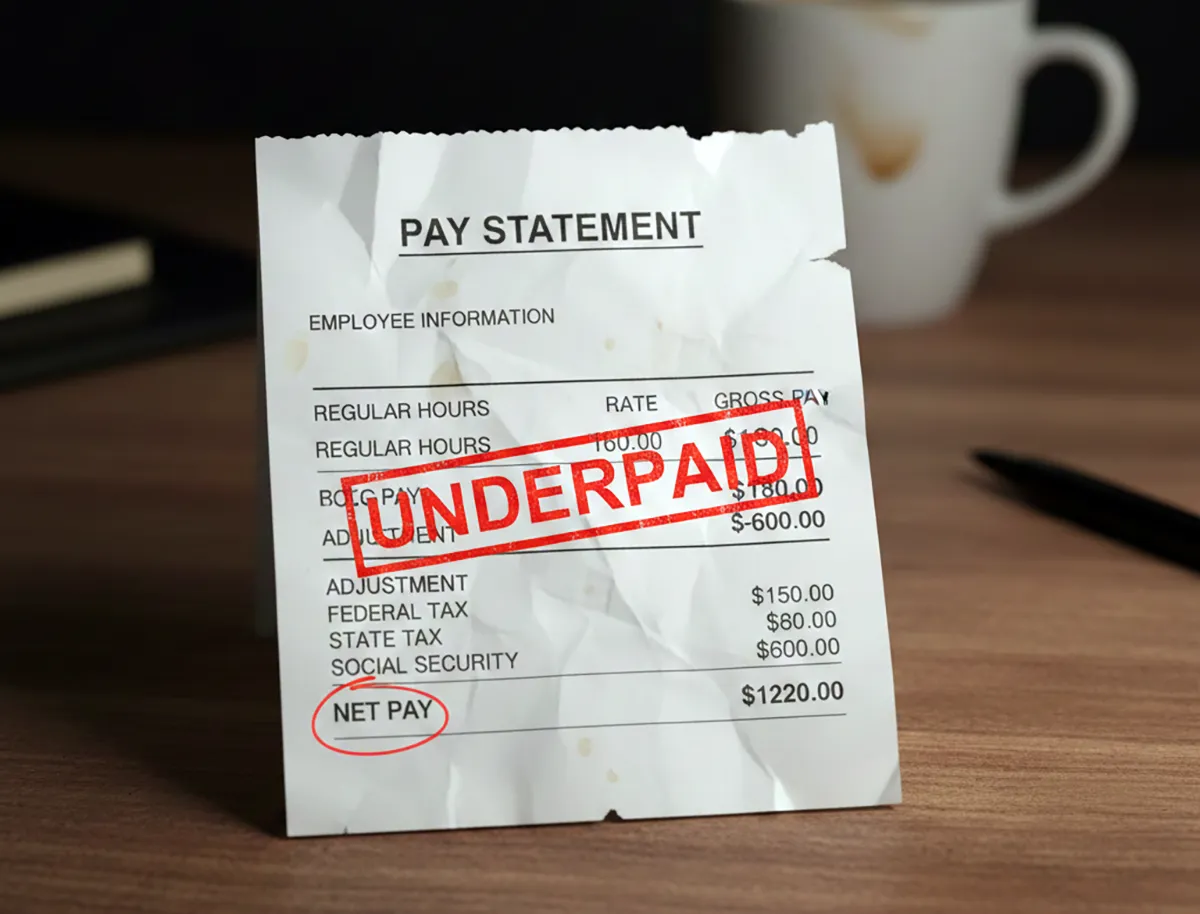
The Wage Theft Prevention Act requires employers to give written notice of the pay rate, the overtime rate, the payday and the employer's identity at hire, and to provide a detailed statement with every payment of wages. The statement has to show the dates covered, the hours worked, the rates and the gross and net figures.Missing or defective pay stubs carry their own statutory damages, and they matter for a second reason: without proper records, courts allow employees to prove hours by reasonable recollection, and the burden shifts to the employer to rebut it. An employer that kept no records tends to be in a worse position than one that kept accurate ones.
How Long You Have, and What You Can Recover
Six years is the headline. New York Labor Law claims carry a six-year statute of limitations, against two years under the federal FLSA — three if the violation was willful. Most New York wage cases are pleaded under both, using federal law for its collective-action mechanism and state law for the longer reach-back.On damages, a successful claim generally recovers the unpaid wages themselves, liquidated damages equal to 100% of those wages unless the employer proves a good-faith basis for what it did, pre-judgment interest, and attorney's fees. Fee-shifting is why wage cases are commonly taken on contingency, and why claims of a few thousand dollars are litigated at all.
The clock runs paycheck by paycheck, so as time passes the oldest weeks fall outside the six-year window and stop being recoverable.
Where to File
You have two routes and they are not mutually exclusive. The New York State Department of Labor's Division of Labor Standards accepts wage claims and investigates them at no cost, which suits a straightforward claim against a single employer. A private lawsuit — individually, or as a class or collective action if the practice affected co-workers — is the route that reaches liquidated damages and fees, and the one that fits a policy applied across a workforce.You can also file with the U.S. Department of Labor Wage and Hour Division on the federal claim. Filing with an agency does not stop the state six-year clock from running on the weeks at the far end of a claim.
Retaliation for raising any of this is separately unlawful under Labor Law section 215, and the protection covers complaints made to your own employer rather than only to an agency. Remedies can include reinstatement, back pay, liquidated damages and civil penalties. Retaliation claims run on their own deadlines, which are much shorter than the six-year wage window.
Frequently Asked Questions
How long do I have to sue for unpaid wages in New York?
Six years under the New York Labor Law, which is the longest wage claim window in the country. The federal Fair Labor Standards Act gives only two years, or three if the violation was willful, so a New York worker who has been underpaid for years can often reach back much further under state law than under federal law. The clock generally runs from each underpaid paycheck, so waiting costs you the oldest weeks first.
Does New York require daily overtime?
No. New York pays overtime at one and a half times your regular rate after 40 hours in a workweek, not after eight hours in a day. A 12-hour shift followed by a short week generally does not trigger overtime. New York does have a separate spread-of-hours rule that can add an extra hour of pay on a long day, and residential employees are covered after 44 hours rather than 40.
What is spread of hours pay in New York?
Under the state wage orders, an employee whose workday spans more than 10 hours from the start of the first shift to the end of the last is owed an additional hour of pay at the basic minimum wage. It is on top of wages for hours actually worked, and it applies even if the middle of that span was unpaid break time, which is why split shifts trigger it so often. Employers who never heard of the rule tend to owe it across an entire staff.
Do manual workers in New York have to be paid weekly?
Yes. Labor Law section 191 requires manual workers to be paid weekly and no later than seven calendar days after the end of the week in which the wages were earned. Paying a manual worker every two weeks is a violation even when the full amount eventually arrives, and New York courts have allowed workers to pursue damages for the late payment itself. Whether someone counts as a manual worker turns on the share of the job that is physical labor, not the job title.
When is my final paycheck due in New York?
By the regular payday for the pay period in which you stopped working, whether you quit or were fired. If you request it in writing, the employer must mail it. New York does not impose a daily waiting-time penalty the way some states do, but unpaid final wages are recoverable as unpaid wages, with liquidated damages and attorney's fees available.
Can my employer fire me for asking about unpaid wages in New York?
Retaliation for complaining about wages is prohibited by Labor Law section 215, and the protection covers complaints made to the employer, not just to a government agency. Remedies can include reinstatement, back pay, liquidated damages and a civil penalty. Retaliation claims have their own shorter deadlines than the six-year wage claim window, so they should be raised promptly.
Sources
• New York Labor Law Article 6 (sections 190–199-a), including section 191 (frequency of payments), section 193 (deductions), section 195 (wage notices and statements), section 198 (remedies and the six-year limitations period) and section 215 (retaliation).• New York Labor Law section 162 (meal periods) and the New York State Department of Labor Minimum Wage Orders, which set overtime, spread-of-hours and call-in pay by industry.
• New York State Department of Labor — minimum wage rates by region.
• U.S. Department of Labor — Fair Labor Standards Act, for the federal overtime floor and the two- and three-year limitations periods.