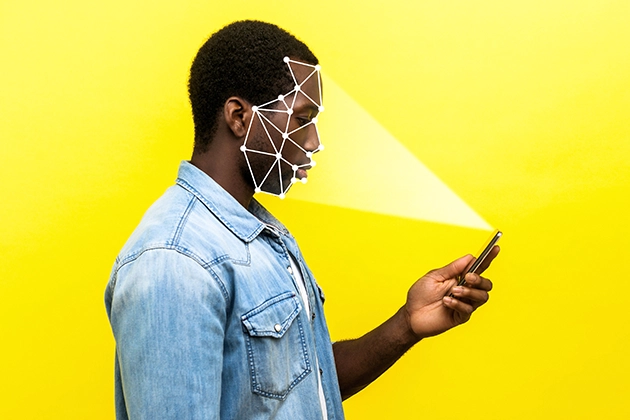
Apple tells you Face ID maps your face. A new Illinois lawsuit claims that is not the whole story — that the attention-aware unlock allegedly scans your irises and retinas too, without the written consent Illinois law demands.

Allegations Only · No Settlement Yet
This article describes a class action complaint. The statements below are unproven allegations. Apple has not been found liable, there is no certified class, and nothing to claim at this time. This page is informational and is not legal advice.
What Is This Lawsuit About?
A proposed class action filed in early July 2026 (reported filed July 4) in the U.S. District Court for the Northern District of Illinois, Western Division, accuses Apple of violating Illinois' Biometric Information Privacy Act (BIPA) through Face ID, the facial-recognition unlock that has shipped on iPhones since the iPhone X in 2017. The named plaintiff, Samantha Mettler of DeKalb County, Illinois, is represented by Yagman PLLC.The complaint's theory is narrower — and more novel — than a typical BIPA claim. It concedes that Apple tells users Face ID collects facial template data. What Apple allegedly never discloses, the suit says, is that Face ID's attention-aware feature, which requires your eyes to be open and looking at the device to unlock it, necessarily tracks and scans the iris and retina. In the complaint's words, that is "an entirely different and additional form of biometric information collection which was not consented to."
Who Would the Case Cover?
The suit seeks to represent Illinois residents who used Face ID on Apple devices — a group news reports note would likely include millions of Illinois Apple customers. The exact class definition and class period will be spelled out as the docket develops; no class has been certified, so at this stage the case covers only the named plaintiff's claims.BIPA allows statutory damages of $1,000 per negligent violation and up to $5,000 per intentional or reckless one. Reporting on the case notes that, multiplied across millions of users, the theoretical exposure would run into the billions — that is the outlets' arithmetic about scale, not a prediction of what anyone will recover.
Free settlement alerts
Get notified when new class actions open to claims
Join thousands of readers who get the latest class action settlements you may qualify for — delivered straight to your inbox.
Apple's Likely Defense — the On-Device Ruling
Apple has beaten a Face ID BIPA claim before. In Barnett v. Apple, an Illinois appellate court held in December 2022 that Face ID and Touch ID device-unlock data does not violate BIPA because it is encrypted and stored on the device itself, in the user's exclusive control — meaning Apple never "collects" or "possesses" the biometric data. Apple's public security documentation makes the same point: Face ID data stays in the device's Secure Enclave and is not transmitted to Apple.That reasoning got stronger in 2026. On August 7, 2026 the Seventh Circuit affirmed the dismissal of a parallel Illinois case against Samsung, holding that BIPA's terms possession, collect, capture and obtain all require a company to have some degree of control over the biometric data — and that a manufacturer does not control face templates its software creates and stores on the user's own device. That ruling binds federal courts in Illinois; see OCA's page on the Samsung Galaxy BIPA case.
The new complaint will have to navigate that precedent. Its answer appears to be the disclosure angle: even if the data stays on the device, the suit alleges Apple never told users iris and retinal scanning was happening at all, and BIPA's consent requirements turn on what the user was told and agreed to in writing. Whether that distinction survives a motion to dismiss is the first big test ahead.
Apple's Broader BIPA Docket
This is far from Apple's only Illinois biometric case. A federal judge certified a class of six-million-plus Illinois users on June 5, 2026 in Hazlitt v. Apple, the long-running suit over faceprints generated by the Photos app's "People" album — a case that remains in litigation, with no settlement. A separate Illinois state-court class action over Siri voiceprints was certified in February 2026. Reporting on the new Face ID suit notes Apple already faces dozens of BIPA cases in the state.Apple has not responded to the new complaint, and no hearing dates have been set. We will update this page as the docket develops — a motion to dismiss, certification ruling, or any settlement would each change what this case means for Illinois iPhone owners.
Frequently Asked Questions
What does the Apple Face ID class action lawsuit allege?
The complaint alleges that while Apple discloses that Face ID collects facial template data, it never tells users that the feature's attention-aware unlock — which requires your eyes to be open and looking at the device — allegedly also scans irises and retinas, a separate category of biometric identifier that Illinois' Biometric Information Privacy Act requires written consent to collect. These are unproven allegations; Apple has not been found liable.
Who could the Apple Face ID lawsuit cover?
The proposed class is reported to cover Illinois residents who used Face ID on Apple devices, which reporting notes would likely include millions of Illinois Apple customers. No class has been certified, so today the case covers only the named plaintiff's claims.
Can I get money from the Apple Face ID lawsuit now?
No. The case was just filed in early July 2026. There is no settlement, no certified class, no claim form, and no money available. If a settlement or certified class emerges later, we will update this page with the details.
How much are BIPA violations worth per person?
Illinois' Biometric Information Privacy Act allows statutory damages of $1,000 per negligent violation and up to $5,000 per intentional or reckless violation. News reports note that across millions of Illinois Face ID users the theoretical exposure would run into the billions — that is the outlets' arithmetic about the claim's scale, not a predicted recovery.
Hasn't Apple already won a Face ID privacy case?
In Barnett v. Apple, an Illinois appellate court held in 2022 that Face ID device-unlock data does not violate BIPA because it is stored on the device in the user's exclusive control, so Apple never possesses it. Apple is expected to raise the same on-device defense here; the new complaint's iris-and-retina disclosure theory will have to contend with that ruling.
Sources
• Law360 — Apple Hit With Ill. Biometric Privacy Suit Over Eye Scans (July 2026)• The Center Square — Class action vs Apple over Face ID scans
• Biometric Update — Barnett v. Apple appellate ruling (context)
• Bloomberg Law — Hazlitt v. Apple class certification (June 2026, context)