Grubhub and Seamless customers in New York City can see a service fee line that reads 16%, crossed out to 8%, plus a flat $2. The discount is a Grubhub+ membership that Amazon Prime members get for free; the $2 is a local add-on the delivery apps introduced after New York City’s minimum pay rate for delivery workers took effect in December 2023. The fees themselves are now the subject of lawsuits against Uber Eats, DoorDash and Grubhub.

What the Three Numbers on the Receipt Mean
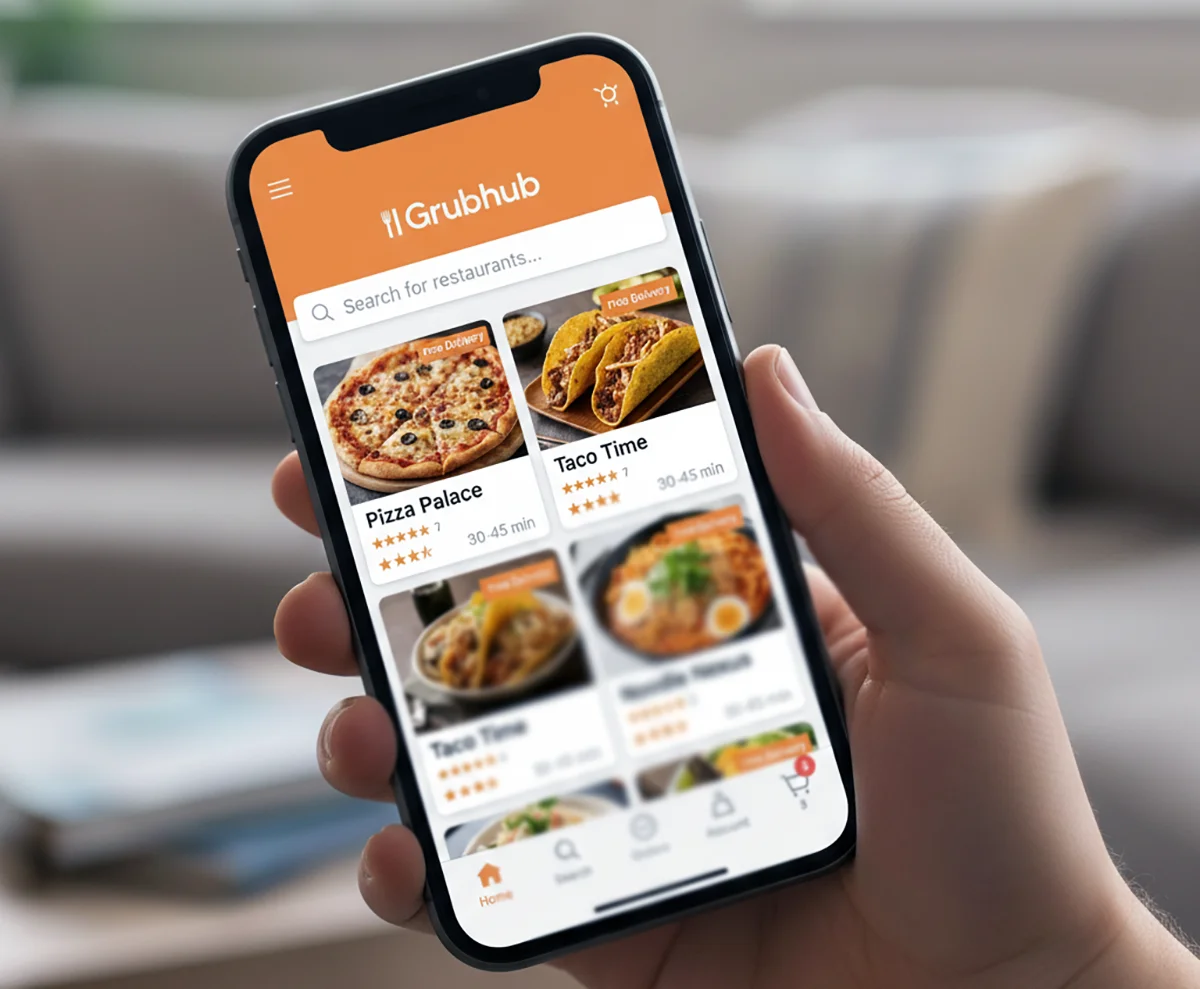
A Grubhub or Seamless checkout in New York City can present the service fee as a single line with three parts. Each part has a different origin:- The first percentage is the standard service fee Grubhub charges on that order. Grubhub describes the service fee as a percentage of the order subtotal that varies by market and order; independent guides put the typical range in the mid-to-high teens, which matches a 16% figure.
- The second, lower percentage is the Grubhub+ member rate. Grubhub+ is the company’s subscription program, and Grubhub says it includes $0 delivery fees on eligible orders over $12 and “lower service fees.” Grubhub does not publish a fixed member percentage, so the drop to 8% on one receipt should not be read as a universal half-off rule.
- The flat $2 at the end is geographic. It appears on orders delivered inside New York City and traces to the city’s minimum pay rate for app-based delivery workers.
Add the driver tip, sales tax and any small-order or delivery fee, and the total can run well above the menu price. None of that is unusual on its own. What makes the New York City receipt different is the third line, which most of the country never sees.
Where the Discount Comes From: Grubhub+ Through Amazon Prime
In May 2024 Amazon and Grubhub made a free Grubhub+ membership a permanent Prime benefit. A Prime member activates the offer once, and the membership stays free for as long as the Prime account does; Amazon says it does not roll into a paid Grubhub+ plan. A standalone Grubhub+ membership otherwise costs $9.99 a month plus tax as of 2026.On the receipt, the membership shows up as the crossed-out service fee. The delivery fee on an eligible order over $12 drops to $0, and the service fee is reduced. Grubhub+ does not remove the service fee entirely, does not change sales tax, and does not touch the New York City add-on. A Prime member ordering in Manhattan still pays the $2; a Prime member ordering in Phoenix does not, and their receipt ends at the reduced percentage.
Where the $2 Comes From: New York City’s Minimum Pay Rate
New York City is the first major U.S. city to guarantee a minimum pay rate to app-based restaurant delivery workers. The rule is administered by the Department of Consumer and Worker Protection (DCWP) under Local Law 115 of 2021, and it has phased in as follows:- December 4, 2023: $17.96 per hour of trip time, before tips.
- April 1, 2024: $19.56 per hour.
- April 1, 2025: $21.44 per hour, the final phase of the original schedule.
- April 1, 2026: $22.13 per hour, the first annual inflation adjustment. As of January 2026 the same floor also covers app-based grocery delivery workers.
The apps may satisfy the rule one of two ways. The “standard method” pays workers for every hour they are connected to the app, including time waiting for an offer. The “alternative method” pays a higher rate, about $29.93 when the rule launched, for trip time only. Customer tips do not count toward either figure. The city’s original November 2022 proposal was $23.82 per hour; the adopted rule set a lower starting figure with a longer phase-in.
In July 2023, days before the rule’s original July 12 effective date, DoorDash and Grubhub filed one lawsuit and Uber a second in New York State Supreme Court seeking to block it. The companies argued the rate was arbitrary, that DCWP’s method for calculating it was flawed, and that the rule would raise costs for restaurants and consumers. Justice Nicholas Moyne paused the rule while the case was argued, then denied the injunction on September 28, 2023. An appellate panel declined to block the ruling at the end of November, and the first-phase rate took effect on December 4, 2023.
How the Apps Passed the Cost to Customers
The delivery platforms had told the court that higher labor costs would reach consumers, and within days of the rule taking effect they changed their New York City checkouts. Each company gave its charge a different name:- DoorDash added a $1.99 “Regulatory Response Fee” to New York City orders. DoorDash’s own fee guide describes the Regulatory Response Fee as a charge applied where a local or state regulation increases its operating costs; the amount varies by city.
- Uber Eats added a “New York Courier Fee” of roughly $2 per order.
- Grubhub and Seamless, which share a parent company, increased their service fees in the city. The company has not published the New York City component as a separate named line the way DoorDash and Uber Eats have, which is why it can appear folded into the service fee formula as a flat dollar amount.
DoorDash and Uber Eats also moved the tip prompt from checkout to after the order is placed, a change that shows a lower total up front. DCWP’s first annual report on the rule, released July 11, 2024, found that New Yorkers paid an average of $20.1 million a week in delivery fees in the first quarter of 2024, a 58% increase from a year earlier. Fees paid by restaurants rose 13% over the same period. The report is the clearest public evidence that most of the new labor cost landed on the customer side of the transaction.
The surcharge is not a pass-through to the worker. The minimum pay rate obligates the app to pay the courier a floor for their time; the fee is money the app collects from the customer and keeps. The two are connected only in the sense that the company chose to fund one with the other.
Seattle Has the Same Fee With a Bigger Number
Seattle’s App-Based Worker Minimum Payment Ordinance, which took effect January 13, 2024, requires delivery apps to pay workers a per-minute and per-mile rate with a minimum per offer. DoorDash and Uber Eats responded with a $4.99 per-order fee, and DoorDash later added a further $1.99 Regulatory Response Fee on certain long-distance orders. DoorDash said publicly that it would drop the $4.99 fee if the city council adopted a lower pay floor, and the council spent much of 2024 and 2025 debating amendments. The structure is the same as New York’s: a local pay mandate, a named or unnamed customer fee, and a company statement blaming the ordinance.Free settlement alerts
Get notified when new class actions open to claims
Join thousands of readers who get the latest class action settlements you may qualify for — delivered straight to your inbox.
The Lawsuits Over Delivery App Fees
Delivery apps now carry service fees, regulatory fees, priority fees, small-order fees and membership programs, and several of those line items have drawn consumer, government and worker litigation. The cases below are the ones most directly tied to the fees on a delivery receipt. None of them is a judgment that any fee is unlawful; the government cases settled without an admission of wrongdoing and the consumer cases are unproven allegations.DoorDash’s $18 Million Settlement With the City of Chicago (November 2025)
On November 14, 2025, the City of Chicago announced an $18 million settlement with DoorDash and its Caviar brand, resolving a 2021 lawsuit filed in the Circuit Court of Cook County. The city alleged that DoorDash listed restaurants on its platform without their consent, did not present the full cost of an order up front, charged a $1.50 “Chicago Fee” whose name suggested a city-mandated charge when it was DoorDash’s own, did not disclose that in-app menu prices were often higher than the restaurant’s own, and used customer tips to subsidize what it paid drivers. The “Chicago Fee” appeared after the city council capped the commissions delivery apps could charge restaurants during the pandemic.According to the city’s announcement, roughly $10 million of the settlement goes to consumers and restaurants as credits, $3.25 million to restaurants that were listed without consent and are no longer on the platform, about $500,000 to delivery drivers, and $4.5 million to the city for its costs. DoorDash denied wrongdoing. Credits are issued by DoorDash and the city; there is no claim form. A separate portion of this settlement, the DoorDash Chicago restaurant attestation program, closed to new attestations on March 30, 2026.
The Uber Eats “Priority” Fee Class Action (July 2026)
On July 27, 2026, a California resident filed a proposed class action against Uber Technologies in the U.S. District Court for the Northern District of California (Wright v. Uber Technologies, Inc., No. 3:26-cv-07753). At checkout, Uber Eats offers a “priority” delivery option for $1 to $5 more, labeled “direct to you.” The complaint alleges that Uber Eats does not tell couriers which orders are priority, instructs them to pick up other batched orders first, and lets them run deliveries for competing apps in between, so the “direct” service is not actually provided. The named plaintiff says he paid $1.49 for priority delivery in November 2025 and was told by the courier that another order was being dropped off first.The suit asserts claims under California’s Unfair Competition Law, False Advertising Law and Consumers Legal Remedies Act, plus common-law fraud, on behalf of a proposed nationwide class and a California subclass. It is at the earliest stage: no class has been certified, Uber has not answered the allegations in a public ruling, and there is no settlement or claim process. The case was reassigned to U.S. District Judge James Donato in August 2026; OCA tracks it on its own page: Uber Eats “direct to you” priority fee class action.
DoorDash’s DashPass “$0 Delivery” Lawsuit (April 2026)
A separate consumer case filed in San Francisco Superior Court in April 2026 alleges that DoorDash markets its DashPass subscription with a “$0 delivery fee” promise while still adding a mandatory service fee at checkout, a practice the complaint characterizes as drip pricing. OCA tracks that case on its own page: DoorDash DashPass hidden service-fee class action. No class has been certified.Grubhub’s $24.75 Million California Driver Settlement (Final Approval July 2026)
The delivery worker side of the ledger has its own litigation. Lawson v. Grubhub, Inc. was filed in September 2015 by a Los Angeles driver who alleged Grubhub misclassified its California delivery drivers as independent contractors and denied them minimum wage and expense reimbursement. After a bench trial, an appeal and a remand, the parties agreed to a $24.75 million settlement covering roughly 60,000 people who completed at least one Grubhub delivery in California between December 3, 2014 and March 13, 2026. U.S. District Judge Jacqueline Scott Corley granted final approval on July 30, 2026, and trimmed the requested attorneys’ fees from $8.25 million to $6.2 million. Payments are calculated from miles driven with a $25 minimum. The claim deadline was June 18, 2026; the Grubhub driver settlement page has the details.Grubhub and Seamless California Delivery Fee Settlement
Customers, rather than drivers, are the class in the Grubhub and Seamless delivery fee settlement, which resolved allegations that the apps advertised free or reduced delivery while charging fees on California orders. Eligible customers could claim a $10 credit; the extended claim deadline was August 7, 2026.The Other New York City Fight: Restaurant Commission Caps
The customer surcharge is one of two New York City rules the apps litigated. The other capped what they could charge restaurants: 15% for delivery and 5% for marketing, enacted in May 2020 as a pandemic measure and made permanent in August 2021. DoorDash, Grubhub and Uber Eats sued in Manhattan federal court. In 2025 the two sides settled: the city agreed to amend the law to allow an additional tier of optional “enhanced” services, raising the effective ceiling, and the apps agreed to drop the challenge. The commission cap and the worker pay rate are separate rules, but together they explain why New York City receipts look different from everyone else’s: the apps have less room on the restaurant side and a higher labor floor on the courier side, and the customer line is where both pressures show up.Reading a Delivery Receipt Outside New York City
In a market without a local pay mandate, the formula collapses to two parts: the standard service fee, and the Grubhub+ member rate if the account is linked to Prime. There is no flat surcharge. Sales tax, the tip and any small-order fee remain. A customer who sees a named regulatory line outside New York City or Seattle is most likely in another jurisdiction with a commission cap or pay ordinance; DoorDash’s fee guide says its Regulatory Response Fee ranges from roughly 10 cents to a few dollars depending on the local rule.The fee lines are disclosed at checkout, so a customer who dislikes them has the usual options: pick up the order, order directly from the restaurant, or compare the same order across apps, since each company sets its own amounts. What a customer cannot do is treat the service fee or the surcharge as a tip; under New York City’s rules, tips are a separate line and are the only part of the total the courier is guaranteed to receive in addition to the minimum pay rate.
Frequently Asked Questions
Why does my Grubhub service fee say 16% crossed out to 8%?
The crossed-out figure is the standard service fee for that order and the lower figure is the Grubhub+ member rate. Amazon Prime members can activate a free Grubhub+ membership, which Grubhub says includes $0 delivery fees on eligible orders over $12 and lower service fees. Grubhub does not publish a fixed member percentage; the exact numbers vary by order and market.
What is the extra $2 on Grubhub and Seamless orders in New York City?
It is a New York City add-on. After the city’s minimum pay rate for app-based restaurant delivery workers took effect in December 2023, the delivery apps raised customer fees in the city. DoorDash charges a $1.99 Regulatory Response Fee in New York City, Uber Eats charges a New York Courier Fee of roughly $2, and Grubhub increased its service fees. Orders delivered outside New York City do not carry the add-on.
What is New York City’s minimum pay rate for delivery workers?
New York City’s Department of Consumer and Worker Protection sets a minimum pay rate for app-based restaurant delivery workers. It started at $17.96 per hour in December 2023, rose to $19.56 in April 2024 and $21.44 in April 2025, and is $22.13 per hour from April 1, 2026. The rate is paid before tips and adjusts annually for inflation.
Is there a class action over delivery app fees I can join?
Several cases are pending or resolved, but none of the fee cases described here currently has an open consumer claim form. The Uber Eats priority fee lawsuit filed in July 2026 has no certified class. The DoorDash Chicago settlement is between DoorDash and the City of Chicago, with credits and payments handled by DoorDash and the city. The Grubhub California driver settlement covered drivers, not customers, and its claim deadline was June 18, 2026.
Does the $2 surcharge go to the delivery worker?
No. The surcharge is a fee the app keeps. The minimum pay rate is a floor the app must pay the worker for their time; how the app funds that obligation is its own business decision. Tips are separate and, under city rules, cannot be counted toward the minimum pay rate.
Sources
• NYC Department of Consumer and Worker Protection — court allows minimum pay rate to take effect (September 28, 2023)• NYC DCWP — delivery worker protections and 2026 pay rate announcement
• NYC DCWP — Minimum Pay Rate for Delivery Workers (rule page)
• Fortune — Uber, DoorDash and Grubhub sue New York City over delivery pay rule (July 7, 2023)
• Restaurant Dive — judge denies DoorDash, Uber Eats and Grubhub injunction (September 2023)
• Bloomberg — New Yorkers see 58% rise in food-delivery fees (July 11, 2024)
• DoorDash Help Center — What fees do I pay? (Regulatory Response Fee)
• Uber — changes for couriers in New York City
• Amazon — Grubhub+ is free for Prime members
• DoorDash — An Update on Operations in the Seattle Market
• Seattle Office of Labor Standards — App-Based Worker Minimum Payment Ordinance
• City of Chicago — $18 million settlement with DoorDash (November 14, 2025)
• Singleton Schreiber — plaintiffs’ counsel release on Wright v. Uber Technologies (July 2026)
• Courthouse News — Grubhub class action settlement delivers nearly $25 million to drivers (July 2026)
• CNBC — DoorDash, Grubhub and Uber Eats settle with New York City over fee caps (June 2025)