Maryland can triple unpaid wages, but only where the employer had no bona fide dispute about owing them — which turns the employer's explanation into the main event. It also has a break law that covers retail and nobody else.

Attorney Advertising · Time-Sensitive
OpenClassActions.com is an attorney-advertising and informational resource — not a law firm. It does not provide legal advice and does not recommend or endorse any particular lawyer. Submitting a form on this page does not create an attorney-client relationship, file a lawsuit, or pause any legal deadline, and it does not guarantee that an attorney will review or respond to your case.
These claims are time-sensitive. Legal deadlines (statutes of limitations) vary by state and can permanently bar a claim once they pass — so don't wait for a callback. You are free to choose any attorney you wish, and if you are considering a claim you should speak with a qualified attorney of your choosing as soon as possible. Prior results do not guarantee a similar outcome. This page explains how Maryland wage rules generally work. It is not advice about your situation, and only a lawyer who knows your facts can tell you what you are owed or what to do next.
Maryland at a Glance
Maryland runs two wage statutes side by side. The Wage and Hour Law sets the minimum wage and the overtime rules. The Wage Payment and Collection Law governs when wages must be paid and what happens when they are not — and it is the one that carries the leverage, because it allows a court to award up to three times the unpaid wage plus counsel fees.That enhancement turns on a single phrase: whether the wages were withheld as the result of a bona fide dispute. Almost every contested Maryland wage case ends up arguing about that, rather than about whether the hours were worked.
Two other features set the state apart. Its break law applies only to retail employees, which means a nurse, a line cook and a warehouse picker in Maryland have no statutory right to a break while a cashier at a large store does. And its overtime threshold is not 40 hours for everyone.
Treble Damages and the Bona Fide Dispute Test
The Wage Payment and Collection Law requires an employer to pay all wages due for work performed before termination on or before the day the employee would have been paid had the job continued. Where wages go unpaid, the statute allows an employee to sue, and it gives the court a specific power: if the court finds the employer withheld the wages and there was no bona fide dispute over whether they were owed, it may award up to three times the wage as damages, together with reasonable counsel fees and costs.Three things about that provision shape how Maryland cases run.
- It is discretionary, not automatic. The statute says the court may award the enhancement. A finding that no bona fide dispute existed opens the door; it does not walk the plaintiff through it.
- A bona fide dispute has to be genuine. It means a real, good-faith disagreement about the obligation to pay — a legitimate question about whether a commission had been earned, whether hours were actually worked, or whether an offset applied. An explanation constructed after the fact, or a blanket refusal with no articulated basis, is not the same thing.
- Counsel fees are the part that makes small claims viable. A few hundred dollars of unpaid final wages will not fund litigation on its own. The fee provision is what allows a wage claim of ordinary size to be brought at all.
Maryland treats a broad range of compensation as wages, including bonuses and commissions that the employee has earned under the terms of the arrangement. That matters because commission forfeiture clauses — the ones that cancel a commission if the employee leaves before payout — are where the bona fide dispute question most often gets litigated.
Free settlement alerts
Get notified when new class actions open to claims
Join thousands of readers who get the latest class action settlements you may qualify for — delivered straight to your inbox.
Minimum Wage — Statewide, Montgomery and Howard
Maryland sets a statewide minimum wage under its Wage and Hour Law, and two jurisdictions run higher local rates:- Montgomery County. A local minimum wage above the state figure, tiered by employer size, on its own adjustment schedule.
- Howard County. A separate local minimum wage, also above the state rate and also adjusted on its own schedule.
Where a county rate applies it governs work performed there; elsewhere the statewide figure controls. Because all three move independently, confirm the operative rate for your worksite with the Maryland Department of Labor rather than relying on a published figure.
Maryland permits a tip credit, letting an employer pay a reduced cash wage where tips bring the employee to at least the full applicable minimum. Where they do not, the employer must make up the difference in that workweek. Maryland also requires employers taking a tip credit to give tipped employees a wage statement showing the effective hourly rate including tips for each pay period, which is a useful document to have when a tip credit case is being assessed.
Overtime, and the Thresholds That Are Not 40
The general Maryland rule is one and a half times the regular rate for hours over 40 in a workweek. The state then writes in higher thresholds for particular employers:- 48 hours. Bowling establishments, and institutions other than hospitals that provide on-premises care to the sick, the aged, or individuals with disabilities.
- 60 hours. Agricultural work.
These attach to the nature of the employer rather than to a job title, which is why the question of who the employer actually is — a staffing agency, a management company, a franchisee — can change the answer. Certain other categories are exempt from the state overtime provision entirely, and federal coverage has to be assessed separately in every case.
The recurring overtime problems are the familiar federal ones and they apply with full force here:
- Misclassification as exempt. Actual duties measured against the tests decide exempt status, not a salary or a supervisor title.
- Independent contractor labels. Employee status turns on the economic reality of the relationship. Maryland also has a separate workplace fraud statute aimed at misclassification in construction and landscaping.
- The regular rate. Non-discretionary bonuses, shift differentials and most commissions belong in it.
- Off-the-clock work and rounding. Pre-shift setup, post-shift closing, required training and one-directional rounding produce the same shortfall across an entire crew.
The Retail Break Law
Maryland's Healthy Retail Employee Act is one of the narrower break statutes in the country: it covers retail establishments at or above an employee-count threshold, and nobody else.For covered employees, the structure is graduated by shift length — a short break for a shift of roughly four to six consecutive hours, a longer break for shifts over six hours, and additional breaks on the longest shifts. There are exceptions where an employee is the only one working, and enforcement runs through the Maryland Department of Labor.
Outside retail, Maryland has no general break entitlement for adults. That does not make a missed lunch harmless: federal rules still control whether a break has to be paid, so a meal period during which the employee kept covering a station is working time, and an automatic 30-minute deduction applied to a shift worked straight through remains an unpaid wage claim under the state wage statutes.
Sick Leave, Pay Statements and Wage Range Disclosure
The Maryland Healthy Working Families Act requires employers to provide earned sick and safe leave, accruing with hours worked. At employers at or above a size threshold the leave is paid; below it, employers must provide the same accrual as unpaid but protected leave. It can be used for the employee's own health needs, a family member's, and absences connected to domestic violence, sexual assault or stalking.Two 2024 changes tightened the documentation side of Maryland employment, and both are useful to a worker assessing a pay problem:
- Pay statements and notice at hire. Employers must give employees a written notice at hire covering the rate of pay, paydays and leave benefits, and must provide a pay statement with each payment listing specified details, including hours worked, rates, and the basis on which wages were paid.
- Wage range transparency. Job postings must disclose a wage range and a general description of benefits and other compensation, and employers must provide that information on request to an applicant who did not receive it.
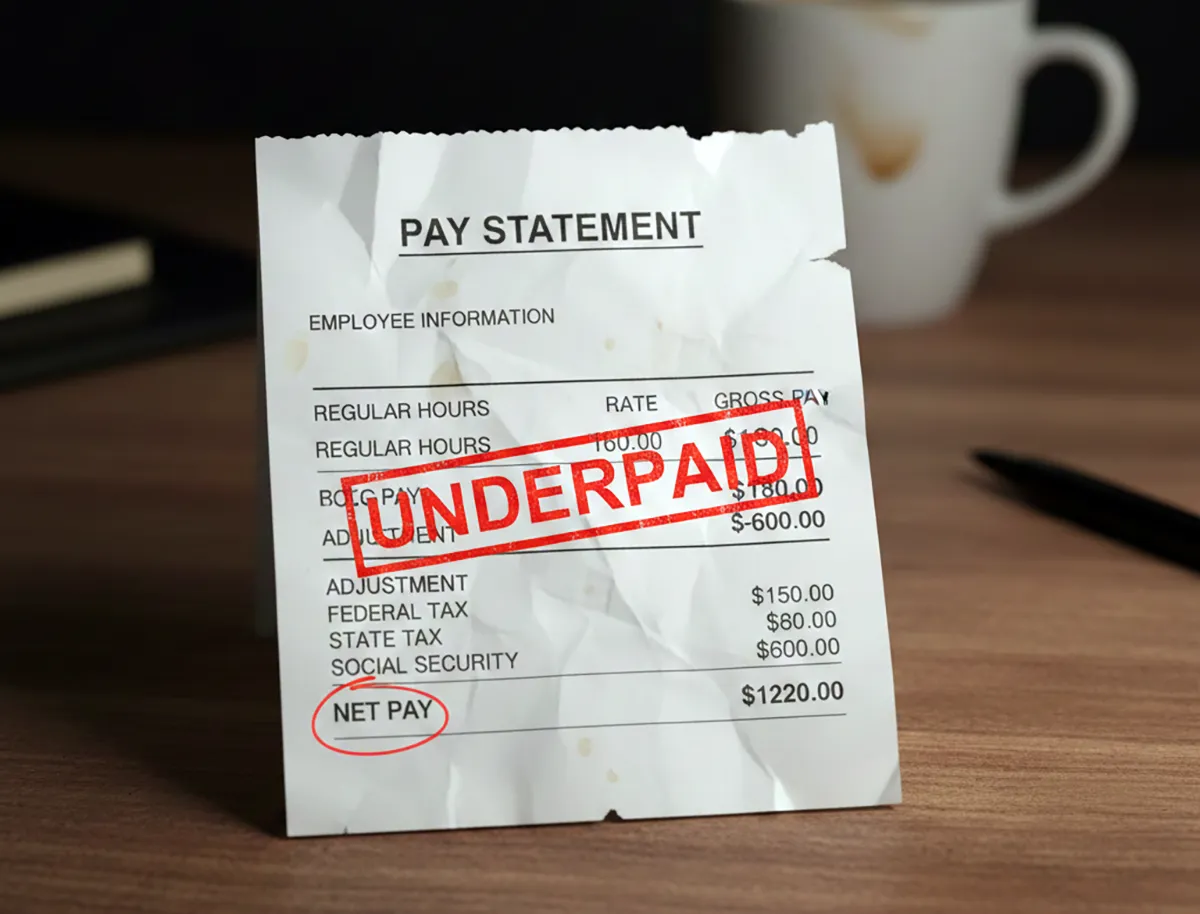
A required pay statement that never arrived, or one that omits the hours and rates it is supposed to show, is often the first concrete sign that a pay practice will not survive scrutiny. Maryland's separate equal pay statute also restricts pay history inquiries and prohibits pay differentials based on sex or gender identity for comparable work.
Deductions, Deadlines and Where to File
Deductions are limited by statute. An employer may deduct from wages only where the deduction is ordered by a court, expressly authorized in writing by the employee, allowed by the Commissioner of Labor and Industry, or otherwise permitted by law. That list is narrower than a signed authorization alone suggests — a written consent to a deduction the statute does not contemplate does not make it lawful. And the federal floor applies independently: no deduction may push effective pay below the minimum wage or cut into the overtime premium, which is what makes charges for uniforms, tools, register shortages and walkouts unlawful at that point.Both Maryland wage statutes run on the state's general three-year civil limitations period. Federal FLSA claims run two years, or three where the violation was willful, with the opt-in rule for collective actions.
The Employment Standards Service of the Maryland Department of Labor accepts wage claims and investigates them at no cost. A private lawsuit is the route that reaches the treble damages provision and the fee-shifting. The U.S. Department of Labor Wage and Hour Division handles the federal claim.
Retaliation for asserting a wage right, using earned sick and safe leave, or filing a complaint is prohibited, and those claims carry their own remedies and their own deadlines.
Frequently Asked Questions
What does bona fide dispute mean in a Maryland wage case?
It is the phrase that decides whether treble damages are on the table. Maryland's Wage Payment and Collection Law lets a court award up to three times the unpaid wage, plus reasonable counsel fees and costs, where it finds the wages were withheld and there was no bona fide dispute over whether they were owed. A bona fide dispute means a genuine, good-faith disagreement about the obligation, not simply an employer saying afterward that it disagreed. So the practical fight in many Maryland cases is over the employer's reason for not paying rather than over the arithmetic.
Does Maryland require meal or rest breaks?
Only in retail. Maryland's Healthy Retail Employee Act requires shift breaks for employees of retail establishments at or above a size threshold: roughly a 15-minute break for a shift of four to six consecutive hours, and a longer break for shifts over six hours, with additional breaks on very long shifts. Outside retail, Maryland has no general meal or rest break requirement for adults, and federal rules govern how any break that is given must be paid.
Is Maryland's minimum wage the same everywhere in the state?
No. Maryland sets a statewide minimum wage, and Montgomery County and Howard County each set their own higher local rates, with Montgomery County's varying by employer size. The rate that applies depends on where the work is performed. Because the statewide and county figures are adjusted on their own schedules, confirm the current rate for your worksite with the Maryland Department of Labor or the county before relying on a number.
When is my final paycheck due in Maryland?
On or before the day you would have been paid had you kept working — in other words, the next regular payday. The rule is the same whether you quit or were fired. Maryland has no separate per-day waiting-time penalty, but a final check withheld without a bona fide dispute can carry the treble damages remedy and attorney fees under the Wage Payment and Collection Law.
Do all Maryland workers get overtime after 40 hours?
Most do, but Maryland writes in some higher thresholds. The general rule is one and a half times the regular rate after 40 hours in a workweek. Employees of bowling establishments and of certain institutions providing on-premises care to the sick, the aged or individuals with disabilities are subject to a 48-hour threshold, and agricultural workers to a 60-hour threshold. Which threshold applies depends on the nature of the employer, not on the job title.
How long do I have to sue for unpaid wages in Maryland?
Three years. Both Wage Payment and Collection Law claims and Maryland Wage and Hour Law claims run on the state's general three-year civil limitations period. A federal Fair Labor Standards Act claim runs two years, or three where the violation was willful, and in a collective action an opt-in plaintiff's clock keeps running until the consent form is filed.
Sources
• Maryland Code, Labor and Employment 3-501 through 3-509 (Wage Payment and Collection Law — timing of payment, permitted deductions at 3-503, final wages at 3-505, and the treble damages and counsel fee provision at 3-507.2).• Md. Code, Lab. & Empl. 3-401 through 3-431 (Maryland Wage and Hour Law — minimum wage at 3-413, overtime at 3-415 including the 48-hour and 60-hour thresholds, and exemptions).
• Md. Code, Lab. & Empl. 3-710 (Healthy Retail Employee Act — shift breaks for covered retail employees).
• Md. Code, Lab. & Empl. 3-1301 and following (Maryland Healthy Working Families Act — earned sick and safe leave) and 3-304 (equal pay for equal work).
• Maryland's 2024 pay statement, notice-at-hire and wage range disclosure requirements.
• Md. Code, Courts and Judicial Proceedings 5-101 (three-year civil limitations period).
• Maryland Department of Labor — wage and hour information.
• U.S. Department of Labor — Fair Labor Standards Act.