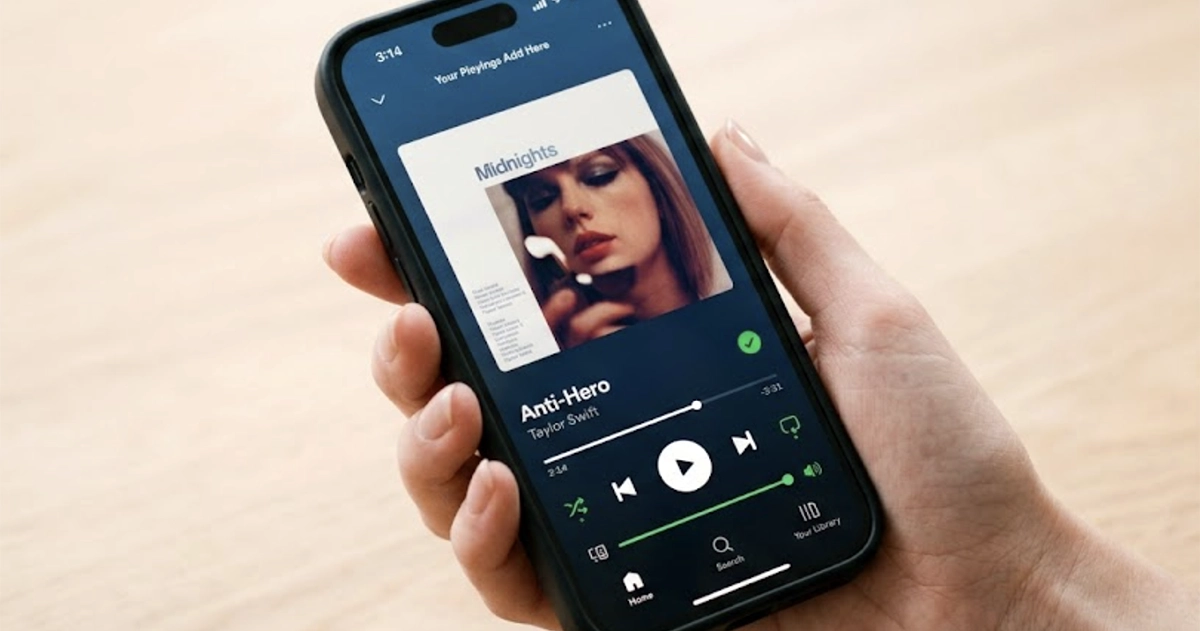
A class action accused Spotify of running a modern form of “payola” — quietly letting labels and artists pay to land songs in “personalized” playlists it markets as neutral. Some posts online say subscribers can now claim $500. In reality, a federal judge has already compelled the case into individual arbitration and dismissed the class claims with prejudice: there is no class action, no settlement, and no $500-per-user payout.

Allegations Only · Decided on Arbitration, Not the Merits
This article describes a class action complaint and the court’s April 30, 2026 order compelling arbitration. The complaint’s statements are unproven allegations. Spotify USA Inc. has not been found liable, and the court did not rule on whether Spotify’s conduct was deceptive — it decided only that the dispute must go to individual arbitration and dismissed the class claims. The existence of Spotify’s Discovery Mode program is a matter of public record; the characterization of Spotify’s conduct as “payola” is the plaintiff’s allegation. This page is general information, not legal advice.
The Short Answer
If you have seen a post claiming Spotify subscribers can get $500, here is the reality: that number was never an award — it was the most a newly filed lawsuit could ask for under one New York statute. And that lawsuit has already hit a wall. On April 30, 2026, a federal judge in New York granted Spotify’s motion to compel individual arbitration and dismissed the plaintiff’s class claims with prejudice. Translation: there is no class action, no class settlement, no claim form, and no $500-per-user payout.What the Class Action Claimed
Spotify USA Inc. — the U.S. arm of the world’s largest music-streaming service, headquartered in New York — was sued in a proposed class action over how it presents its playlists and recommendations. The case is Capolongo v. Spotify USA Inc., No. 1:25-cv-09216, filed November 4, 2025 in the U.S. District Court for the Southern District of New York.According to the complaint, Spotify markets its playlists and recommendations as neutral and “personalized” — “made just for you” and “based on your listening habits” — while, the suit alleged, quietly allowing commercial incentives to shape what songs are promoted. The complaint called this a modern, algorithmic form of “payola,” the century-old practice of secretly paying to get music in front of an audience. It brought claims under New York General Business Law §§ 349 and 350, plus fraudulent inducement and unjust enrichment. Spotify has not been found liable, and the allegations have not been proven.
Free settlement alerts
Get notified when new class actions open to claims
Join thousands of readers who get the latest class action settlements you may qualify for — delivered straight to your inbox.
What the Court Just Ruled
On April 30, 2026, U.S. District Judge John G. Koeltl granted Spotify’s motion to compel arbitration, stayed the lawsuit, and dismissed the plaintiff’s class claims with prejudice. The decision turned on Spotify’s Terms of Use, which — like those of most apps — contain a mandatory arbitration provision and a class action waiver.The court found that the plaintiff agreed to those terms when she signed up for Spotify in 2021 by tapping “Create account,” and again by continuing to use and pay for Spotify after being notified, by email and in-app pop-up, of updated terms in 2023 and 2025. Under long-standing New York contract law, the court held, continuing to use a service after clear notice of updated terms counts as agreeing to them. Because the plaintiff never used the 30-day window to opt out of the arbitration changes, she was bound by them.
The judge also rejected each of the plaintiff’s arguments that the arbitration clause was unenforceable — including that it improperly waived public injunctive relief, allowed too little discovery, or imposed fees larger than her likely recovery. The result: her individual claims must be resolved in private arbitration, and the class case cannot proceed.
A Ruling on the Forum, Not the Facts
One thing the order did not do is decide whether Spotify’s “payola” allegations are true. The court ruled only on where the dispute must be heard — individual arbitration rather than a class action in court. It made no finding that Spotify’s recommendations are, or are not, deceptive. So this is not a case of Spotify being cleared on the merits, any more than it is a case of Spotify being found liable. The allegations were simply never tested, and they remain unproven.Where the “$500” Number Came From
The $500 is real, but it was always a legal request, not a payout. Among the complaint’s claims were two under New York’s consumer-protection statutes:• New York General Business Law § 350 (false advertising) lets a plaintiff recover “actual damages or five hundred dollars, whichever is greater,” plus possible treble damages and attorneys’ fees. That is the source of the “$500.”
• New York General Business Law § 349 (deceptive acts and practices) carries a smaller figure — “fifty dollars,” or actual damages, whichever is greater.
So $500 was the per-person statutory maximum the lawsuit asked a court to award under one New York statute — not a fund Spotify agreed to pay, and not a number any judge approved. In fact, the plaintiff’s own briefing estimated her actual individual damages at roughly $5 to $21. And with the class claims now dismissed, there is no class mechanism through which any Spotify user could collect a statutory award at all.
Why You Can’t Get $500
Put the fact-check plainly. As of today:• The class claims were dismissed with prejudice. There will be no class action, so there is no class-wide settlement or judgment that could pay Spotify users.
• You agreed to arbitration too. Like the plaintiff, Spotify users generally accept Terms of Use with a mandatory arbitration clause and class action waiver when they sign up or keep using the app after the terms update — the same hurdle that ended the class case here.
• $500 was the request, not the result. It was the statutory maximum sought under one New York law, and the plaintiff’s own filings pegged her real damages at about $5 to $21.
• There is no claim form and no deadline. There is literally nothing to file, so any “claim your $500 from Spotify” prompt is not describing a real process.
The dispute is real and continues in private arbitration. The “$500 for every Spotify user” framing is not.
Is There a Settlement or Claim Form?
No. This was never a settlement, and it is now not even a class action. There is no settlement fund, no class action claim form, no payout, and no deadline. If a class settlement over some issue ever did emerge in the future, class members are reached through an official notice — see our explainer on why you might get a class action notice — not through a random post telling you to “claim $500 today.”If you are looking for a streaming-service case you can actually act on, a separate, unrelated matter — the YouTube TV auto-renewal settlement — has an open claim window for eligible California subscribers.
What Happens Next?
The lawsuit is stayed while the named plaintiff’s individual claims go to arbitration before National Arbitration and Mediation (NAM). The court asked the parties to file a status report within 14 days of the arbitration’s completion. Because Spotify’s Terms bind its users to the same arbitration provision and class action waiver, another consumer trying to revive a class action over the same “payola” theory would face the very same obstacle that ended this one.OpenClassActions.com will watch the docket for anything that would actually matter to consumers — an arbitration outcome, an appeal, or any future settlement with a real claim process — and update this page if the picture changes.
Frequently Asked Questions
Can Spotify users really get $500 from the payola lawsuit?
No. On April 30, 2026, a federal judge in New York compelled the case into individual arbitration and dismissed the class claims with prejudice, so there is no class action, no class settlement, and no $500-per-user payout. The $500 was only ever the per-person statutory maximum the complaint requested under New York’s false-advertising law (General Business Law § 350) — it was never an award. The plaintiff’s own court briefing estimated her actual individual damages at roughly $5 to $21.
What did the court rule in Capolongo v. Spotify?
U.S. District Judge John G. Koeltl granted Spotify’s motion to compel arbitration and stayed the lawsuit, and dismissed the plaintiff’s class claims with prejudice. The court held that the plaintiff had agreed to Spotify’s Terms of Use — which contain a mandatory arbitration provision and a class action waiver — when she signed up and by continuing to use Spotify after being notified of updated terms. The ruling decided where the dispute must be heard, not whether Spotify’s conduct was deceptive.
Does the ruling mean Spotify’s payola allegations were proven false?
No. The court did not decide whether Spotify’s “payola” allegations are true or false. It ruled only on the forum — that the claims must be resolved in individual arbitration rather than a class action in court. The underlying allegations were never tested on their merits, Spotify has not been found liable, and the allegations remain unproven.
Is there a Spotify settlement or claim form?
No. There is no settlement, no settlement fund, no claim form, and no deadline. With the class claims dismissed with prejudice and the case sent to individual arbitration, there is nothing for Spotify users to join or file. Any website telling you to “file a Spotify $500 claim” is not describing a real claim process.
What is Spotify’s Discovery Mode?
Discovery Mode is a Spotify program, publicly described by the company, that lets artists and labels flag priority songs to increase the chance they are recommended in certain algorithmic contexts such as Radio, Autoplay, and some mixes. Participants do not pay cash up front; instead they accept a lower royalty rate on the streams the boost generates. The program’s existence is not in dispute — the lawsuit’s claim was that failing to clearly tell listeners when commercial incentives shape recommendations is deceptive, a claim that will now be tested, if at all, only in individual arbitration.
Sources
• Capolongo v. Spotify USA Inc., No. 1:25-cv-09216 (JGK) (S.D.N.Y.) — Memorandum Opinion and Order compelling arbitration and dismissing class claims (Apr. 30, 2026)• Capolongo v. Spotify USA Inc., No. 1:25-cv-09216 (S.D.N.Y.) — Class Action Complaint (Nov. 4, 2025)
• New York General Business Law § 349 (deceptive acts and practices) and § 350 (false advertising)
• CourtListener — docket search for Capolongo v. Spotify USA Inc. (S.D.N.Y.)
• Spotify for Artists — official Discovery Mode program page
• The Guardian — “Pay to get playlisted? The accusations against Spotify’s Discovery Mode” (Feb. 19, 2025)