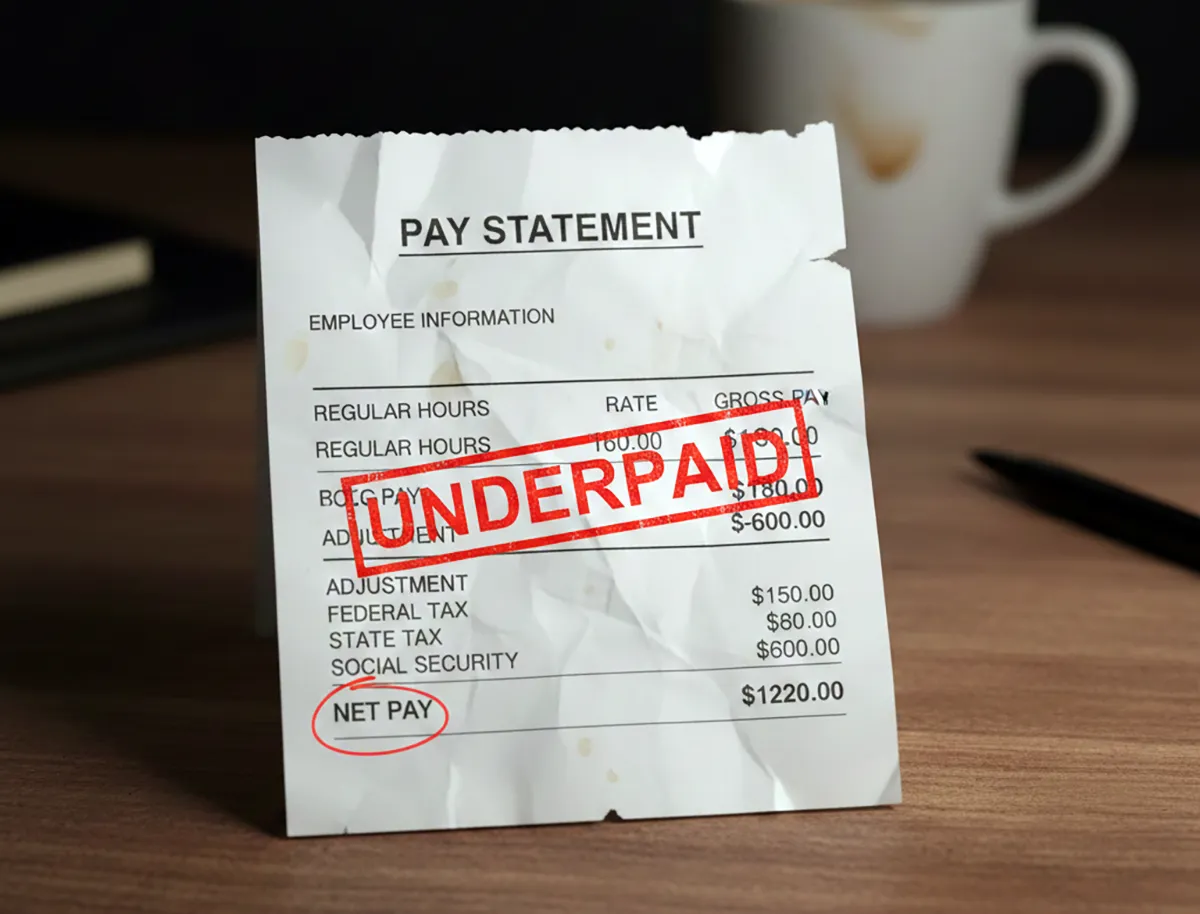
This settlement resolves claims that trucking company CRST Expedited underpaid California drivers who were paid by the mile, leaving non-driving hours — waiting at customer sites, breakdowns, layovers, sleeper-berth time — allegedly uncompensated. If you were a California resident driving piece-rate for CRST, there is nothing to file: your share of $14,500,000 is mailed automatically, and the only date that asks anything of you is October 5, 2026.

Current Status
There is no claim form and no claim deadline. If you qualify, the settlement administrator already has you on its list from CRST's payroll records, and a check goes to your last known mailing address after the settlement takes effect. The court has granted preliminary approval and certified the class for settlement purposes. The Final Approval and Fairness Hearing is set for November 16, 2026 at 1:30 p.m. Pacific Time before Judge Otis D. Wright II in the U.S. District Court for the Central District of California; no final approval order has been entered, so no payment date has been announced. October 5, 2026 is the deadline for the three things a driver can actually do — opt out, object, or dispute the workweek count printed on the postcard notice — and the most useful step for most people is simply making sure the administrator has a current address.What Changed Recently?
The court granted preliminary approval of the settlement and certified the class for settlement purposes, which is what put notice in the mail and set the October 5, 2026 and November 16, 2026 dates. Kroll Settlement Administration LLC is running notice and distribution, and the official settlement website is live.The case dates to 2021. The named plaintiff, a former driver, alleged that CRST Expedited and CRST International failed to pay minimum wages for non-driving time — time spent on non-driving tasks, waiting at customer sites, sitting through breakdowns and weather delays, on layovers, and in the sleeper berth of a truck — that he alleged was still under the company's control. The complaint also alleged failure to pay statutory and contractual wages tied to actual miles driven, failure to reimburse business expenses, inaccurate itemized wage statements, failure to timely pay wages, and a violation of California's Unfair Competition Law. A parallel action in Los Angeles County Superior Court carried the claim for civil penalties under the Private Attorneys General Act, including an allegation that the company failed to reimburse the cost of pre-employment medical examinations.
CRST denies all liability, says its conduct has been lawful at all times, and maintains that the claims lack merit and would not have met the requirements for class certification or a representative action. No court has found the company liable. The notice describes the settlement as a compromise reached through arm's-length negotiation and not an admission of liability.
Free settlement alerts
Get notified when new class actions open to claims
Join thousands of readers who get the latest class action settlements you may qualify for — delivered straight to your inbox.
Who Qualifies?
There are two overlapping groups, and a driver can be in one or both. Both are drawn from CRST's records, so neither requires you to sign up.- Class Members — all current and former employees who had a residential address in California and worked as a truck driver for CRST Expedited, Inc., and who were compensated by a piece-rate at any time from August 9, 2017 through April 10, 2023.
- PAGA Group Members — the same definition, but with a shorter window: compensated by a piece-rate at any time from August 9, 2020 through April 10, 2023.
Both groups exclude anyone who participated in the settlement of Montoya v. CRST Expedited, Inc., an earlier case in the U.S. District Court for the District of Massachusetts. That carve-out turns on actual participation in the Montoya settlement, not merely on having driven for the company during an overlapping period.
Two details decide most edge cases. The class is built on California residency, so it is the driver's home address on file, not the routes driven, that puts someone in it. And the test is being paid by a piece-rate — the per-mile pay structure at the center of the case — at some point in the relevant window; a driver who was paid that way for part of the period and hourly for the rest still qualifies.
How Much Can You Get?
No per-person figure has been published, and none can be until opt-outs are counted. What the settlement fixes is the formula.CRST is paying a Gross Settlement Amount of $14,500,000, and that figure is a ceiling — the notice says CRST will not be required to pay more than it under any circumstance. Everything comes out of it: driver payments, attorneys' fees and costs, the service award, administration, the PAGA penalties, and payroll taxes. Subject to court approval, the deductions are a service award of up to $15,000 to the class representative, administration costs estimated at about $60,703 and capped at $65,363, the $725,000 PAGA Amount, attorneys' fees of up to one-third of the gross ($4,833,333.33), and litigation costs expected not to exceed $410,000. If the court awarded every one of those at its cap, roughly $8.45 million would remain as the Net Settlement Amount — that is arithmetic from the notice, not a figure the settlement publishes, and the court can award less.
The Net Settlement Amount is then divided among Class Participants — every class member who does not opt out — as a pro rata share based on Qualifying Class Workweeks. That means the total weeks you worked for CRST Expedited during the Class Release Period, which runs August 9, 2017 through March 1, 2026. One wrinkle changes the math for recent weeks: a Qualifying Class Workweek beginning after May 1, 2023 is worth 25 percent of the value of a workweek beginning before that date.
The PAGA money is separate and is paid on top of the class payment. Of the $725,000 PAGA Amount, California law sends 75 percent — $543,750 — to the state's Labor and Workforce Development Agency. The remaining $181,250 is split among PAGA Group Members pro rata by Qualifying PAGA Pay Periods, meaning pay periods worked during the PAGA Release Period of August 9, 2020 through March 1, 2026, with the same 25 percent weighting for pay periods beginning after May 1, 2023.
Both formulas are relative, so both can move. The notice states plainly that if additional class members or PAGA group members are identified, an individual payment may be reduced.
What Proof or Claim Form Is Required?
None. The notice says it in one line: you do not need to do anything to receive your Individual Class Payment and Individual PAGA Amount. There is no claim form, no notice ID to enter, no receipts, and no portal to log into. Eligibility and workweek counts come from CRST's own payroll records, and the settlement administrator calculates each payment from them.The one number worth checking is the workweek count. The postcard notice mailed to each driver prints the Qualifying Class Workweeks and Qualifying PAGA Pay Periods credited to them, and that count is what drives the payment. If it looks wrong, the notice sets out a dispute process, described in the next sections — and it is the only place in this settlement where documentation matters.
Payment is conditional on the court, not on you. No money moves unless and until final approval is granted and the settlement becomes effective.
What Are the Deadlines?
- Opt-out deadline: October 5, 2026. A written Opt-Out Request must be signed and postmarked by that date, and must give your name and the last four digits of your Social Security number and state that you wish to opt out of the case. Excluding yourself preserves your right to sue CRST separately on the wage claims, at your own expense — but not on the PAGA claims.
- Objection deadline: October 5, 2026. A written objection must be filed with the court and served on counsel for both sides, and must identify the case, give your name and the last four digits of your Social Security number, state your grounds, and be signed. Anyone who opts out cannot object. Anyone who wants to speak at the hearing must also file a notice of intention to appear at the same time.
- Workweek dispute deadline: October 5, 2026. A written explanation disputing the Qualifying Class Workweeks or Qualifying PAGA Pay Periods on your postcard must be postmarked by that date, with supporting documents. The notice warns against using a postage meter, since it may leave no postmark on the envelope.
- Final Approval and Fairness Hearing: November 16, 2026 at 1:30 p.m. Pacific Time, in Courtroom 5D of the U.S. District Court for the Central District of California in Los Angeles. Attendance is not required to be paid, and the hearing may be moved or continued without further notice.
On a workweek dispute, the bar is high and worth knowing before you spend the effort. CRST's calculation is presumed accurate unless you submit clear and compelling documentary evidence that a mistake was made, and the notice says evidence of your dates of engagement alone will not satisfy that standard if you held other jobs or positions with the company. The administrator investigates, requests information from CRST as needed, and makes the final determination.
How Do You Take Action?
For most drivers the answer is: confirm your address and then do nothing. Payment depends entirely on a check reaching your last known mailing address, and drivers change addresses often, so a stale address is the most common way to lose money in a settlement that otherwise asks nothing of you. Use the contact page on the official settlement website at Trucking Driver Settlement.com to update your contact information, and check that the workweek count on your postcard matches what you remember.If you want out of the class settlement, or you want to object, or you believe the workweek count is wrong, all three run through a written submission postmarked by October 5, 2026 — the opt-out and dispute submissions to the settlement administrator, the objection to the court with copies served on counsel for both sides. The official settlement website carries the long-form notice, the settlement agreement, the preliminary approval order and the approval and fee motions, which is where the exact submission instructions live.
One caution worth repeating: the settlement website run by the court-appointed administrator is the only authorized site for this case. A legitimate administrator does not charge a fee to release a settlement payment and does not ask for a banking password. If a message about this settlement reaches you out of the blue, go to the official site directly rather than following the link.
What Happens Next?
The next milestone is the Final Approval and Fairness Hearing on November 16, 2026, where the court will decide whether the settlement is fair, adequate and reasonable, and will rule on the plan of distribution, attorneys' fees and costs, and the service award. If final approval is granted, the order and judgment are to be posted on the settlement website.Payment follows a defined sequence rather than an announced date. The Effective Date arrives when the court grants final approval and any appeals are resolved. CRST then deposits the Gross Settlement Amount into the settlement fund within 30 days of that date, and the administrator mails the Individual Class Payments and Individual PAGA Amounts within 15 days after the fund is financed. Because the Effective Date depends on whether anyone appeals, no calendar date for checks exists yet.
After that, one clock does start running for you. A check left uncashed 180 days after issuance is cancelled, and the money behind it goes to the court-approved cy pres recipient — while you stay bound by the settlement. We will update this page when the court rules or a payment schedule is announced.
Sources and Verification
- Official settlement website — Trucking Driver Settlement.com, including its FAQ, Documents and Important Dates pages.
- Notice of Proposed Class Action Settlement and Final Approval Hearing, authorized by the U.S. District Court for the Central District of California (embedded below).
- Settlement Agreement and Release of Claims, together with the preliminary approval order and the motions for preliminary and final approval and for attorneys' fees, as posted on the settlement website.
- Docket in Keith Huckaby v. CRST Expedited, Inc., et al., Case No. 2:21-cv-07766-ODW-PD (C.D. Cal.), and the related PAGA action in the Superior Court of California, County of Los Angeles, Case No. 21STCV37657.
Questions
Why can I opt out of the class part but not the PAGA part?
Because the two halves belong to different people. The class claims are yours, so you can take them back by opting out. A PAGA claim is not: under California's Private Attorneys General Act the named plaintiff sues as a proxy for the State of California and the Labor and Workforce Development Agency, which is why 75 percent of the PAGA money goes to the LWDA rather than to workers. The state's claim is not a driver's to withdraw, so the notice states that PAGA Group Members are bound by the release of the Released PAGA Claims regardless of whether they opt out of the class, and regardless of whether they ever cash the PAGA check.
If I opt out of the class settlement, do I still get any money?
You may. The notice says that a class member who submits a valid opt-out request receives no benefits under the settlement apart from the benefits allotted as a PAGA Group Member. So if you drove piece-rate for CRST Expedited between August 9, 2020 and April 10, 2023 and were not in the Montoya settlement, you are still a PAGA Group Member, you still receive your Individual PAGA Amount from the $181,250 allocated to workers, and you still release the PAGA claims. What opting out preserves is your right to bring your own case on the wage claims, at your own expense.
The class period ends April 10, 2023, so why does my workweek count run past it?
Two different dates are doing two different jobs. The April 10, 2023 date is part of the eligibility test: it defines the window in which you had to be paid by piece-rate to be a class member at all. The Class Release Period, which runs August 9, 2017 through March 1, 2026, is what the payment formula counts, and Qualifying Class Workweeks means the weeks you worked for CRST Expedited at any time in that longer window. A driver who qualified on the piece-rate test and kept working can therefore accrue workweeks well past April 2023 — though weeks beginning after May 1, 2023 are counted at 25 percent of the value of earlier weeks.
What happens if my check never arrives or I never cash it?
Checks go to the last known mailing address the settlement administrator has on file, which is why updating a stale address is the single most useful thing a driver can do here. Under the notice, any check for an Individual Class Payment or Individual PAGA Amount that is still uncashed 180 days after it is issued gets cancelled, and the money behind it goes to the court-approved cy pres recipient rather than back to you or to CRST. Cancellation does not release you from the settlement: the notice is explicit that you remain bound by its terms either way.
What is the Montoya settlement, and how do I know whether it excludes me?
Montoya v. CRST Expedited, Inc., Case No. 16-cv-10095-PBS in the U.S. District Court for the District of Massachusetts, was an earlier case against the same company, and people who participated in its settlement are carved out of both the class and the PAGA group here. The exclusion turns on whether you actually participated in that settlement, not on whether you drove for CRST during an overlapping stretch. If you are unsure, the settlement administrator holds the participant list drawn from CRST's records, and the contact page on the official settlement website is the place to ask before the October 5, 2026 deadlines pass.