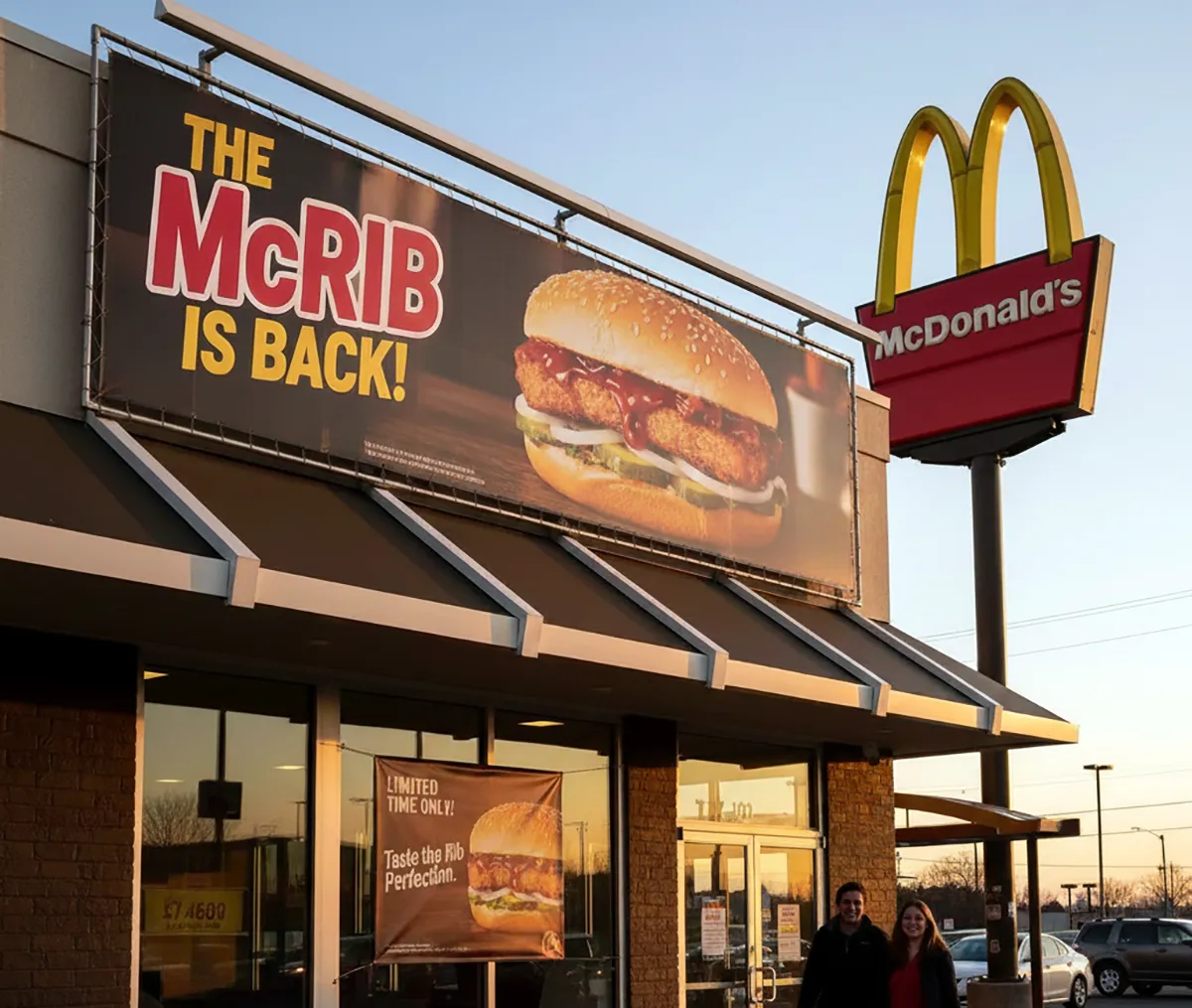
Anyone in the United States who bought food at a McDonald’s may be covered by a proposed class action alleging McDonald’s used a machine-learning pricing engine to coordinate menu prices among its franchised and company-run restaurants. No class has been certified and there is nothing to file yet.

Allegations Only · No Settlement Yet
This article describes a class action complaint. The statements below are unproven allegations. McDonald’s has not been found liable, there is no certified class, and nothing to claim at this time. This page is informational and is not legal advice.
What Is This About?
A McDonald’s customer filed a proposed nationwide class action on October 2, 2026, in the U.S. District Court for the Northern District of Illinois, alleging that McDonald’s turned its menu-pricing software into a tool for fixing prices. The case is Thomas v. McDonald’s USA, LLC, No. 1:26-cv-12149, assigned to Judge Thomas M. Durkin. The 31-page complaint claims McDonald’s pooled confidential sales data from thousands of restaurants that are supposed to compete with one another, ran it through a machine-learning “pricing engine,” and pushed franchisees to follow the engine’s recommended prices. McDonald’s denies the allegations and says franchisees set their own prices.Free settlement alerts
Get notified when new class actions open to claims
Join thousands of readers who get the latest class action settlements you may qualify for — delivered straight to your inbox.
What Does the Lawsuit Allege?
About 95% of the roughly 14,000 McDonald’s restaurants in the U.S. are owned by independent franchisees, and McDonald’s has said publicly that those franchisees set their own prices. The complaint alleges that since no later than 2019, that independence has been undercut by a McDonald’s-controlled pricing engine. According to the complaint:- McDonald’s required franchisees to use a company-owned point-of-sale system that sends transaction-level sales data to McDonald’s, with no contractual limit on how McDonald’s uses it.
- The engine combines that data from franchised and company-run stores and generates recommended prices item by item and restaurant by restaurant, based in part on estimates of customers’ “willingness to pay.” One example alert quoted in the complaint told a franchisee: “Your restaurant is showing MEDIUM SENSITIVITY to Price.”
- Under what the complaint calls the “30% rule,” the engine recommends raising an item’s price when at least 30 percent of stores have recently raised it. The plaintiff argues that makes one restaurant’s price depend on whether its competitors already raised theirs.
- Starting in January 2026, McDonald’s franchising standards required franchisees to be “constructively engaging” with the company’s approved pricing consultant and tools, and the complaint alleges “pricing non-compliance” is weighed when McDonald’s decides on franchise renewals and new locations.
- The pricing portal’s terms of service warn users that fellow users “may be competitors of each other” and must follow antitrust law, which the complaint treats as an acknowledgment of the risk.
The complaint leans on McDonald’s own 2024 statement that its average menu prices rose about 40 percent from 2019 to 2024, the same period it says the engine was in use. Much of its detail is attributed to a Reuters investigation published September 29, 2026. The complaint also says McDonald’s bought the AI company Dynamic Yield in 2019 for $300 million and that the consulting firms Deloitte and Tiger Analytics reportedly helped build the platform. None of those companies is a defendant.
Who Is in the Proposed Class?
The complaint asks the court to certify two groups:- Nationwide class: all persons in the United States who bought menu items at any McDonald’s restaurant, whether operated by McDonald’s or by a franchisee.
- Illinois subclass: all Illinois residents who bought menu items at a McDonald’s restaurant in Illinois.
McDonald’s, its affiliates, officers and directors, and the judges on the case are excluded. The class definitions have no start date; the alleged conspiracy is described as running from no later than 2019 to the present. A court decides later whether any class is certified and what its boundaries are.
What Laws Does It Claim Were Broken?
The complaint brings four claims. Two arise under Section 1 of the Sherman Act, the federal law against agreements that restrain trade: one for price fixing, which it argues is illegal on its face, and one for an unlawful exchange of competitively sensitive information. The other two are under the Illinois Antitrust Act and the Illinois Consumer Fraud and Deceptive Business Practices Act, for the Illinois subclass. Only McDonald’s USA, LLC and McDonald’s Corporation are sued. Franchisees, McDonald’s-owned operating companies and outside vendors are described as co-conspirators but are not defendants.The plaintiff asks for triple damages under federal antitrust law, damages and restitution under Illinois law, a court order barring the alleged agreements, and an order requiring McDonald’s to pay for notifying the class. The case is represented by Clarkson Law Firm.
What Has McDonald’s Said?
McDonald’s has disputed the core premise. The company told Reuters that “AI does not set the price of a Big Mac or any other menu item,” and told Nation’s Restaurant News that “McDonald’s franchisees do” set menu prices, that the complaint is “filled with inaccuracies,” and that it will “vigorously defend against this lawsuit.” A day before the suit was filed, McDonald’s posted a statement on its corporate website saying it does not use dynamic pricing and that franchisees are not required to accept pricing recommendations. McDonald’s has not yet filed a response in court.How Does This Fit With Other Algorithmic Pricing Cases?
The case is one of a growing number of lawsuits claiming that shared pricing software can do what competitors are not allowed to do by agreement. The complaint cites a U.S. Department of Justice statement of interest in a Chicago health-insurance case, In re MultiPlan, which argued that using a common algorithm to set prices can violate the Sherman Act, and a Washington federal decision in a rent-pricing case, Duffy v. Yardi Systems. It also points to an earlier lawsuit by a Connecticut franchisee, Michell v. McDonald’s in federal court in Brooklyn, that followed a viral photo of an $18 Big Mac meal. Similar algorithmic pricing claims have produced a $359.9 million RealPage rent settlement for apartment renters.What Happens Next?
McDonald’s has not yet appeared in the case. Large antitrust suits like this usually move next to a motion to dismiss, where the court decides whether the complaint states a plausible claim, and only later to class certification. Other customers or franchisees may file similar suits, which are often combined before one judge. OCA will update this page as the case develops.Questions
Who is covered by the McDonald’s AI pricing class action?
The complaint proposes a nationwide class of everyone in the United States who bought menu items at any McDonald’s restaurant, whether run by McDonald’s or a franchisee, plus an Illinois subclass. The class definitions have no date limit; the alleged conspiracy runs from no later than 2019 to the present. No class has been certified.
Is there a McDonald’s price-fixing settlement or claim form?
No. The case was filed on October 2, 2026 and is at the complaint stage. There is no settlement, no certified class and no claim form. If the case ever settles or a class is certified, the court would approve a notice explaining any claim process.
What is the “30% rule” in the McDonald’s lawsuit?
The complaint, citing Reuters reporting, alleges that McDonald’s pricing engine recommends raising an item’s price when restaurants that account for at least 30 percent of stores have already raised it recently. The plaintiff argues that ties one restaurant’s price to whether its competitors already raised theirs. McDonald’s says franchisees set their own prices and are not required to follow recommendations.
What has McDonald’s said about the AI pricing lawsuit?
McDonald’s told reporters that AI does not set the price of a Big Mac or any other menu item, that franchisees set their own prices, and that the complaint is filled with inaccuracies. The company said it will vigorously defend the case.
Are franchisees or software companies being sued?
No. The only defendants are McDonald’s USA, LLC and McDonald’s Corporation. The complaint describes franchisees, McDonald’s-owned operating companies and outside vendors as co-conspirators but does not name them as defendants.
Sources
• Thomas v. McDonald’s USA, LLC, No. 1:26-cv-12149 (N.D. Ill.) — docket and complaint• Reuters (via Claims Journal) — October 6, 2026 report on the lawsuit and McDonald’s response
• Nation’s Restaurant News — McDonald’s statement on the lawsuit
• McDonald’s — corporate statement on how menu prices are set