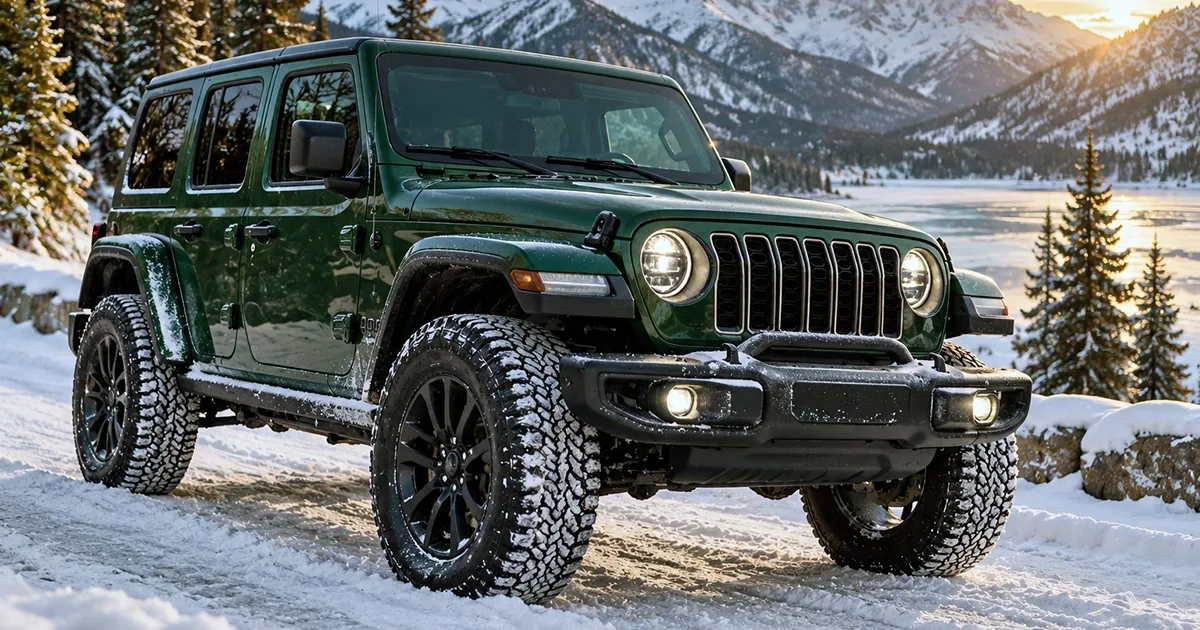
Owners and lessees of Jeep Wrangler 4xe plug-in hybrids may be covered by a proposed class action alleging FCA US sold the SUVs with a high-voltage battery that can catch fire while the vehicle is parked and switched off. No class has been certified and there is nothing to file yet.

Allegations Only · No Settlement Yet
This article describes a class action complaint. The statements below are unproven allegations. FCA US LLC has not been found liable, there is no certified class, and nothing to claim at this time. This page is informational and is not legal advice. If your vehicle is under a recall, follow the official recall notice and any NHTSA guidance.
What Is This About?
FCA US LLC, the Stellantis unit that builds Jeep, is defending a proposed class action over the Jeep Wrangler 4xe plug-in hybrid. The complaint alleges the vehicles were sold with a defect in the hybrid propulsion system that can cause them to catch fire, including while they sit parked with the ignition switched off.The case is captioned Frisch v. FCA US LLC, Case No. 2:24-cv-10546, and is pending in the U.S. District Court for the Eastern District of Michigan before Judge Brandy R. McMillion. It was filed on March 4, 2024, and has since been amended three times, most recently in November 2025. FCA US denies the allegations, no class has been certified, and no court has found the vehicles defective.
A second proposed class action over the same battery, Aiello v. FCA US LLC, was filed in the same court in April 2026. It is built around a much larger group of vehicles: FCA US has now recalled every Wrangler 4xe and Grand Cherokee 4xe it built, 320,065 in all, and has twice reported to regulators that its previous repair did not work.
A third suit, Andreoli v. FCA US LLC, was filed on October 9, 2026. It is not a class action: roughly 170 named 4xe owners and lessees are suing together over their own vehicles, and it is the first of the three to add the 2026 power steering pump fire recall to the battery claims.
What the Lawsuit Alleges
At the center of the case is the Wrangler 4xe's high-voltage lithium-ion battery pack. The complaint alleges the pack can fail internally and enter thermal runaway, the self-heating chain reaction that turns a single overheating cell into a vehicle fire. According to the complaint, the reported fires happened while the vehicles were parked and switched off rather than after any crash or external damage.The complaint further alleges that FCA US knew or should have known about the risk before it told owners, pointing to published research on lithium-ion fire risk, a 2017 National Highway Traffic Safety Administration report on battery safety, and earlier fire-related recalls of other automakers' plug-in hybrids that used battery cells from the same supplier.
A large part of the complaint is about the remedy rather than the defect. In November 2023, FCA US filed a Part 573 safety recall report with NHTSA, recall number 23V-787, covering the plug-in hybrid Wranglers. The complaint alleges that instead of a repair, owners were initially told to stop recharging the vehicles and not to park them inside buildings or near other vehicles until a final fix was available. The plaintiffs argue that a plug-in hybrid that cannot be charged or parked at home is not fit for its ordinary purpose, and that owners kept making loan, lease and insurance payments on vehicles they could not use as sold.
The counts pleaded include:
• Breach of the federal Magnuson-Moss Warranty Act
• Breach of the implied warranty of merchantability under several states' laws
• Violations of state consumer protection statutes, including in Arizona, California, Florida, New Jersey, North Carolina, Pennsylvania and Texas
• Unjust enrichment
As with any complaint, these are allegations only. FCA US has not been found liable, and the court has not ruled on whether the vehicles are defective.
Free settlement alerts
Get notified when new class actions open to claims
Join thousands of readers who get the latest class action settlements you may qualify for — delivered straight to your inbox.
Which Jeeps Are Involved?
The original March 2024 Frisch complaint defined the class around 2021 through 2023 model year Jeep Wrangler 4xe plug-in hybrids, the vehicles covered by recall 23V-787, and estimated more than 32,000 of them were on the road. The recalled population is now roughly ten times that size.FCA US’s most recent Part 573 safety recall report, NHTSA number 25V-741, filed October 30, 2025, covers 320,065 vehicles: 228,221 model year 2020 through 2025 Jeep Wrangler 4xe and 91,844 model year 2022 through 2026 Jeep Grand Cherokee 4xe. The report gives production end dates of August 25, 2025 for the Wrangler 4xe and October 15, 2025 for the Grand Cherokee 4xe, which covers both models’ entire production runs.
Because no class has been certified in either case, the model years, the vehicle list and the class definition are not final and can still change as the litigation moves forward. Drivers most likely to be watching these cases include:
• Wrangler 4xe and Grand Cherokee 4xe owners and lessees who received a high-voltage battery recall notice
• Owners who were told not to charge their vehicle or not to park it in a garage
• Drivers who say they lost the use of electric mode and paid for gasoline instead
• Anyone who bought or leased a 4xe without being told about a battery fire risk
Three Recalls, and FCA Says the First Two Did Not Work
FCA US has filed three Part 573 safety recall reports with NHTSA over the same high-voltage battery. Each covered more vehicles than the last, and in the second and third the company reported that its previous repair had not worked.• Recall B9A / NHTSA 23V-787, November 2023 — 32,125 Jeep Wrangler 4xe vehicles.
• Recall 95B / NHTSA 24V-720, September 2024 — 154,032 vehicles, made up of 118,230 Wrangler 4xe and 35,802 Grand Cherokee 4xe. In that report FCA US stated the earlier remedy was ineffective at detecting certain abnormalities within the battery that may lead to a fire.
• Recall 68C / NHTSA 25V-741, October 2025 — 320,065 vehicles across both models. FCA US again reported the prior remedy ineffective.
Each recall carried the same interim instruction to owners: stop recharging the vehicle, and park it away from structures and other vehicles until a remedy is available. That instruction is the basis for the loss-of-use theory in both lawsuits, because a plug-in hybrid that cannot be plugged in runs only on gasoline.
On the cause, the 2024 and 2025 reports say battery supplier Samsung SDI identified separator damage combined with other complex interactions within the cell as the most likely root cause, and that FCA US and Samsung SDI were continuing to investigate. The remedy announced in January 2026 for recall 68C directs dealers to run a battery analysis routine and update the battery pack control module software if the routine calls for it.
FCA US also raised its own estimate of how many recalled vehicles actually carry the defect. The 2023 and 2024 reports each estimated one percent. The 2025 report estimates five percent, which against 320,065 recalled vehicles works out to roughly 16,000.
The Aiello complaint counts at least 40 fire incidents FCA US disclosed across the three reports — 8 between April and November 2023, 13 between April and July 2024, and 19 between January and September 2025 — and alleges that 9 of the most recent 19 involved vehicles that had already received the 2024 repair. Those counts and that characterization come from the complaint and have not been tested in court.
In January 2026, Stellantis discontinued its traditional plug-in hybrid models for the 2026 model year, ending both the Wrangler 4xe and the Grand Cherokee 4xe. The Aiello complaint alleges the unresolved fire risk contributed to that decision. That is an allegation, and the complaint does not cite a company statement saying so.
Where the Case Stands Now
Most of the activity in this case so far has been a fight over arbitration rather than over the battery itself. FCA US has argued that arbitration provisions in the vehicles' warranty booklets and in dealer sale and lease contracts require many of the plaintiffs to arbitrate individually instead of litigating as a class.The court denied FCA US's first motion to compel arbitration on June 5, 2025, and ordered a period of limited discovery on the arbitration question. It appointed interim co-lead class counsel the same day. FCA US then filed renewed arbitration motions, and after a hearing on June 23, 2026, the court issued an opinion and order on June 25, 2026 granting in part and denying in part the second renewed motion to compel arbitration and stay proceedings. That order sent some plaintiffs' claims to arbitration and let others remain in court.
The plaintiffs moved for reconsideration of that ruling in July 2026. On July 29, 2026 the court entered a stipulated order holding any ruling on that motion in abeyance. According to that order, FCA US had determined that some versions of the model year 2021 warranty booklets did not actually contain an arbitration provision, which would mean certain plaintiffs should not have been treated as bound by one. The parties agreed FCA US would finish investigating which booklets carried the provision and when, and then file a joint report. Further scheduling orders were entered through the end of August 2026.
The practical takeaway for owners is that the case is still in its pretrial stage more than two years after filing, and the court has not yet reached the merits of the fire-defect allegations or the question of class certification.
A Third Suit: Andreoli v. FCA US LLC
On October 9, 2026, a group of Wrangler 4xe and Grand Cherokee 4xe owners and lessees filed Andreoli v. FCA US LLC, Case No. 2:26-cv-13867, in the same Eastern District of Michigan court. It is assigned to Judge Jonathan J.C. Grey and referred to Magistrate Judge Kimberly G. Altman.Unlike Frisch and Aiello, this is not a class action. The complaint names roughly 170 plaintiffs from more than 30 states, including one small business, and each is suing over the specific vehicle they bought or leased. There is no proposed class, so the case does not cover any 4xe owner who is not named in it, and it changes nothing about the status of the two class actions.
The complaint pleads two counts under the federal Magnuson-Moss Warranty Act: breach of FCA US’s written new-vehicle and high-voltage battery warranties, and breach of the implied warranty of merchantability. It asks for actual, consequential and exemplary damages and attorneys’ fees.
What sets it apart is a second alleged defect. Alongside the battery recalls, the plaintiffs point to recall 21D (NHTSA campaign 26V363000), issued in June 2026, which covers 1,076,999 model year 2021 through 2025 Wrangler and Gladiator vehicles, including the Wrangler 4xe, over an electric hydraulic power steering pump connection that can overheat and cause a fire. The complaint alleges FCA US investigated fires at that connection from May 2023 to April 2024, closed the inquiry, and reopened it in August 2024 after more fires were reported. Those are the plaintiffs’ allegations and have not been tested in court.
The complaint also addresses the two fights that have dominated Frisch. On arbitration, the plaintiffs say they never agreed to the warranty booklet’s arbitration clause and that they opted out of it by letter to FCA US on July 7, 2026. On timing, they argue the statute of limitations on their claims was paused while the proposed class actions, including Frisch and Aiello, were pending. FCA US had not responded to the complaint when this page was updated.
Is There a Jeep 4xe Settlement Yet?
No. Frisch v. FCA US LLC is a pending lawsuit, not a settlement.That means:
• There is no settlement fund.
• There is no claim form.
• There is no payout, and no deadline to act.
• Owners and lessees do not need to do anything to "join" at this stage.
If the case is ever resolved through a class settlement, or a class is certified and the case is later tried, a formal process with its own eligibility rules and deadlines would be announced separately and mailed or emailed to affected owners. Any website asking Jeep 4xe owners to pay a fee to "register" for this case should be treated with suspicion, because nothing is claimable.
A second proposed class action over the same battery, Aiello v. FCA US LLC, Case No. 2:26-cv-11365, was filed in the same court on April 24, 2026 and is assigned to Judge Terrence G. Berg. It is pleaded around the expanded 2025 recall population, covering model year 2020 through 2025 Wrangler 4xe and model year 2022 through 2026 Grand Cherokee 4xe, and brings a nationwide Magnuson-Moss Warranty Act claim plus subclasses in twelve states. FCA US moved to dismiss it on July 1, 2026, and the court entered a scheduling order on August 5, 2026. Like Frisch, it is at the pleading stage: no certified class, no settlement and nothing to claim.
What Jeep 4xe Owners Can Do Now
The recall and the lawsuit are separate tracks, and the recall is the one that actually does something for an owner today. Recall repairs are free regardless of how the litigation turns out. Owners can check whether their specific vehicle has an open recall by entering their VIN in NHTSA's recall lookup or the manufacturer's owner site, and schedule any repair a dealer offers.Follow the manufacturer's safety guidance about charging and where to park while a recall is open, since that guidance is about fire risk rather than about the case. It is also worth keeping purchase or lease paperwork, recall letters and dealer service records, because those are the documents a claims process would ask for if one ever opens.
This page is informational and is not legal advice. Owners with questions about their individual situation, including state lemon law options for a vehicle repeatedly out of service, may want to speak with a licensed attorney in their state.
What Happens Next?
The immediate next step is the joint report on the model year 2021 warranty booklets and the court's ruling on the pending motion for reconsideration. How that comes out determines how many plaintiffs stay in the case in federal court rather than heading to individual arbitration, which in turn shapes how broad any eventual class could be.After that, the case would move toward a ruling on FCA US's motion to dismiss the surviving claims, merits discovery, and a motion for class certification. Each of those steps can take months, and the case could still be narrowed, consolidated with the related action, or resolved along the way. In the newer Andreoli suit, the next step is FCA US’s response to the complaint, which may include its own bid to send some plaintiffs to arbitration.
OpenClassActions.com will keep watching the docket for a class certification ruling, settlement talks, or any future claim form. For a closely comparable case at an earlier stage, see our coverage of the Volkswagen ID.4 battery defect and fire risk lawsuit, and for the recall side of the Jeep story, our page on the Jeep Wrangler and Gladiator fire-risk recall.
Frequently Asked Questions
Is there a Jeep 4xe battery fire settlement yet?
No. Frisch v. FCA US LLC is a proposed class action still in pretrial litigation in the Eastern District of Michigan. There is no settlement fund, no claim form and no deadline. FCA US has not been found liable, and the allegations remain unproven.What does the Jeep Wrangler 4xe lawsuit allege?
The complaint alleges the plug-in hybrid propulsion system in certain Wrangler 4xe vehicles contains a fire defect tied to the high-voltage lithium-ion battery pack, that the vehicles can ignite even while parked with the ignition off, and that FCA US knew or should have known about the risk before disclosing it. FCA US denies the claims and no court has ruled on them.Which Jeep vehicles are involved?
The original Frisch complaint defined the class around 2021 through 2023 model year Wrangler 4xe plug-in hybrids covered by NHTSA recall 23V-787. The recall population is now far broader: FCA US’s report for recall 25V-741, filed October 30, 2025, covers 320,065 vehicles, made up of 228,221 model year 2020 through 2025 Wrangler 4xe and 91,844 model year 2022 through 2026 Grand Cherokee 4xe. No class has been certified in either case, so the final vehicle list is not settled.Did the Jeep 4xe recall fix the battery fire risk?
FCA US has issued three recalls over the same high-voltage battery: 23V-787 in November 2023, 24V-720 in September 2024 and 25V-741 in October 2025. In the 2024 and 2025 Part 573 reports the company told NHTSA that the previous remedy was ineffective at detecting certain battery abnormalities that may lead to a fire. The current remedy, announced in January 2026, is a battery analysis routine plus a battery pack control module software update where the routine calls for it. Owners should still have any open recall performed and follow the manufacturer’s guidance on charging and parking.Why is the case taking so long?
Most of the docket since 2024 has been taken up by FCA US's motions to compel individual arbitration under warranty and dealer contracts, followed by limited discovery on that question, an appeal-adjacent round of supplemental authority, and a July 2026 disclosure that some 2021 warranty booklets may not have contained an arbitration clause at all. The merits of the fire-defect claims have not been reached.Is Andreoli v. FCA US LLC a Jeep 4xe class action?
No. Andreoli v. FCA US LLC, Case No. 2:26-cv-13867, filed October 9, 2026 in the Eastern District of Michigan, is a joint lawsuit by roughly 170 individually named Wrangler 4xe and Grand Cherokee 4xe owners and lessees, each suing over their own vehicle under the Magnuson-Moss Warranty Act. It proposes no class and covers no one who is not named in it. It is the first of the 4xe cases to add the June 2026 power steering pump fire recall to the battery claims. The allegations are unproven.Do I need to do anything right now?
There is nothing to file in the lawsuit. Separately, check your VIN against open recalls through NHTSA, have any free recall repair performed, and follow the manufacturer's guidance on charging and parking. Keep your paperwork and service records in case a claims process ever opens.Sources
• U.S. District Court for the Eastern District of Michigan — Frisch v. FCA US LLC, Case No. 2:24-cv-10546 (filed March 4, 2024): class action complaint, third amended complaint, the June 5, 2025 opinion and order denying the motion to compel arbitration, the June 25, 2026 opinion and order on the second renewed motion to compel arbitration, and the July 29, 2026 stipulated order holding reconsideration in abeyance• Public docket for the case: CourtListener — Frisch v. FCA US, LLC
• U.S. District Court for the Eastern District of Michigan — Aiello v. FCA US LLC, Case No. 2:26-cv-11365 (filed April 24, 2026): class action complaint, the June 12, 2026 amended complaint, the July 1, 2026 motion to dismiss, and the August 5, 2026 scheduling order
• Public docket for the second case: CourtListener — Aiello v. FCA US, LLC
• U.S. District Court for the Eastern District of Michigan — Andreoli v. FCA US LLC, Case No. 2:26-cv-13867 (filed October 9, 2026): complaint
• Public docket for the third case: CourtListener — Andreoli v. FCA US LLC
• National Highway Traffic Safety Administration — Part 573 safety recall reports 23V-787 (November 2023), 24V-720 (September 2024) and 25V-741 (October 30, 2025), power steering pump recall campaign 26V363000 (June 2026), and the VIN recall lookup: NHTSA Recalls