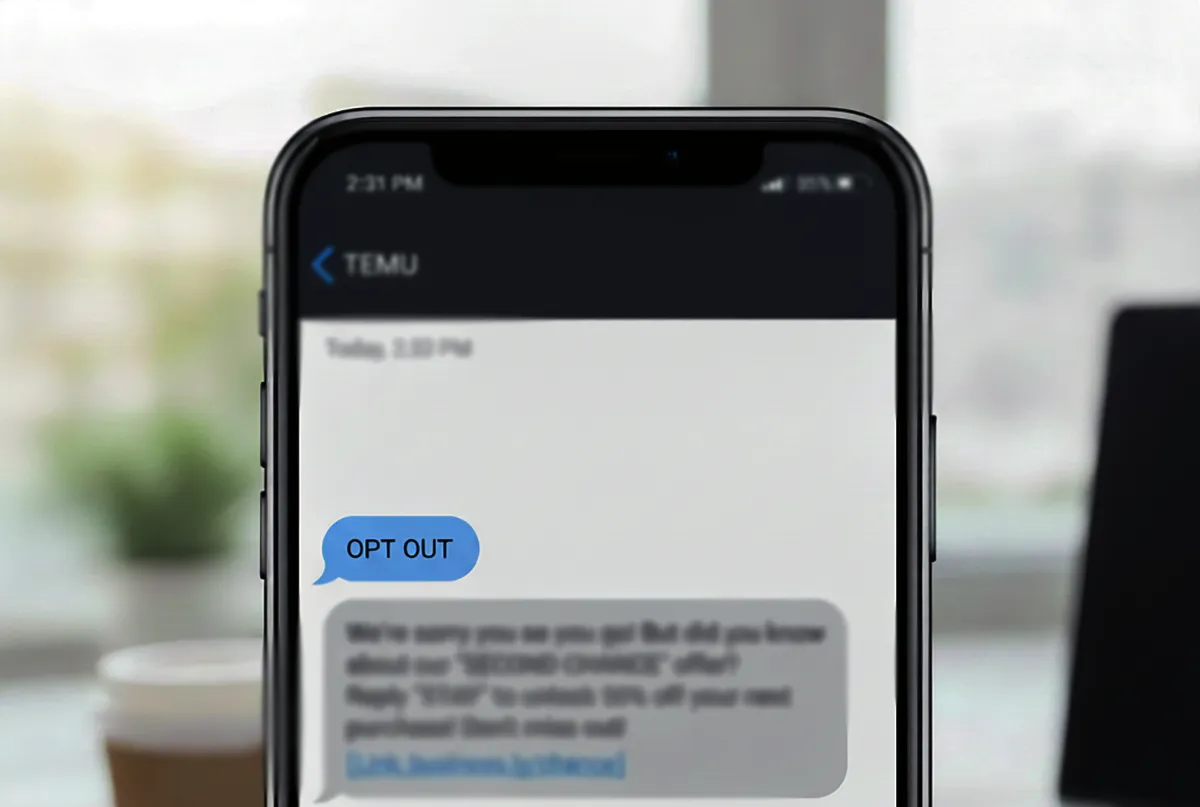
People who got marketing texts from Transform Credit, now Together Loans, after asking it to stop, while on the Do Not Call Registry, or before 8 a.m. or after 9 p.m. may be covered by a proposed class action alleging the cosigner lender broke federal and South Carolina telemarketing rules. No class has been certified and there is nothing to file yet.


Allegations Only · No Settlement Yet
This article describes a class action complaint. The statements below are unproven allegations. Transform Credit Inc. (Together Loans) has not been found liable, there is no certified class, and nothing to claim at this time. This page is informational and is not legal advice.
What Is This About?
A proposed class action filed on November 18, 2026 alleges that Transform Credit Inc., the online cosigner loan company that now does business as Together Loans, kept sending loan marketing texts to a South Carolina consumer after she replied “Cancel,” even though her number was on the National Do Not Call Registry, and sent at least one of those texts before 8 a.m. The case, Aiken v. Transform Credit Inc., No. 1:26-cv-01483, is in the U.S. District Court for the District of Delaware. It brings claims under the federal Telephone Consumer Protection Act (TCPA) and the South Carolina Telephone Privacy Protection Act, and includes a jury demand.According to the complaint, Transform Credit is a Delaware corporation, believed to be based in Chicago, that makes personal loans online that a borrower takes out with a cosigner. The texts at issue went out under the Transform Credit name. The complaint says the company rebranded as Together Loans in December 2025 and quotes it describing itself as “the cosigner loan company formerly known as Transform Credit” and as “the same company, same team, and same loan.”
As of November 22, 2026, the docket showed no response from the company. A summons was issued to Transform Credit on November 18, and no judge had yet been assigned.
Free settlement alerts
Get notified when new class actions open to claims
Join thousands of readers who get the latest class action settlements you may qualify for — delivered straight to your inbox.
What Does the Complaint Allege?
The plaintiff lives in Beaufort, South Carolina, and uses a cell phone with a South Carolina area code as her residential line. The complaint says the number has been on the National Do Not Call Registry since March 2, 2021.The complaint states that she had dealt with the company before the texts at issue. On or about September 21, 2023, she applied to Transform Credit for a cosigner loan and gave her phone number; she never received a loan. Marketing texts followed from a short code, signed by company representatives and carrying tracking links, and many of them said to reply CANCEL to unsubscribe. On September 24, 2023, after a morning text urging her to send a cosigner a link to apply for $3,250, she replied “Cancel.” The complaint says she never received a confirmation that she had been opted out.
Fifty-eight days later, according to the complaint, the texts resumed. It describes at least four more marketing messages:
- three nearly identical texts on November 21 and 22, 2023, telling her a $3,250 cosigner loan had been approved and could be paid out “with 1 MONTH FREE before Black Friday” — one of them sent at 4:41 a.m.;
- a January 2, 2024 text saying the company could lend her $7,000 if she found a cosigner with a credit score of 750 or higher or who owns a home.
The Federal Rules at Issue
The TCPA and the Federal Communications Commission’s rules at 47 C.F.R. § 64.1200 treat marketing texts as calls. The complaint relies on three parts of those rules.The National Do Not Call Registry rule, § 64.1200(c)(2), generally bars telephone solicitations to a residential number that has been on the Registry, subject to exceptions such as prior express written consent or an existing business relationship. The internal do-not-call rule, § 64.1200(d), requires a business that telemarkets to keep its own do-not-call list and honor a consumer’s request to stop. The quiet-hours rule, § 64.1200(c)(1), bars telephone solicitations before 8 a.m. or after 9 p.m., measured by the local time where the person receiving the message is located.
The complaint notes that when the texts were sent in 2023, the FCC’s rule gave businesses up to 30 days to honor a do-not-call request; a 2024 FCC order (89 Fed. Reg. 15756) has since shortened that to 10 business days. The FCC also added the words “or text messages” to § 64.1200(e) effective March 26, 2024. The complaint argues that texts were already covered before that change.
Under 47 U.S.C. § 227(c)(5), a person who receives more than one violating call or text within 12 months from or on behalf of the same entity may seek up to $500 per violation, and a court may increase that to up to $1,500 if it finds the violation willful or knowing. The complaint pleads each of the three federal claims in both negligent and willful forms.
The South Carolina Claims
The complaint also brings three claims under the South Carolina Telephone Privacy Protection Act, a state telemarketing law with its own rules and remedies:- § 37-21-70(A), which bars telephone solicitations to a person who has asked not to be contacted, and requires such requests to be honored for five years;
- § 37-21-70(B), which bars telephone solicitations to numbers on the National Do Not Call Registry;
- § 37-21-30, which bars telephone solicitations outside the hours of 8 a.m. to 9 p.m.
Who Could Be Covered?
The complaint proposes three nationwide classes, each reaching back four years before the filing and running through any class certification:- Do-Not-Call Registry Class: people who got more than one telephone solicitation, including texts, in a 12-month period at a number that had been on the Registry for at least 31 days;
- Internal Do-Not-Call Class: people who got more than one telemarketing text or call in a 12-month period after asking the company to stop, including by replying CANCEL or STOP;
- Quiet-Hours Class: people who got more than one solicitation in a 12-month period, at least one of them before 8 a.m. or after 9 p.m.
The complaint asks the court to certify the classes, declare the practices unlawful, award statutory damages and attorney’s fees, and order the company to stop texting Registry numbers, people who have opted out and people outside permitted hours, and to put do-not-call policies in place.
What Happens Next?
Once served, the company will have a chance to respond to the complaint. The plaintiff is represented by Long Law, LLC, as Delaware counsel, and Lavian, P.C., whose attorney’s pro hac vice application is listed as forthcoming. The plaintiff would later have to ask the court to certify the classes. None of the allegations has been tested in court.The case is one of several recent lawsuits over lender marketing texts. A separate suit filed earlier in November alleges Reprise Financial sent personal loan texts to a Do Not Call Registry number.
Questions
Are Transform Credit and Together Loans the same company?
According to the complaint, yes. The defendant is Transform Credit Inc., which sent the texts at issue under the Transform Credit name and rebranded as Together Loans in December 2025. The complaint quotes the company describing itself as the cosigner loan company formerly known as Transform Credit.
Does it matter that the plaintiff applied for a loan first?
The complaint acknowledges that the plaintiff applied for a cosigner loan in September 2023 and gave her number, though she never received a loan. Its claims focus on texts sent after she replied Cancel on September 24, 2023. Whether the earlier application affects any claim is a question for the court; the company has not yet responded.
Why is South Carolina law part of the case?
The plaintiff lives in Beaufort, South Carolina, and the complaint adds claims under the South Carolina Telephone Privacy Protection Act for a proposed subclass of people reached at South Carolina numbers or residences. That law separately restricts solicitations after a do-not-contact request, to Do Not Call Registry numbers, and outside 8 a.m. to 9 p.m.
Is there a Together Loans settlement or claim form?
No. The lawsuit was filed on November 18, 2026. There is no settlement, certified class or claim form, and as of November 22, 2026 the docket showed no response from the company.
Sources
• Docket and class action complaint, Aiken v. Transform Credit Inc., No. 1:26-cv-01483 (D. Del., filed November 18, 2026), via CourtListener• 47 C.F.R. § 64.1200, the FCC’s telemarketing and Do Not Call rules (Cornell Legal Information Institute)
• 47 U.S.C. § 227, the Telephone Consumer Protection Act (Cornell Legal Information Institute)
• South Carolina Code Title 37, Chapter 21, the Telephone Privacy Protection Act (South Carolina Legislature)