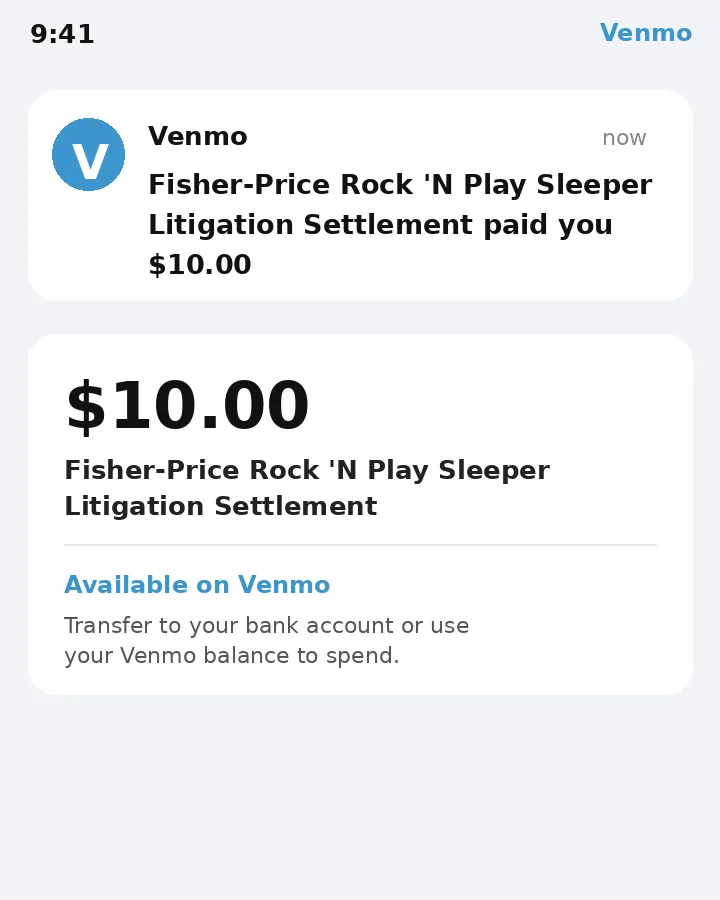
Class members who picked Venmo on a settlement claim form sometimes see nothing arrive, because Venmo holds a payment addressed to an email address it has not confirmed on an account. The fix is usually a manual email verification on Venmo's website, and there is a 30-day clock before an unclaimed payment expires back to the settlement administrator.

Why a Venmo Settlement Payout Stalls
Venmo distinguishes between a payment sent to an existing user and a payment sent to a bare email address or phone number. A settlement administrator is doing the second thing. It has no Venmo username on file — only the contact details typed into the claim form — so the money goes out addressed to that string and Venmo has to match it to an account before releasing it.That matching step is where these payouts get stuck. An account can be several years old, verified by phone number, and in daily use for splitting dinner, while the email address written on the claim form is either not on the profile at all or is sitting on it unconfirmed. Venmo's help center is explicit that an email address has to be verified for an account to keep receiving payments, and a peer-to-peer transfer from a friend who already has the username does not exercise that path. The first payment that does is often a payout from a company.
The result looks like a bug rather than a hold. Recipients describe getting a legitimate Venmo notice inviting them to accept money from a settlement or distribution, clicking the button in it, landing on a login or home screen, and finding no pending balance and no error message explaining what went wrong.
How Administrators Actually Send Money to Venmo
Most settlement administrators do not push funds into a wallet directly. They hand a batch file to a disbursement vendor, and the vendor emails each claimant a branded link to accept the payment into the method that claimant elected. Some cases name the vendor in the notice; others send from an address the claimant has never seen, which is why these emails so often end up filtered.Three consequences follow from that structure, and all three matter when a payment goes missing. The address the money is addressed to is the one typed on the claim form, not whatever address is current on the Venmo account today. The acceptance link is generated once, on a schedule the administrator controls, and can expire. And the administrator, not Venmo, is the party holding the record of what was sent, when, and to which address.
Free settlement alerts
Get notified when new class actions open to claims
Join thousands of readers who get the latest class action settlements you may qualify for — delivered straight to your inbox.
The Email Verification Fix
The step that clears most of these holds is confirming, inside Venmo, the exact email address the settlement notice was sent to. Do it in a browser rather than the app — the app's settings screen does not always surface the prompt for an address that is on the profile but unconfirmed.1) Sign in to venmo.com in Chrome, Safari or Firefox. A phone browser is fine; the point is to be on the web version rather than in the app.
2) Open the email settings for the account. Venmo's own walkthrough for phone and email verification describes the path and what a confirmed address looks like. Signed-in users can also open the email verification screen directly.
3) Enter the address exactly as it appears on the settlement notice, character for character. A claim filed from a work address or an older personal address will not match the address on the profile, and close is not good enough.
4) Open the verification email Venmo sends and click through it. Check Spam, Promotions and Updates before concluding it never arrived; Venmo's guidance is to search the inbox for its own name. Replying to the message does nothing — the link is what verifies the address.
5) Reload the Venmo account. A payment that was waiting on the address should appear in the balance or as a completed transfer rather than a pending item.
If Verification Alone Does Not Release It
Three further moves account for most of the remainder, in the order worth trying them.• Add the claim-form address as a secondary email. A Venmo profile can carry more than one address. When the claim was filed from an address that is not the account's primary one, adding and confirming it is faster than asking the administrator to change its records, because the administrator's batch has usually already gone out.
• Force a fresh verification link. Some recipients report that changing the primary address to another one and changing it straight back produces a new verification prompt where the original screen produced nothing. It is a workaround rather than a documented procedure, and it is worth attempting only after the direct route has failed.
• Get past the support chatbot. Venmo's in-app assistant is built around common peer-to-peer problems and tends not to recognize a held third-party disbursement. Asking for a human agent and describing the problem as an incoming payment addressed to an email that is not releasing gets the account looked at by someone who can see the pending item.
The 30-Day Clock
There is a deadline on this, and it is the reason not to leave a pending notice sitting for a month. Venmo's help center states that a payment sent to a phone number or email address not attached to an active account stays pending for 30 days, then expires automatically and returns to the sender's funding source. For a settlement payout, the sender is the administrator, so an expired payment lands back in the settlement fund rather than in the claimant's account.An expired payment is not necessarily a lost one. Administrators commonly reissue once on request, and many convert a failed electronic payment to a mailed check on their own. But the reissue has to be asked for, and nothing about the expiry generates a notice to the claimant that it happened.
When the Problem Is Not Venmo
Not every missing payout is a wallet problem, and verifying an email address will not fix a case that has not started paying. Before spending time inside Venmo's settings, check the official settlement website for the case: distribution usually begins only after final approval and the expiry of the appeal window, and payments then roll out in waves over several weeks rather than all at once. A claim flagged for a name or address mismatch, or one awaiting a requested document, also sits without paying and without any signal reaching the claimant.Where the case is genuinely paying and the wallet is genuinely verified, the settlement administrator named on the official case website is the party to contact. It can confirm the claim status and the approved amount, say which method and address the payment went to and on what date, reissue an expired link, and switch the method to a mailed check. The general version of that process — for PayPal and Zelle as well as Venmo — is in where is my settlement payment, and the timeline a payout has to clear before any of this applies is in how long it takes to get a settlement check.
Cases Paying Through Venmo Right Now
Venmo has become a standard election on consumer claim forms, usually offered alongside PayPal, Zelle and a mailed check. The $59.5 million Flo period tracker privacy settlement is one still taking claims, with Venmo listed next to PayPal, Apple Pay, Amazon credit and direct deposit on its form. Cases already paying that way include the WISP website privacy settlement, a flat $18 per valid claim by PayPal, Venmo or Zelle following its August 5, 2026 final approval hearing; the Alpha Baking data breach settlement; the MarinHealth pixel tracking settlement, paying roughly $111 per person by Venmo, PayPal or check; and the Macy's CVC sheets settlement, where claimants have reported Venmo and PayPal notices alongside ACH deposits and paper checks. A confirmed $10 Venmo payment from the Fisher-Price Rock 'n Play settlement landed in June 2026.The practical lesson from that list is to treat the email address on a claim form as a commitment. The address chosen at filing is the one the money is addressed to, sometimes a year or more later, and it has to still be reachable and still be confirmed on the wallet when the batch goes out.
What a Real Payout Never Asks For
A legitimate settlement payment never costs anything to collect. Filing a claim is free, and so is receiving an approved payment. Any message conditioning a settlement payout on a processing fee, a gift card, a cryptocurrency transfer, a full card number, a Social Security number sent by email, or a Venmo password or PIN is a scam regardless of how closely it copies an administrator's branding. Scam reports can be filed with the FTC at ReportFraud.ftc.gov.Identity verification by Venmo itself is a different thing and can be legitimate — a wallet provider is allowed to confirm who holds an account before releasing funds. The line to hold is that verification happens inside Venmo, after signing in independently rather than through a link in an unexpected message, and it never involves paying anything. OCA's guides to checking whether a settlement email is real and to claim-filing fees cover how the fakes are built.
Frequently Asked Questions
Why does Venmo hold a settlement payment when my account is years old?
Age of the account is not what Venmo checks. A payment addressed to an email address rather than to an existing Venmo user is held until that exact address is confirmed as belonging to a Venmo account. An account can be verified by phone number and in daily use for peer-to-peer transfers while the email address the settlement administrator was given sits unconfirmed on the profile, or is not on the profile at all.
How long does Venmo hold an unclaimed payment before it goes back?
Venmo's help center states that a payment sent to a phone number or email address that is not attached to an active account stays pending for 30 days. If it is not claimed or taken back in that window it expires automatically and the money returns to the sender's funding source, which for a settlement means it goes back to the administrator.
I clicked the accept link in the Venmo email and it just logged me in. Is that normal?
It is a common report. The link can drop a recipient on a general login or home screen without completing the transfer when the address the money was sent to is not confirmed on the account. Confirming that exact address inside Venmo's email settings and then reloading the account is what usually releases it.
I filed my claim with a different email than the one on my Venmo account. What now?
Venmo lets a profile carry more than one email address. Adding the address used on the claim form as a secondary address and confirming it is generally faster than asking the administrator to change the address on file, because the administrator's batch may already have gone out. If the address cannot be added, the administrator is the one to ask for a reissue or a switch to a check.
Will Venmo or a settlement administrator ever charge a fee to release my payout?
No. Filing a class action claim is free and collecting an approved payment is free. A message demanding a processing fee, a gift card, cryptocurrency, a full card number or a PIN before a settlement payment can be released is a scam and can be reported to the FTC at ReportFraud.ftc.gov.
Can I switch from Venmo to a paper check after filing?
Often yes, as long as the funds have not been accepted yet. The settlement administrator listed on the official case website controls the payment method on file and can usually reissue by another method, though some close the batch after a set period and default unclaimed electronic payments to a mailed check on their own.
Sources
• Venmo Help Center — Phone and Email Verification• Venmo Help Center — My personal Venmo payment is "Pending"
• Venmo Help Center — Payments & Requests FAQ
• Venmo Help Center — How do I update my email address?
• Venmo Help Center — Unexpected Emails from Venmo
• Federal Trade Commission — ReportFraud.ftc.gov
• Official settlement websites and notices for the cases named above, as summarized on their OCA case pages