A class action settlement check arrives wrapped in security screens, watermark warnings and a shrunken signature box, and none of it changes how the check is deposited. The detail that actually costs people money is the expiration date printed on the face — settlement checks commonly go void 90, 120 or 180 days after they are issued.
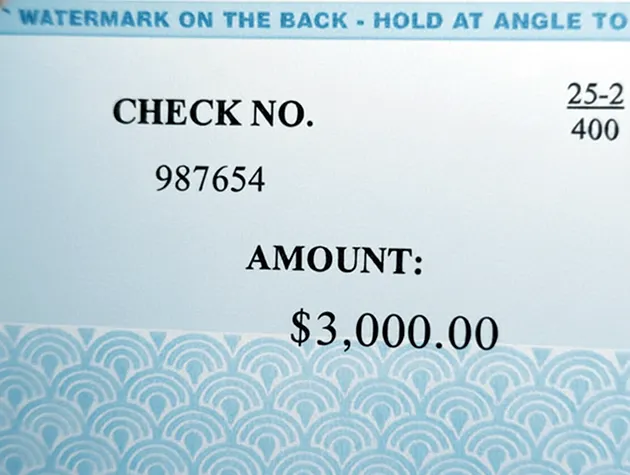

All of that printing is aimed at counterfeiters, not at the person holding the check. The settlement administrator issues payments by the thousands, those checks circulate through the mail, and high-security check stock is the standard defense. A payee has nothing to activate and nothing to prove.
A Settlement Check Is an Ordinary Check
A settlement check is drawn on a U.S. bank account funded by the settlement, and it clears through the same system as any other check. Made payable to you, it can be endorsed and deposited exactly the way a payroll check or a refund check is deposited.The security features are worth recognizing, because misreading one of them is what sends people looking for a special procedure that does not exist:
• Watermarks. A true watermark is pressed into the paper and appears when the check is tilted toward a light source. The instruction printed on the check is telling a teller how to verify the stock, not telling the payee to do something first.
• Heat-sensitive ink. Some check stock carries a thermochromic patch that fades or changes color when it is warmed by a thumb and returns as it cools. It exists because a photocopier cannot reproduce it. Rubbing it is a verification test a bank may run, not a step required before a deposit.
• Security screens and void pantographs. The tinted patterns are designed so that the word VOID surfaces on a photocopy. On the original, they mean nothing more than that the check was printed on high-security stock.
• The padlock symbol. The small padlock near the signature line is a certification mark indicating that the check meets the security-feature requirements of the ANSI X9 check standard. It is a printing certification, not a restriction on how the check is handled.
None of these affect negotiability. A check with every one of them deposits the same as a check with none of them.
Why the Endorsement Box Is So Small
The cramped signature strip on the back is a federal processing requirement rather than a design choice. Regulation CC requires banks handling a check to place their endorsements according to the American National Standard for check endorsements, ANSI X9.100-111, and that standard divides the back of the check into zones: a band roughly an inch and a half from the trailing edge for the payee, the next band for the bank of first deposit, and the remainder for later banks in the chain.Keeping each endorsement inside its own band is what lets a check be imaged and read automatically once it enters the clearing system. So the payee's box is small because it is only one of four or five claims on the same piece of paper. Sign inside it. A signature that wanders slightly outside is not usually a reason for a bank to refuse a deposit, but a signature sprawled across the bank zones can make the image harder to process.
How to Endorse the Check
There are three endorsements worth knowing, and the right one depends on how the check is being deposited.• A blank endorsement is your signature and nothing else. It is the simplest form and also the least protected: once signed this way, the check can be deposited by whoever is holding it. Sign in blank only at the moment of deposit — at the teller window, at the ATM, or in front of the phone camera.
• A restrictive endorsement adds an instruction above or below the signature, most often "For Deposit Only" with the account number. The words limit what can be done with the check; they do not replace the signature. A deposit slip and an unsigned check are not an endorsement, whatever a bank may accept as a courtesy for its own customers.
• A mobile-deposit endorsement is the restrictive form plus whatever wording the bank requires for remote deposit, commonly a line such as "For mobile deposit only" naming the bank. Banks that require it may reject an image without it, so the wording is worth checking in the app before the picture is taken.
Sign the name as it is printed on the front of the check. If the administrator misspelled it, or used a maiden name, or dropped a middle initial, UCC section 3-204(d) allows the endorsement to be made in the name on the check, in your own name, or both, and permits the bank taking the check to require both. Signing the printed version first and the correct legal name directly beneath it satisfies every version of the rule at once.
Waiting to sign until you are standing at the teller window is sound practice for a different reason than most people assume: it is not that the signature is hard to place, it is that an endorsed check is a negotiable instrument that a stranger can deposit if it is lost between the kitchen table and the branch.
Free settlement alerts
Get notified when new class actions open to claims
Join thousands of readers who get the latest class action settlements you may qualify for — delivered straight to your inbox.
A Check Payable to Someone Else
This is where an otherwise routine deposit goes wrong. A check payable only to your spouse is your spouse's check. Writing "For Deposit Only" and an account number on the back does not make it depositable by you — the payee has to endorse it, and that remains true when the destination is a joint account both of you own.Banks read multiple payees off the connector printed between the names. Names joined by "and" generally require both people to endorse; names joined by "or" generally require only one. Practice varies between institutions, and a bank's own deposit agreement can be stricter than the default rule, so the question is worth asking before anyone signs anything.
Two other situations come up often with settlement payments. A check issued to a business or a trust has to be endorsed by someone with authority to endorse for it and deposited into that entity's account, not a personal one. A check issued to someone who has died is handled through the estate, which usually means the executor or administrator endorses it in that capacity — and if the estate has already been closed, the settlement administrator is the party to contact about reissuing the payment.
Choosing How to Deposit It
Every ordinary route works. They differ in speed, in limits, and in how much help is available if something is wrong with the check.• At a branch. The most reliable option for an unfamiliar check, and the only one where a person can inspect the security features and answer questions about a hold on the spot. Preferable for large amounts.
• Mobile deposit. Convenient and normal for routine amounts, but subject to per-check and daily limits that vary by bank and by account history. A settlement check above those limits will be rejected in the app with no explanation of the underlying reason, which is the usual reason a large check ends up at a branch anyway.
• ATM deposit. Fine at your own bank's machine. Endorse it properly first — a set of initials is not an endorsement. Deposits at another institution's ATM are subject to longer availability schedules.
• A check that arrived by email. Some administrators now send a check image to print at home rather than mailing one. The printed sheet is the check and deposits the same way, but the printer settings and the receiving bank’s policy on printed items both matter — see printing and depositing an emailed settlement check.
• No bank account. Several routes exist — the bank named on the check, a retailer money center, a check-cashing app, a prepaid card, a check-cashing store — and they are covered in the next section, along with the reason a settlement check is the type most likely to be turned away.
Whatever the route, keep the paper check until the deposit has posted and the funds are available. The FDIC's guidance on remote deposit is to hold the original until the deposit clears and then destroy it, and to mark the back so the same check is never presented twice — an accidental double deposit is easy to create in a household where two people can see the same envelope.
Cashing It Without Your Own Bank Account
Every route below works for ordinary checks. Which of them works for a settlement check specifically is a separate question, and the section after this one explains why.• The bank named on the check. A bank will often cash a check drawn on its own accounts for a non-customer, an arrangement the industry calls an on-us check. No federal law requires it, policies differ, and many charge a fee or cap the amount. The practical obstacle with settlement checks is geography: the drawee is frequently a commercial bank chosen by the administrator rather than a retail brand with a branch nearby.
• Retailer money centers. Walmart cashes pre-printed payroll, government, tax-refund, cashier's, insurance-settlement and retirement-disbursement checks at its money centers and service desks, for a published fee of $4 on checks up to $1,000 and $8 above that, with a $5,000 limit most of the year and a higher seasonal cap for tax refunds. Two-party personal checks are capped far lower, around $200. Some grocery chains run comparable services, usually for customers enrolled in a loyalty program.
• Check-cashing apps. Venmo, PayPal and several prepaid-card programs offer in-app check cashing through First Century Bank and Ingo Money. Cash App runs its own version for customers who receive direct deposits. The shape is the same across all of them: photograph the front and back of an endorsed check, wait for an approval decision, then choose between free processing that takes several business days and instant funding that costs a percentage of the check — typically low single digits for payroll and government checks and several times that for everything else, subject to a per-check minimum. Venmo's version requires direct deposit or a Venmo debit card on the account and caps each check at $5,000, with daily and monthly ceilings above that.
• Prepaid cards with mobile deposit. Mechanically the same service under a different brand — most prepaid programs that advertise mobile check loading are running Ingo behind it, with the same approval logic and the same instant-funding fee, plus whatever the card charges for an ATM withdrawal afterward.
• Signing the check over to someone else. A special endorsement — "Pay to the order of" a named person, then your signature — is valid under UCC section 3-205, but validity is not acceptance. Banks are free to refuse third-party checks and many do, the receiving bank will often want both people present with identification, and a settlement agreement may separately restrict assignment of a class member's award. It is the least reliable route on this list.
• Check-cashing stores. Immediate cash, at the highest cost — commonly a percentage of the face amount, under fee caps that each state sets differently. Worth it only when the alternatives have been exhausted, and worth comparing against simply opening an account.
Why Some Places Refuse a Settlement Check
A refusal at a store counter or a decline in an app is not a verdict on the check. These services are not deciding whether the check is genuine; they are pricing the risk that it will come back unpaid, and settlement checks score badly on every input they use.• They underwrite the drawer, not the payee. Instant check cashing works because the service can recognize the account the check is drawn on. Payroll processors and the U.S. Treasury issue continuously from stable accounts with years of history. A settlement distribution account is the opposite: opened for one case, at a bank chosen by the administrator, funded for a single mailing, and closed when the distribution ends. Ingo Money's own published explanation for declines names exactly this — insufficient verification data about the check writer's account.
• The service eats the loss. When an app funds a check instantly, it is advancing its own money before the item clears, and its terms say plainly that it takes the risk of payment and may decline any check at its sole discretion. Anything unusual is cheaper to refuse than to investigate.
• Settlement checks are among the most counterfeited. The fake-check schemes the FTC warns about lean on legal-sounding payments precisely because they arrive unexpectedly and look official. A category with a high fraud rate gets suppressed wholesale rather than judged item by item.
• The item itself carries extra return risk. Void-after windows, stop payments on reissued checks, and a funding account that closes at the end of the distribution all raise the chance of a return well after the cash has gone out the door.
• Store policies work off a printed list. A retailer money center accepts named categories. A class action check that is pre-printed and payable to one person often clears that test; one that reads like a business or trust-account check, or names two payees, often does not — and the clerk applying the rule has no authority to make an exception.
None of this makes the check harder to deposit at a bank or credit union where you hold an account. A deposit puts the collection risk on the bank's ordinary process rather than on a company advancing cash, which is why the routes that charge the most are also the ones most likely to say no.
The Option That Avoids the Check Entirely
Many settlements now let class members elect a digital payment on the claim form — PayPal, Venmo, Zelle, a virtual prepaid card, or direct deposit — instead of a mailed check. Recent cases OCA has covered offered exactly that choice, among them the Film Forum ticket-fee settlement and the Alpha Baking data breach settlement, both of which paid by PayPal, Venmo or Zelle for claimants who picked one.A third delivery method now sits between the two: an emailed check the class member prints and deposits, which keeps the endorsement and the void-after window while removing the mail. Its own mechanics are covered in printing and depositing an emailed settlement check.
Electing a digital payment removes the mail, the endorsement, the void-after window and the question of who will accept the check. It introduces a smaller failure of its own — a payment sent to an email address or phone number that no longer reaches you — and that election is usually made when the claim is filed, not afterward.
When the Money Is Actually Available
Deposited is not the same as available. Federal Reserve Regulation CC sets the outer limits on how long a bank can hold a check deposit, and those limits were adjusted for inflation effective July 1, 2025.The general rule is that the first $275 of a check deposit must be available by the next business day, with most of the rest available by the second business day. A bank may hold longer under specific exceptions the rule names, including deposits that push the day's total above $6,725, accounts open less than 30 days, accounts repeatedly overdrawn, and checks the bank has reasonable cause to doubt will be paid. Deposits made at another bank's ATM run on a longer schedule, and deposits made by phone may follow a timetable the bank sets for itself.
Banks frequently release funds faster than the rule requires, and a hold is not a signal that anything is wrong with the check. It also does not mean the check has cleared: a hold expiring and a check being finally paid are separate events, which is the mechanism every fake-check scheme depends on.
The Deadline Most People Miss
Look at the face of the check for wording such as "void after 90 days." Settlement checks are routinely issued with a printed validity window, and the window is shorter than people expect. Recent OCA-tracked settlements illustrate the range: checks in the SportsEdTV video privacy settlement expire 90 days after issue, checks in the Red Robin Washington job-postings settlement at 120 days, and checks in the WISP website-tracking settlement at 180 days.Separately from whatever the check says, UCC section 4-404 relieves a bank of any obligation to pay a check presented more than six months after its date, though the bank may pay it in good faith if it chooses. So a settlement check left in a drawer has two clocks running against it, and the printed one usually expires first.
An expired check is not necessarily lost money. While the distribution is still open, administrators commonly stop payment on the stale check and reissue it on request, and many settlement agreements expressly provide for that. The request goes through the official settlement website for the case. What ends the possibility is the close of the distribution: at that point the remaining money follows whatever the settlement agreement and the court ordered, which is typically a second distribution to class members who already cashed their checks, a cy pres award to a designated nonprofit, or a reversion under the agreement's terms.
Telling a Real Settlement Check From a Fake One
Fake settlement checks exist precisely because real ones arrive unannounced. The distinguishing feature is not how the check looks — counterfeits are printed on convincing stock — but what the sender wants next.A genuine class action payment asks nothing of the recipient beyond depositing it. There is no fee to release it, no tax payment to forward, no portion to wire back, no gift card to buy, and no verification call that requires an account number or a one-time passcode. Any of those means the check is bait.
The FTC's warning about fake checks is the part worth internalizing: a counterfeit can take weeks to be discovered, and money appearing in the account is not proof the check cleared. When it is returned, the bank reverses the deposit, and the person who sent money on from those funds is generally the one left owing it. If a check arrives for a settlement you do not recognize, verify the case before depositing anything — our guide to checking whether a settlement notice is real covers the five-minute version.
If the Deposit Is Reversed After It Posts
A settlement check that the bank accepts and then reverses a few business days later was returned unpaid by the bank it was drawn on, most often with the reason "Refer to Maker." That code means the paying bank declined the check and is sending the payee back to the issuer, which for a settlement check is the administrator. The usual causes are a positive pay mismatch on the administrator's issue file, a stop payment on a check that was already replaced, or a check presented after its void date; none of them cancels the claim, but the original cannot be deposited again. The steps — what to save, who to contact, the bank fee to contest, and how to get a replacement — are in settlement check returned: what Refer to Maker means and what to do.If the Check Never Arrives
Most missing settlement payments are not lost checks. Payment usually begins only after final approval and after any appeal is resolved, which routinely puts months between a claim and a check, and administrators frequently pause a distribution for fraud review before mailing. Address changes are the other common cause: the administrator mails to the address on the claim form, and a forwarding order that has lapsed is enough to strand a payment.Two companion guides cover that ground in detail — how long it takes to get a settlement check walks through the stages of a distribution, and where is my settlement payment covers digital payments that never land, reissue rules, and when to contact the administrator. Tax treatment of settlement money is a separate subject this page does not address; OCA's explainer on whether class action settlements are taxable describes the general framework, and an individual answer belongs with a tax professional.
What Not to Do
• Do not shred or discard the paper check before the deposit has posted and the funds are available.• Do not deposit the same check twice — once through the app and again at the branch. The duplicate is reversed, sometimes with a fee.
• Do not alter anything on the face of the check, including a misspelled name. Endorse around the problem instead.
• Do not sign the back until you are ready to deposit it.
• Do not send money to anyone in connection with a settlement check, for any stated reason.
• Do not let the printed expiration date pass while deciding what to do with it.
Frequently Asked Questions
Do I have to do anything special to cash a class action settlement check?
No. A settlement check drawn on a U.S. bank and made payable to you is an ordinary check. Endorse the back and deposit or cash it the way you would a payroll check. The security screens, watermark notices and fine print on the back are printing features meant to deter counterfeiting; there is nothing a payee has to activate, rub or reveal before a bank will take it.
Where do I sign a settlement check when the endorsement box is covered in security printing?
Sign inside the narrow band at the top of the back of the check, the area marked for the payee endorsement. Federal check-processing standards reserve the rest of the back for the banks that handle the check, which is why the payee's space is a thin strip. Writing outside it can make the endorsement harder to image, but a signature that strays slightly is not normally a reason for a bank to reject the deposit.
My name is misspelled on the settlement check. Can I still deposit it?
Usually yes. Under UCC section 3-204(d), a payee named under a name that is not their own may endorse in the name on the instrument, in their own name, or both — and the bank taking the check may require both signatures. The practical approach is to sign the misspelled version exactly as printed, then sign your correct legal name directly beneath it.
Can I deposit a settlement check made out to my spouse?
Not on your own signature. A check payable only to your spouse has to be endorsed by your spouse, even if the money is going into a joint account, and writing "For Deposit Only" does not substitute for that endorsement. Where a check is payable to two people joined by "and," banks commonly require both payees to endorse; where the names are joined by "or," one endorsement is generally enough. Individual bank deposit agreements vary, so confirm with the bank before signing anything.
How long can the bank hold a settlement check deposit?
Regulation CC sets the outer limits. The first $275 of a check deposit generally has to be available by the next business day, with most of the remainder available by the second business day. Banks may hold longer under stated exceptions, including deposits above $6,725 in one day, accounts open less than 30 days, repeated overdrafts, and reasonable doubt about collectibility. Mobile and non-branch ATM deposits can run on a different schedule, and a bank is always free to release funds sooner than the rule requires.
What happens if a settlement check expires before I cash it?
Many settlement checks are printed void after 90, 120 or 180 days, and banks are free to refuse a check presented more than six months after its date under UCC section 4-404. If the printed window has passed, contact the settlement administrator through the official settlement website and ask whether a reissue is possible. Reissues are common while the fund is still open, but once the distribution is closed the money typically goes to a second distribution, a cy pres recipient, or wherever the settlement agreement directs.
Is it safe to deposit a settlement check with my phone?
Mobile deposit is a normal way to deposit a settlement check, subject to the bank's own deposit limits, which is why larger checks are often easier to handle at a branch. Follow the bank's endorsement wording for mobile deposits, which usually means adding a line such as "For mobile deposit only" beneath your signature. The FDIC advises keeping the paper check until the deposit has posted and cleared, then destroying it, so the same check is never deposited twice.
A check arrived and the sender wants part of it back. Is that a real settlement?
No. A genuine class action settlement payment requires nothing of the recipient except depositing it — no fee, no wire transfer, no gift cards, no returning a portion. The FTC warns that a fake check can take weeks to be discovered, and that funds showing in an account do not mean the check has cleared; when it bounces, the person who deposited it is generally responsible for the money they sent on.
Can I cash a settlement check in Venmo?
Sometimes. Venmo offers in-app check cashing through First Century Bank and Ingo Money for accounts that have direct deposit or a Venmo debit card enabled, with a per-check cap of $5,000 and daily and monthly limits above that. Approval is decided check by check, and a settlement check is more likely to be declined than a payroll check because the service cannot verify the account it is drawn on. Standard processing takes several business days at no cost; instant funding costs a percentage of the check, with a higher rate for checks that are not payroll or government issued.
Why did Walmart or a check-cashing app refuse my settlement check?
Because of how the check was issued, not because anything is wrong with it. Retailer money centers accept a printed list of check categories, and a settlement check drawn on a one-off distribution or trust account often falls outside it. Check-cashing apps advance their own money before the check clears, decline at their sole discretion, and cite insufficient verification data about the account a check is drawn on — which is the normal condition of a settlement distribution account opened for a single case. Depositing the check at a bank or credit union where you hold an account avoids the issue entirely.
Can I sign my settlement check over to someone else?
A special endorsement — writing "Pay to the order of" and the person's name, then signing beneath it — is valid under UCC section 3-205, but no bank is required to accept a third-party check and many refuse them outright. Banks that do accept one commonly want both people present with identification. Some settlement agreements also restrict assignment of a class member's award, so this is the least dependable route.
My settlement check deposit was reversed as Refer to Maker. What happened?
The bank the check was drawn on declined to pay it, and your bank took back the provisional credit. Refer to Maker does not state the cause; for settlement checks it is usually a positive pay exception, a stop payment on a check that was reissued, or a check presented after its void date. Do not redeposit the original. Contact the settlement administrator through the official settlement website with the check number, amount and return reason and ask for a replacement, and ask your bank to waive any returned deposited item fee.
Can I cash a settlement check without a bank account?
Sometimes. The bank whose name is printed on the check may cash it for a non-customer, though no federal law requires any bank to cash a check for someone who does not hold an account there, and many charge a fee or impose a dollar limit for doing so. Check-cashing businesses are the other route and charge their own fees, which are regulated at the state level. Some settlements also offer electronic payment options that avoid the paper check entirely.
Sources
• Consumer Financial Protection Bureau — Regulation CC threshold adjustments, effective July 1, 2025• Consumer Financial Protection Bureau — How long can a bank hold funds I deposited?
• 12 CFR 229.35 — Regulation CC indorsement standards
• Accredited Standards Committee X9 — ANSI X9.100-111, Check Endorsements
• Uniform Commercial Code — Section 3-204, Indorsement
• Uniform Commercial Code — Section 4-404, Bank not obligated to pay check more than six months old
• Uniform Commercial Code — Section 3-205, Special indorsement; blank indorsement
• Venmo — Cash a Check FAQ
• Ingo Money — Mobile check cashing FAQ and terms
• Walmart — Check cashing services, fees and limits
• Federal Trade Commission — How to Spot, Avoid and Report Fake Check Scams
• Federal Deposit Insurance Corporation — FDIC Consumer News on depositing checks by phone
• American Bar Association — Undistributed settlement funds and cy pres