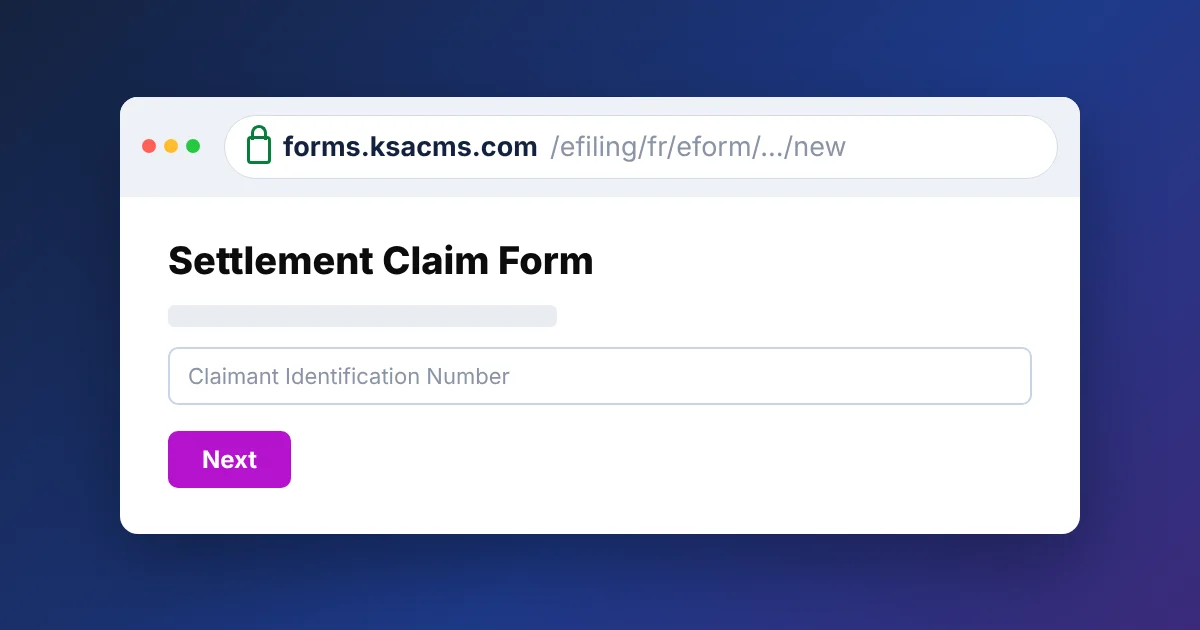
forms.ksacms.com is the online forms system of Kroll Settlement Administration, one of the largest court-appointed class action administrators, so the Submit Claim button on a Kroll-run settlement website often opens a page there rather than on the case’s own domain. The mismatch looks like a red flag, but it is how Kroll separates a case’s public website from its claim filing.

The Short Answer
forms.ksacms.com hosts the online claim forms, contact forms and lookup tools for class action settlements administered by Kroll Settlement Administration LLC. Every page on it carries a Kroll copyright notice, says the site was designed and developed by Kroll, and links to Kroll’s privacy policy on kroll.com. The “ksa” in the address matches the initials of Kroll Settlement Administration.Readers usually meet the domain the same way. They open a court-approved settlement website, such as the American Express robocall settlement’s site, click Submit Claim, and land on a page whose address mentions neither the case nor American Express. Kroll is a court-appointed administrator on a long list of cases. Of the settlement pages OpenClassActions.com has published, 97 name Kroll Settlement Administration as the administrator.
Why the Claim Form Is on a Different Website
A class action settlement usually has two separate online pieces. The first is the settlement website: an informational site on a case-specific domain that posts the notice, the key dates, the FAQ and the court documents. The second is the claim filing system, where a class member logs in, enters information and picks a payment method.The settlement agreement in the American Express case shows the split. It requires the administrator to set up a settlement website “using a domain name selected by and agreed to jointly by the Parties” and to allow online claim submission. The domain is chosen for the case. The filing system belongs to the administrator, which runs many settlements on it at once.
The address itself reflects that structure. Each case gets its own path on the shared domain. The Amex claim form sits at a path ending in
duke_v_americanexpresscompanies_claimform, while the claim form and VIN lookup for the Kia window regulator settlement sit at paths starting with kiawindowregulatorsettlement. The contact links carry a numeric case code; for the Amex case it is 83487, the same number printed in the barcode on that settlement’s paper claim form.
Not Every Kroll Case Uses It
Kroll has more than one forms address. Many Kroll cases send claimants tosecureforms.krollsettlementadministration.com or forms.krollsettlementadministration.com instead, and those claim pages carry the same Kroll branding. A Kroll case on either domain is normal.
Other administrators follow the same pattern with their own infrastructure. Angeion Group, which runs the $309.5 million Amazon returns settlement, serves that case’s notices and court filings from an Amazon S3 storage address rather than from the settlement website’s own domain. A file or form living off the case domain is common across the industry and says nothing on its own about whether a page is real.
What the Form Asks For
The forms vary by case, but the ones OpenClassActions.com has reviewed follow a similar sequence. They open with a login for an identifier from the class notice. The Amex form calls it a Claimant Identification Number; other cases use a Class Member ID or Notice ID. Then come contact details, the case-specific eligibility questions (the phone numbers that were called, a vehicle identification number, a purchase), a choice between a mailed check and electronic payment, and an affirmation that the information is true.That opening login is why OpenClassActions.com marks most Kroll-run claims as Proof Required. A form that will not open without an administrator-issued number requires something from the notice, even when no receipts are needed. Several Kroll cases let people without a notice request their number through the Contact Us form on the settlement website.
How Real Kroll Forms Are Reached
The domain is legitimate, but that does not make every link pointing at it trustworthy. A message can show one address and link to another, and scammers register addresses that differ from a real one by a letter. OpenClassActions.com has covered how a single typo in a settlement link leads to a lookalike site.The court-approved path runs the other way. The class notice names the official settlement website; that website’s Submit Claim button opens the Kroll form; and the form’s footer names Kroll Settlement Administration LLC. A claim form reached from the official settlement website is the one the court approved. None of the Kroll claim forms OpenClassActions.com has reviewed charges a filing fee or asks for an online banking password.
When a notice itself is the open question, OpenClassActions.com’s guide to checking whether a settlement email is real covers that step, and a form that will not go through is covered in the claim form troubleshooting guide.
Who Kroll Settlement Administration Is
Kroll Settlement Administration is the class action and claims administration business of Kroll, the risk and financial advisory firm. Courts appoint it, as they appoint other settlement administrators, to send notice, take claims and opt-outs, answer class members’ questions and distribute payments under the court’s supervision. Kroll says its settlement practice has processed more than 100 million claims and distributed more than $30 billion.The administrator does not decide who wins a case or what a settlement pays. Those terms come from the settlement agreement and the court’s orders. Kroll’s job is to carry them out, including deciding whether individual claims are valid under the agreement’s rules.
Free settlement alerts
Get notified when new class actions open to claims
Join thousands of readers who get the latest class action settlements you may qualify for — delivered straight to your inbox.
Frequently Asked Questions
Who runs forms.ksacms.com?
The claim and contact forms on forms.ksacms.com carry the copyright of Kroll Settlement Administration LLC, say they were designed and developed by Kroll, and link to Kroll’s privacy policy on kroll.com. Court-approved settlement websites that Kroll administers link to them from their Submit Claim and Contact Us buttons.
Why doesn’t the claim form address match the settlement website?
The settlement website and the claim form are two different things. The parties choose a case-specific domain for the informational website, while the administrator runs claim filing on its own forms system, which serves many cases at once. Each case gets its own form path on the shared domain.
Is a link to forms.ksacms.com in a text message safe?
The domain itself is Kroll’s, but a message can display one address and link to another, and lookalike domains exist. The dependable route is the one the court approved: the settlement website named in the notice, whose Submit Claim button leads to the form. A link that arrives any other way is the kind fake-settlement schemes use.
Do other settlement administrators use separate claim-form domains?
Yes. Kroll itself also uses forms and secureforms subdomains of krollsettlementadministration.com, and other administrators host documents and forms outside the case website too; Angeion Group, for example, serves case documents from an Amazon S3 storage address. The pattern is common across the industry.
What does a Kroll claim form on forms.ksacms.com ask for?
It varies by case, but the forms OCA has reviewed open with a login for an identifier printed on the class notice, such as a Claimant Identification Number, then ask for contact details, case-specific eligibility information, a payment choice and a signed affirmation that the information is true.
Sources
• American Express TCPA Settlement website and its online claim form, Duke v. American Express Company, No. 4:23-cv-00125-RM-LCK (D. Ariz.)• Settlement Agreement and Release, Duke v. American Express Company (Doc. 155-1, filed June 24, 2026), Section III.E.3
• Kia window regulator settlement claim form, Le Beau v. Kia America, Inc.
• Kroll — Settlement Administration
• Kroll — Settlement Administration Cases