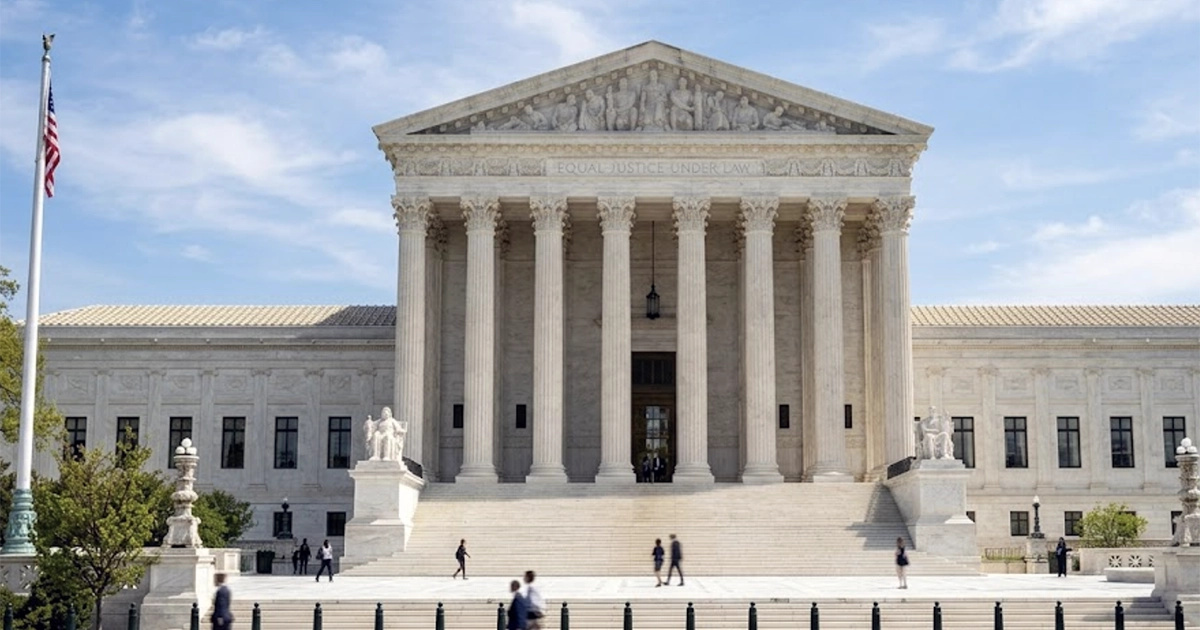
The Supreme Court turned down Donald Trump's request to reconsider its refusal to hear his appeal of E. Jean Carroll's $5 million verdict, ending his challenge to the 2023 jury finding. The money itself left the court's registry a month ago — but a separate appeal over how it got paid out is still alive.

What Happened
On August 17, 2026, the Supreme Court denied Trump's petition for rehearing in Trump v. Carroll, No. 25-573. The order was a single sentence on a routine order list, issued without comment and with no noted dissents. That is standard for both certiorari denials and rehearing denials, and rehearing petitions are rarely granted in any event. It follows the Court's June 29, 2026 denial of certiorari in the same case, which the Clerk of the Supreme Court reported to the Second Circuit that afternoon.The practical effect is that the judgment entered against Trump on May 11, 2023 is now beyond further review. A jury in Manhattan federal court found him liable in May 2023 for sexually abusing E. Jean Carroll in a department store dressing room in the mid-1990s and for defaming her when he denied her account in an October 2022 statement. The Second Circuit affirmed that judgment in December 2024, declined to rehear the case en banc in June 2025, and issued its mandate in July 2025.
What the Jury Actually Decided
Precision matters here, because the verdict is narrower than it is often described. The jury was asked separately about rape as New York law then defined it, which required a specific act of forcible penetration, and about the lesser offense of sexual abuse. It answered no on the first question and yes on the second. In his July 19, 2023 opinion denying Trump a new trial, Judge Lewis A. Kaplan addressed that distinction at length, explaining that the finding fit the ordinary everyday meaning of the word even though it did not meet the narrower statutory definition the verdict form used.The jury also found that Trump defamed Carroll in an October 2022 statement denying her account. The judgment breaks the $5 million into five pieces: $2,000,000 for injuries and $20,000 in punitive damages on the battery claim, and $1,000,000 in damages other than the reputation repair program, $1,700,000 for the reputation repair program and $280,000 in punitive damages on the defamation claim.
This was a civil case, not a criminal one. The jury decided it under the preponderance of the evidence standard, and the only consequence is a money judgment. Trump has denied Carroll's account throughout, and denies it still. What the Supreme Court's order does is close off any further avenue to disturb the jury's answer, not to endorse or re-examine it — a denial of certiorari, and a denial of rehearing on that denial, are not rulings on the merits.
Free settlement alerts
Get notified when new class actions open to claims
Join thousands of readers who get the latest class action settlements you may qualify for — delivered straight to your inbox.
How It Got to the Supreme Court
Carroll filed the case in the Southern District of New York on November 24, 2022, as a companion to an earlier suit already pending before Judge Kaplan. Trial began April 25, 2023 before a nine-member anonymous jury, and the verdict came in on May 9. Trump filed his notice of appeal on the same day judgment was entered.The appeal, No. 23-793 in the Second Circuit, was argued on September 6, 2024. A three-judge panel affirmed in a per curiam opinion on December 30, 2024. Trump petitioned for rehearing en banc; the full court denied it on June 13, 2025, over two dissents and with several judges writing separately, and the mandate issued on July 10, 2025.
Trump then obtained an extension to file at the Supreme Court and docketed his certiorari petition on November 13, 2025 as No. 25-573. It sat for more than seven months before the Court denied it on June 29, 2026. He filed the rehearing petition on July 8, 2026 — the same day the district court ordered the money released and the same day he opened a new appeal over that order. According to reporting on the filing, the rehearing petition argued that Carroll's lawyers had relied at trial on statements he made while president. The Court denied it without comment.
The Money Left the Court's Registry in July
An appeal does not automatically stop a winning party from collecting. To pause collection, a losing defendant normally posts a supersedeas bond. Here the parties stipulated to a cash alternative: on June 23, 2023, Judge Kaplan signed an order allowing a deposit into the court's registry under Federal Rule of Civil Procedure 67(a) in place of a bond, and $5,550,000 was deposited on June 28, 2023. It sat in the Court Registry Investment System, earning interest, for three years.The day after certiorari was denied, Carroll moved to have it released. Trump opposed, attaching the rehearing petition he was about to file. On July 8, 2026, Judge Kaplan granted the motion and directed the clerk to disburse the $5,000,000 principal plus post-judgment interest computed under 28 U.S.C. § 1961, as accrued to that date, to the trust account of Carroll's law firm on her behalf.
The order names no total, but the filings do: $5,625,005.48 was disbursed to Carroll and her attorneys on Monday, July 13, 2026. A letter filed with the Second Circuit the next day confirmed that the registry had released the money to her counsel — five weeks before the rehearing petition was resolved, and while Trump's appeal of that disbursement order was already pending.
What Is Still Live: the Fight Over the Payout
Trump appealed the disbursement order the day it issued, opening Second Circuit case No. 26-1840. This appeal does not attack the verdict. It attacks the decision to release the money while the rehearing petition was still pending.That appeal moved fast and then stopped. An emergency motion for an immediate administrative stay was filed on the afternoon of July 8, opposed by Carroll that evening, and denied by Circuit Judge Eunice C. Lee the same night. A broader motion to stay the district court proceedings followed on July 10. By the time briefing on that motion finished in late July, the money was already gone.
On July 30, 2026, Judge Lee entered an order that anticipated exactly the news that arrived today. Carroll had suggested holding the stay motion in abeyance until the Supreme Court ruled on the rehearing petition, noting that a decision could come as early as August 17, 2026. Trump opposed waiting. The court split the difference and stayed its own decision on the motion until August 18, 2026, at which point it would decide whether an expedited ruling was warranted. That date is tomorrow, and the contingency the order was waiting on has now resolved.
Separately, on August 6, 2026, the Second Circuit set October 21, 2026 as the deadline for Trump's opening brief in that appeal, on a schedule his own counsel proposed and Carroll did not oppose. The order carries an unusual bite: the appeal is dismissed effective October 21 if the brief is not filed by then, and a motion to extend the time will not toll the date.
The Other Carroll Case Is Not Over
Everything above concerns one of two lawsuits. The earlier case, docketed in the same court as 1:20-cv-07311, produced a separate jury award of $83.3 million in January 2024 on a defamation claim over statements Trump made in 2019. The Second Circuit upheld that award in September 2025 and declined to rehear it en banc in April 2026.That case is now at the Supreme Court twice over. On July 28, 2026, Trump's private lawyers filed a petition raising presidential immunity, and the Justice Department filed a separate petition arguing that under the Westfall Act the United States, rather than Trump personally, should be the defendant. The department's position traces to April 2025, when Attorney General Pam Bondi recertified that Trump had been acting within the scope of his federal employment and moved to substitute the United States as defendant. The Second Circuit rejected that recertification, and the department argues it had no authority to do so.
The second petition is the one worth watching, because it is not an argument about the size of the award. Substituting the United States as defendant would effectively end the case: the Federal Tort Claims Act does not permit defamation claims against the federal government. Both petitions are pending. Today's order resolved only the $5 million case, and says nothing about how the justices will treat the larger one.
What Happens Next
Three things are worth watching. The Second Circuit will decide on or after August 18, 2026 whether to rule quickly on the stay motion in No. 26-1840, a motion whose stated premise — a pending rehearing petition — no longer exists. Trump's opening brief in that appeal is due October 21, 2026, with dismissal as the automatic consequence of missing it. And the two petitions in the $83.3 million case remain undecided.We will update this page if the Second Circuit rules or the separate petition is acted on.
Why We Are Covering This
OCA covers class actions and settlements, and this is neither: it is an individual lawsuit by one plaintiff, with no class, no fund and nothing for a reader to file. We are covering it because the procedural machinery on display is the same machinery that governs the class actions we track every day — a bond substitute holding a judgment in escrow through years of appeal, the difference between a certiorari denial and a merits ruling, and a mandate that only issues once rehearing is resolved. Anyone who has watched a settlement sit unpaid while an objector appeals has seen a version of this.If you want to read the underlying filings yourself, all of them are on the public dockets, and our explainer on how PACER and court records work covers how to pull them. For the broader picture of what the justices did this term, see our 2026 Supreme Court roundup for consumer cases.
Sources
- Supreme Court of the United States, docket No. 25-573, Donald J. Trump, President of the United States v. E. Jean Carroll — certiorari denied June 29, 2026 and reported to the Second Circuit by the Clerk that day; rehearing denied August 17, 2026.
- U.S. Court of Appeals for the Second Circuit, No. 23-793 — per curiam opinion affirming the judgment, December 30, 2024; order denying rehearing en banc with separate opinions, June 13, 2025; mandate issued July 10, 2025.
- U.S. Court of Appeals for the Second Circuit, No. 26-1840 — notice of appeal and denial of the emergency administrative stay, July 8, 2026; order staying decision on the stay motion until August 18, 2026, entered July 30, 2026; scheduling order setting the opening brief for October 21, 2026, entered August 6, 2026. Docket via CourtListener.
- U.S. District Court for the Southern District of New York, Carroll v. Trump, No. 1:22-cv-10016 (LAK) — judgment entered May 11, 2023; stipulation and order permitting a $5,550,000 registry deposit in lieu of a supersedeas bond, June 23, 2023; opinion denying the Rule 59 motion, July 19, 2023; order directing disbursement of the deposited funds, July 8, 2026.
- Same-day reporting on the August 17, 2026 order, including CNN, CNBC and Axios.
- The exact disbursement figure is from the court filings as reported by Forbes on July 14, 2026.
- On the separate $83.3 million case and the two July 28, 2026 petitions, including the Justice Department's Westfall Act substitution argument: CNBC.
Questions
Is this a criminal conviction?
No. Carroll v. Trump is a civil lawsuit for money damages, decided by a jury under the preponderance of the evidence standard rather than the beyond a reasonable doubt standard used in criminal cases. No criminal charge was brought, and the judgment carries no criminal penalty. The only consequence is the money judgment entered on May 11, 2023, which totaled $5 million. Trump has denied Carroll's account throughout the case.
Did the jury find that Trump raped E. Jean Carroll?
No, and the distinction is narrow. The verdict form asked the jury separately about rape as it was then defined by New York law, which required a specific act of forcible penetration, and about the lesser offense of sexual abuse. The jury answered no on rape and yes on sexual abuse, and also found that Trump defamed Carroll when he denied her account in an October 2022 statement. In his July 19, 2023 opinion denying a new trial, Judge Lewis A. Kaplan addressed the point directly, explaining that the jury's finding fit the ordinary everyday meaning of the word even though it did not meet the narrower statutory definition the verdict form used.
If the money was already paid in July, what is Trump still appealing?
The pending Second Circuit appeal, No. 26-1840, does not challenge the verdict. It challenges Judge Kaplan's July 8, 2026 order directing the court clerk to release the deposited funds to Carroll while a rehearing petition was still pending at the Supreme Court. A single circuit judge denied an emergency administrative stay the same night the appeal was opened, and the funds were distributed days later. The court set October 21, 2026 as the deadline for Trump's opening brief and said the appeal is dismissed effective that date if the brief is not filed.
Why was $5.55 million sitting in a court account for three years?
Filing an appeal does not by itself stop the winning party from collecting a money judgment. To pause collection, the losing party normally posts a supersedeas bond. Here the parties stipulated to an alternative in June 2023: instead of a bond, $5,550,000 in cash was deposited into the court's registry under Federal Rule of Civil Procedure 67(a), where it sat in the Court Registry Investment System earning interest while the appeals ran. That is why the money was available to release immediately once certiorari was denied.
Does this ruling affect the separate $83.3 million defamation case?
No. That is a different lawsuit, filed earlier and docketed in the same court as case 1:20-cv-07311, and it produced a separate jury award of $83.3 million in January 2024. The Second Circuit upheld that award in September 2025 and declined to rehear it en banc in April 2026. Two petitions were then filed at the Supreme Court on July 28, 2026: one by Trump's private counsel raising presidential immunity, and a separate one by the Justice Department arguing that the United States, not Trump personally, should be the defendant. Both are pending, and neither was resolved by the August 17 order, which addressed only the $5 million case.