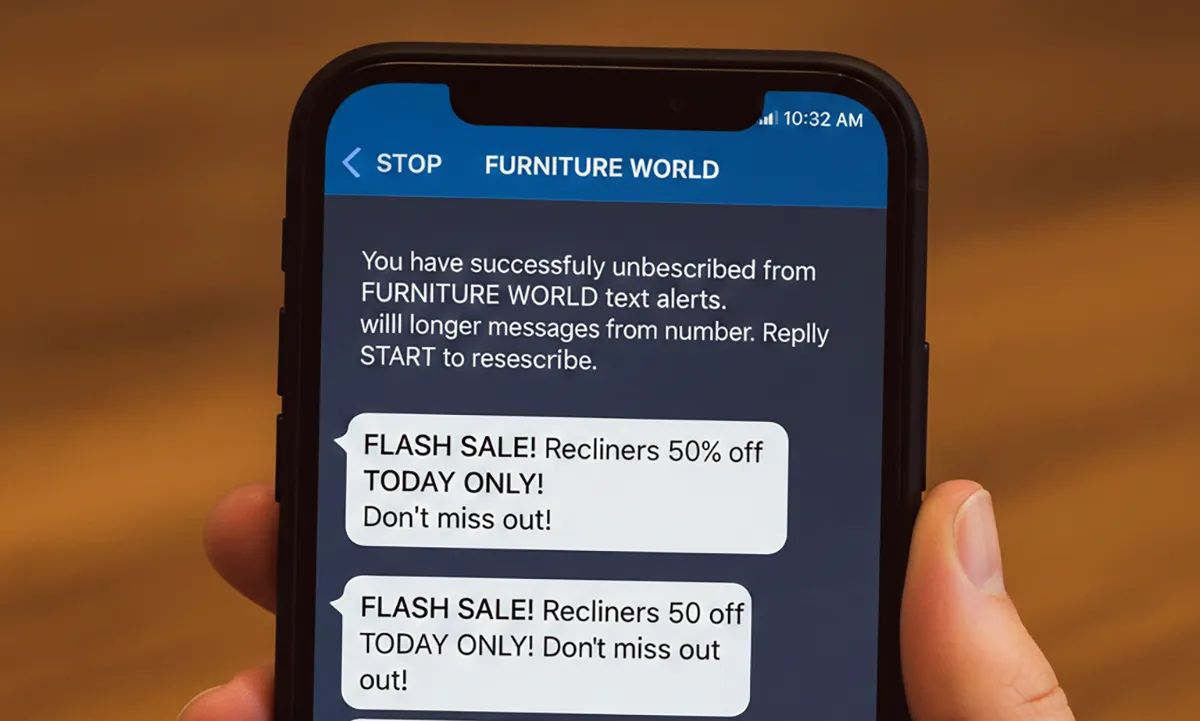
People on the National Do Not Call Registry who got repeated marketing texts from Lemonaid Health may be covered by a proposed class action alleging the telehealth platform texted Registry numbers without consent and without registering as a telephone seller in Texas. No class has been certified and there is nothing to file yet.


Allegations Only · No Settlement Yet
This article describes a class action complaint. The statements below are unproven allegations. Lemonaid Health has not been found liable, there is no certified class, and nothing to claim at this time. This page is informational and is not legal advice.
What Is This About?
A proposed class action filed on November 17, 2026 alleges that Lemonaid Health, Inc., an online telehealth platform, sent repeated marketing texts to a Texas consumer whose cell phone number was on the National Do Not Call Registry, without the plaintiff’s consent. The case, Harper v. Lemonaid Health, Inc., No. 1:26-cv-00519, is in the U.S. District Court for the Eastern District of Texas, Beaumont Division. It brings one claim under the federal Telephone Consumer Protection Act (TCPA) and two under the Texas Business and Commerce Code, and includes a jury demand.Lemonaid Health is based in San Francisco. The complaint describes it as a platform that offers virtual doctor visits and prescription medications across areas including weight loss, mental health, men’s and women’s health and primary care. As of November 22, 2026, the docket showed no response from Lemonaid; a summons was issued and the case was assigned on November 18.
Free settlement alerts
Get notified when new class actions open to claims
Join thousands of readers who get the latest class action settlements you may qualify for — delivered straight to your inbox.
What Does the Complaint Allege?
The plaintiff lives in Orange County, Texas, and is the sole user of a personal cell phone used as a residential line. The complaint says the number has been on the National Do Not Call Registry since April 19, 2023, that the plaintiff never had a business relationship with Lemonaid, and that the plaintiff never gave it express written consent to send marketing messages.Beginning by at least May 2026, according to the complaint, Lemonaid sent the plaintiff marketing texts from a short code promoting its telehealth services and prescription medications. The complaint lists 17 dates between May 20 and September 1, 2026, with texts arriving several times a month through the summer, and includes screenshots of the messages.
The complaint also alleges that Lemonaid never registered as a telephone solicitation seller in Texas. It says the plaintiff’s lawyers searched the Texas Secretary of State’s telephone solicitation registry on November 11, 2026 and found no registration for the company, and that no exemption applies.
The Laws Behind the Claims
The federal claim relies on the FCC’s Do Not Call Registry rule, 47 C.F.R. § 64.1200(c), which generally bars telephone solicitations to residential numbers listed on the Registry. The TCPA treats marketing texts as calls. Under 47 U.S.C. § 227(c)(5), a person who receives more than one violating call or text within 12 months from or on behalf of the same entity may seek up to $500 per violation, and a court may treble that amount if it finds the violation willful or knowing.The first Texas claim is under Texas Business and Commerce Code § 305.053, which lets a person who receives a communication that violates the TCPA bring a claim under state law as well. The complaint seeks $500 per text or actual damages under that section.
The second Texas claim is under § 302.101 of the same code, which requires a seller to hold a registration certificate before making telephone solicitations from or into Texas. The complaint alleges Lemonaid sold its products by telephone solicitation without one and seeks up to $5,000 per violation under § 302.302, plus costs and attorney’s fees.
Who Could Be Covered?
The complaint proposes three classes, each reaching back four years before the filing:- Do Not Call Registry Class: people in the United States who got more than one text in a 12-month period promoting Lemonaid’s products, at a number that had been on the Registry for at least 30 days;
- Texas Do Not Call Registry Class: the same group, limited to people in Texas;
- Texas Telephone Solicitation Registration Class: people who received a telephone solicitation, as Texas law defines it, made from or into Texas to sell Lemonaid’s products while the company lacked a § 302.101 registration certificate.
A Separate, Earlier Lemonaid Case
This lawsuit is unrelated to an earlier case over Lemonaid’s website. That case ended in a $3.25 million Lemonaid Health pixel tracking settlement over tracking pixels and health-related browsing data, and its claim deadline passed on February 23, 2026. The new suit concerns marketing texts only.What Happens Next?
Lemonaid will have a chance to respond to the complaint once it is served. The plaintiff is represented by Shamis & Gentile, P.A., the same firm behind a recent Do Not Call text lawsuit against Reprise Financial filed in the Northern District of Texas. The plaintiff would later have to ask the court to certify the classes. None of the allegations has been tested in court.Questions
Who would be covered by the Lemonaid Health lawsuit?
The complaint proposes a nationwide class of people who, from four years before the November 17, 2026 filing, got more than one text in 12 months promoting Lemonaid Health's products while their number had been on the National Do Not Call Registry for at least 30 days. It also proposes a Texas version of that class and a Texas class of people who received telephone solicitations while Lemonaid lacked a Texas registration certificate. No class has been certified.
What does Texas telephone seller registration have to do with the case?
Texas Business and Commerce Code § 302.101 requires a seller to hold a registration certificate before making telephone solicitations from or into Texas, unless an exemption applies. The complaint says a search of the Texas Secretary of State's registry on November 11, 2026 found no registration for Lemonaid, and alleges no exemption applies. Lemonaid has not responded to that allegation in court.
Is this related to the Lemonaid Health pixel tracking settlement?
No. The earlier Lemonaid Health case was a separate $3.25 million settlement over website tracking pixels and health-related browsing data, and its claim deadline passed on February 23, 2026. The new lawsuit is about marketing texts and has no settlement.
Is there a Lemonaid Health text message settlement or claim form?
No. The lawsuit was filed on November 17, 2026. There is no settlement, certified class or claim form, and as of November 22, 2026 the docket showed no response from Lemonaid Health.
Sources
• Docket and class action complaint, Harper v. Lemonaid Health, Inc., No. 1:26-cv-00519 (E.D. Tex., filed November 17, 2026), via CourtListener• 47 C.F.R. § 64.1200, the FCC’s telemarketing and Do Not Call rules (Cornell Legal Information Institute)
• 47 U.S.C. § 227, the Telephone Consumer Protection Act (Cornell Legal Information Institute)
• Texas Business and Commerce Code Chapter 305 (Texas Legislature)
• Texas Business and Commerce Code Chapter 302, telephone solicitation registration (Texas Legislature)