People who filed approved claims in the $152.2 million canned tuna price-fixing settlements with StarKist, Chicken of the Sea and Bumble Bee owner Lion Capital are being paid, after a San Diego federal judge cleared distribution on July 27, 2026. Replacement checks for claimants whose first check was returned because of a bank processing issue were mailed September 28, 2026. Claims closed December 31, 2024, so nobody can join the payout now.

Had a tuna check reversed as “Refer to Maker”? This page covers tuna settlement payments in general. The returned-check problem, the September 28 replacement checks and the extra $20 for bank fees have their own page: Tuna replacement checks: what to do →
Latest Update: Replacement Checks Mailed September 28
In mid-September some claimants had a tuna settlement check their bank accepted reversed days later as "Refer to Maker." The administrator says the cause was a bank processing issue that has been resolved, and that replacement checks, each with an extra $20 toward bank fees, were mailed to affected class members on September 28, 2026. Anyone whose check was not affected should deposit it as usual. The step-by-step instructions are in the tuna replacement check update.Current Status
Money from the $152.2 million packaged tuna end-purchaser settlements is moving to claimants. Judge Dana M. Sabraw of the U.S. District Court for the Southern District of California signed the order authorizing distribution on July 27, 2026, after finding that the settling defendants had paid their settlement amounts in full and that the appeals were exhausted. Trade press covering the order reported that the administrator, JND Legal Administration, would begin distributing within 30 days of it, and that claimants would have 60 days to cash a check before it was canceled. The claim deadline was December 31, 2024, and it has passed — this distribution goes only to people whose claims were already on file and were approved. Some claimants say the amounts are far larger than the notice's estimate implied, in the $1,600 range and up, though nothing official confirms a figure like that. The full settlement page has the eligibility terms and the covered states.Who Is Being Paid
The class covered people who indirectly bought cans or pouches of tuna smaller than 40 ounces for personal consumption, rather than for resale, between June 1, 2011 and July 1, 2015, and who lived in one of the covered jurisdictions: Arizona, Arkansas, California, the District of Columbia, Florida, Guam, Hawaii, Iowa, Kansas, Maine, Massachusetts, Michigan, Minnesota, Mississippi, Missouri, Nebraska, Nevada, New Hampshire, New Mexico, New York, North Carolina, North Dakota, Oregon, Rhode Island, South Carolina, South Dakota, Tennessee, Utah, Vermont, Virginia, West Virginia and Wisconsin. It was never a nationwide class. Claims filed in the earlier Chicken of the Sea settlement carried forward, so someone who filed there did not need to file a second time. Businesses that bought tuna straight from the producers were covered by a separate direct purchaser settlement, not this one.Free settlement alerts
Get notified when new class actions open to claims
Join thousands of readers who get the latest class action settlements you may qualify for — delivered straight to your inbox.
How Much the Payments Are
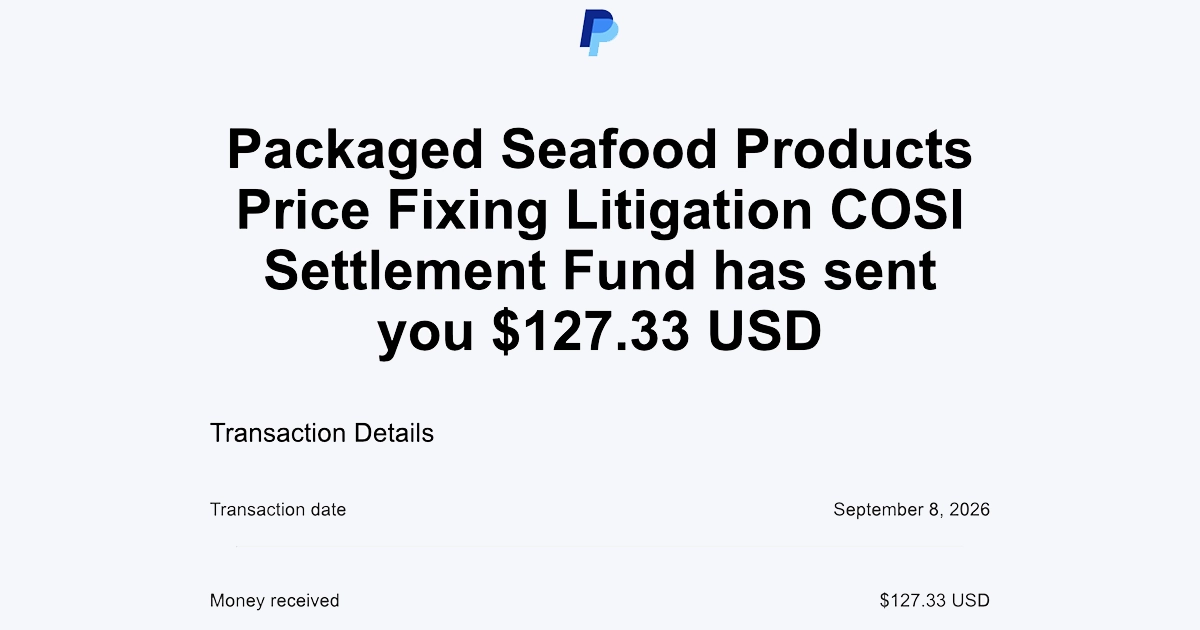
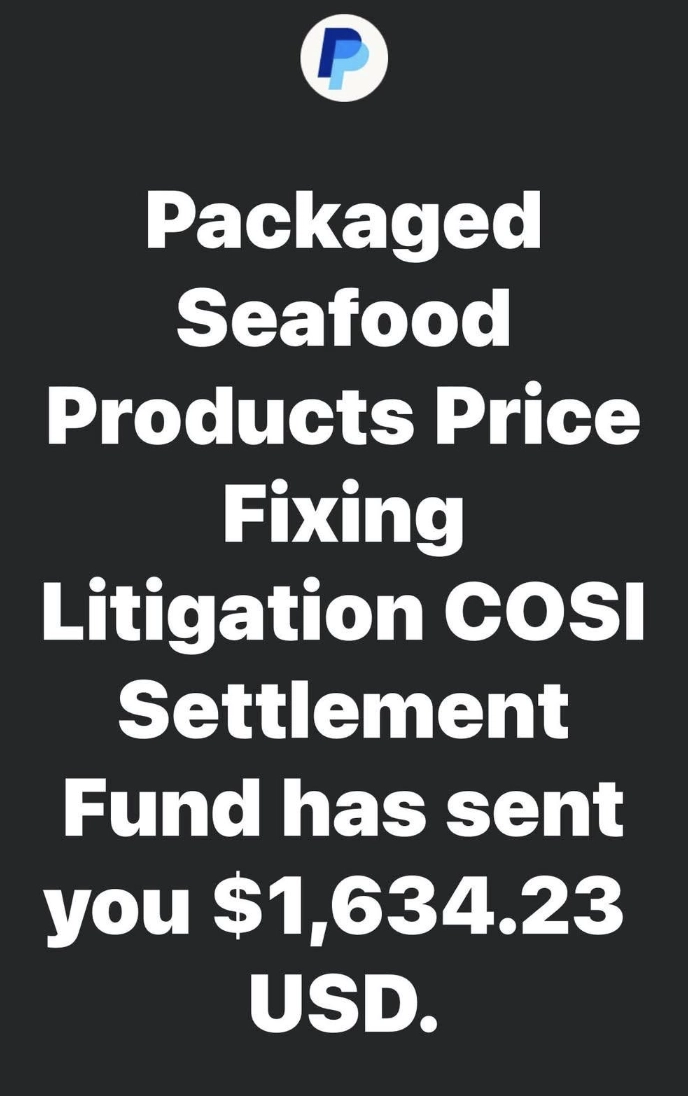
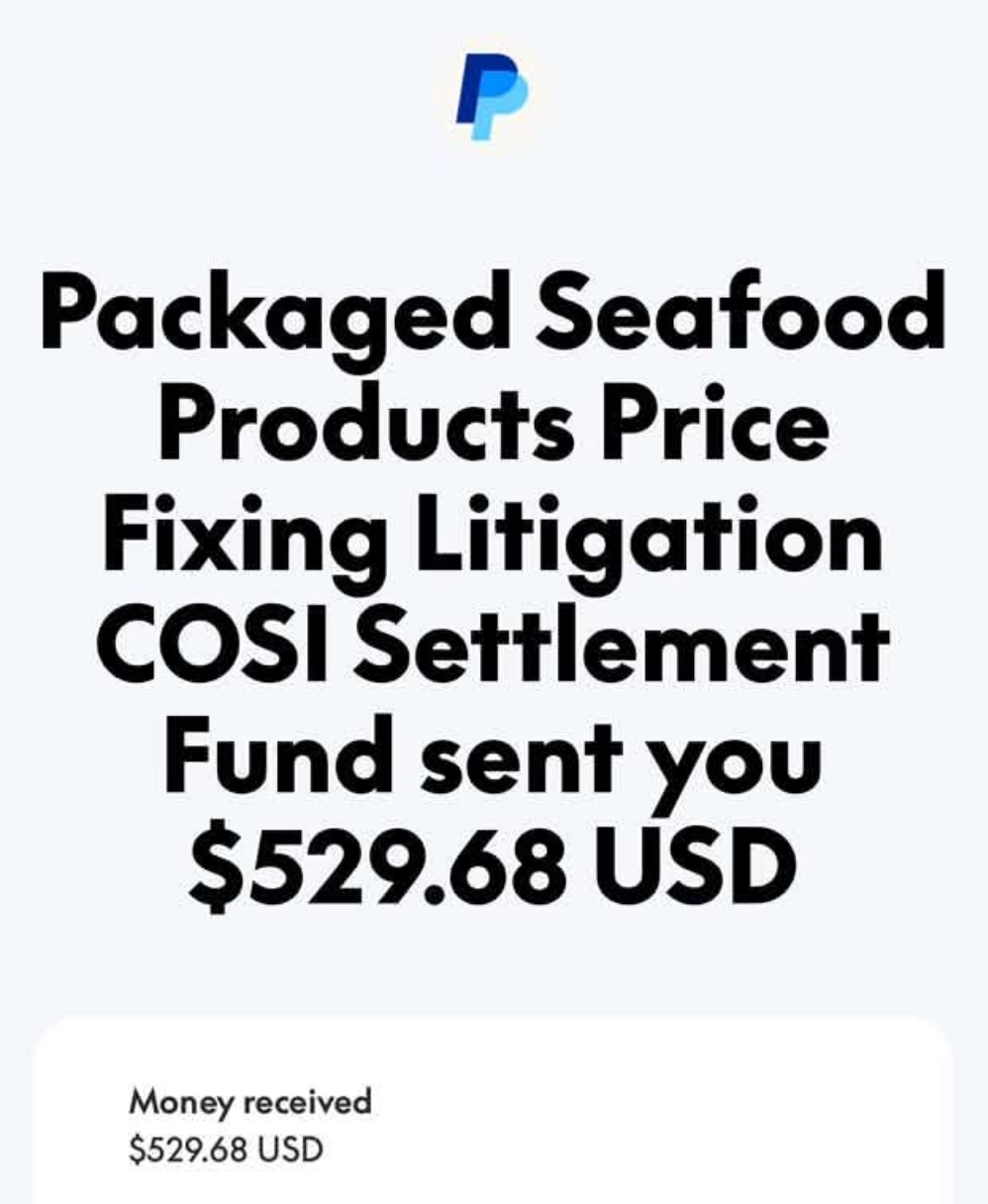
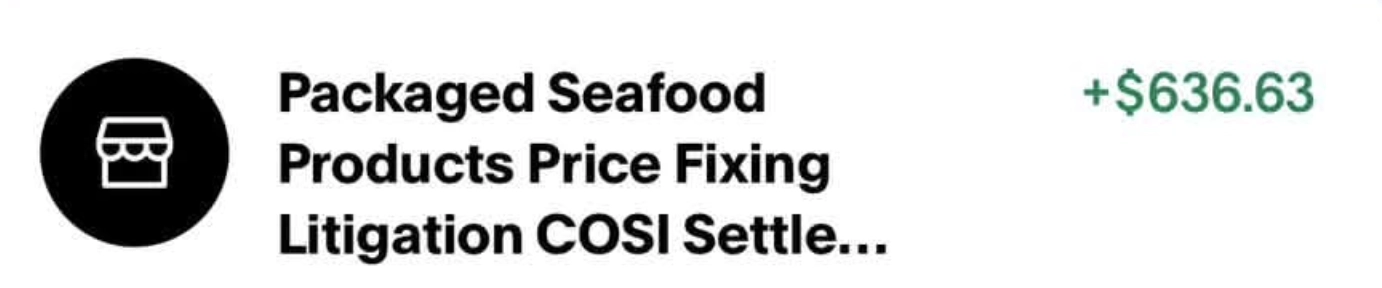
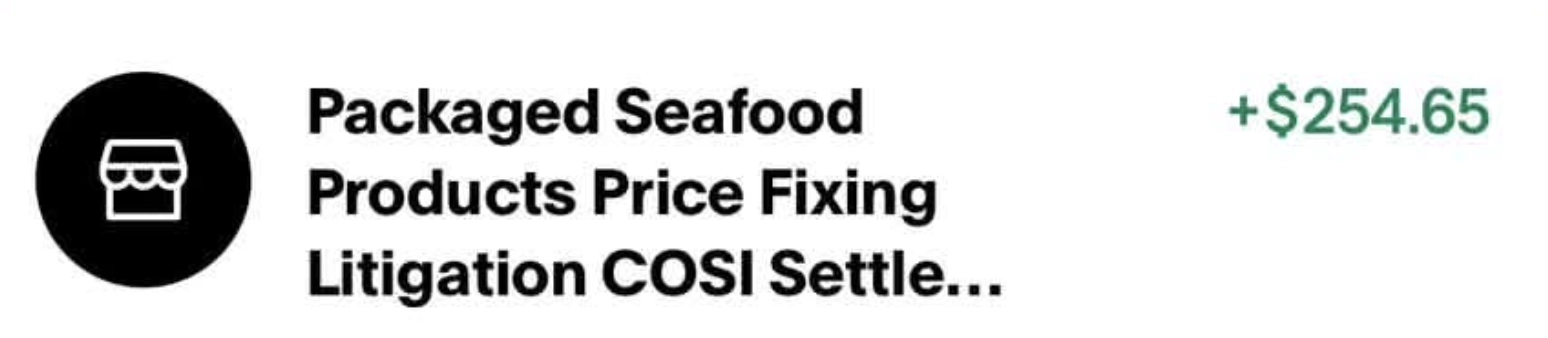
The court-approved notice estimated roughly $0.12 per can, or about $24.50 for every 200 cans and pouches claimed. That figure was always an estimate. What a claimant actually receives depends on the net fund left after the fees, costs, service awards and administration expenses the court approved, and on the total volume represented across every approved claim — a pro rata split, not a fixed per-can rate. The notice also said no payment would be issued where a claimant's total came to less than $5. Anyone comparing their payment to the headline $152.2 million should keep both adjustments in mind: that number is the gross value of three settlements combined, before any of it was spent.Some class members are reporting payments well above what the notice's estimate suggests, in the $1,600 range and higher. Open Class Actions has not confirmed those figures with the administrator, and no official per-claim schedule has been published, so treat them as claimant reports rather than a rate anyone should expect. The screenshots below, shared by class members, are a useful illustration of the spread: four payments from the same distribution, ranging from $254.65 to $1,634.23. That range is the point. No single number in it is the tuna settlement payment.
How the Payment Arrives — and How to Spot a Fake
Class members are describing both mailed paper checks and electronic payments landing in payment apps. Open Class Actions has not independently confirmed with the administrator which electronic payment services are being used for this particular distribution, so a payment notification that arrives by email or in an app should be treated as unverified until it is checked against the official settlement website. Large, well-publicized payouts attract impostors, and the tells are consistent: a real settlement payment never requires a fee to release it, never needs a bank login or online banking password, and never asks for a full Social Security number over email. Anyone who receives a paper check should also note the void date printed on it, because the reporting on the distribution order describes a 60-day window to cash it.What If You Did Not Receive a Check Yet?
A missing payment in the third week of September is not yet a problem. The administrator began issuing payments for approved claims on September 8, 2026, and a distribution of close to a million claims is not mailed in a single day; paper checks go out in batches over days or weeks, and first-class mail adds several more days on top of the mailing date. Trade press on the July 27 order described a 30-day window for JND Legal Administration to begin distributing, not a date by which every claimant would be paid. A claimant who filed a valid claim and has heard nothing should give the mail until at least early October before treating the payment as missing.Before that, four things are worth checking. First, the email address used on the claim, including the spam folder: some claimants are receiving electronic payments rather than paper, and a payment-app notification that sits unopened can expire. Second, the mailing address on file: anyone who moved since filing in 2024, or since the earlier Chicken of the Sea claim, should update it through the official settlement website now, because a check mailed to an old address comes back to the administrator as undeliverable and is re-mailed only once a current address is found. Third, the size of the claim: the court-approved notice said no payment would be issued where a claimant's total came to less than $5, so a claim for a handful of cans produces nothing rather than a small check. Fourth, whether the claim was accepted: a claim that was rejected or left deficient during the review is not in this distribution, and the administrator, not Open Class Actions, holds that record.
If the mail window passes with nothing, the claimant should contact the administrator through the official Tuna End Purchaser settlement website and ask three specific things: whether the claim was approved, what payment method and date are on file, and whether the check was returned as undeliverable. Have the claimant name and address exactly as filed and the claim confirmation number if it was kept. Do not respond to an email, text or social-media message that offers to "release" or "locate" a tuna payment for a fee or asks for a bank login; the administrator does neither. Open Class Actions cannot look up a claim or confirm whether a payment was issued.
Why It Took Almost Two Years
The StarKist and Lion settlements received final approval on November 22, 2024, and claims closed weeks later, which is usually the point at which money starts moving. It did not here, for two reasons. The court held the funds until every settling defendant had actually paid its full amount and every appeal was resolved, rather than releasing money that might have to be clawed back. Separately, the administrator had to validate an unusually large claim pool — reporting on the case puts it near a million claims — before any per-can allocation could be calculated at all. The July 27 order is the point at which both conditions were satisfied.Where the $152.2 Million Came From
The end-purchaser total combines three settlements: $130 million from StarKist, $6 million from Lion Capital, the private equity owner associated with Bumble Bee, and $16.2 million from the earlier Chicken of the Sea and Thai Union settlement. The underlying allegation was that packaged tuna producers conspired between June 2011 and July 2015 to fix, raise, maintain or stabilize prices. The criminal side of the story resolved separately and is a matter of record: StarKist was fined $100 million, Bumble Bee $25 million, and former Bumble Bee chief executive Chris Lischewski was convicted and sentenced to prison. The civil settlements themselves resolved the claims without the settling parties admitting wrongdoing. Consumers in some states were also reached by earlier, smaller deals arising from the same conduct, including a $20 million StarKist consumer settlement and a $40.6 million Washington state refund program.What Claimants Should Do Now
Nothing new needs to be filed. People who have a claim on file should watch the mail and the email address they used to file, keep the confirmation from the 2024 or Chicken of the Sea process, and check the official settlement website for the administrator's current distribution notice before responding to anything that asks for information. Anyone who moved since filing should use the administrator's own channel on that website to update an address, since a check sent to a stale address is the most common way a valid claim goes unpaid. A mailed check that a bank accepted and then reversed a few days later as “Refer to Maker” was dishonored by the bank it was drawn on; it cannot be redeposited, and the replacement has to come from the administrator, requested through the official site with the check number and amount before the 60-day cash-by window runs out. The reports and the tuna-specific steps are in tuna settlement checks being returned: what to do, and the full sequence, including the bank fee to contest, is in settlement check returned: what Refer to Maker means and what to do. Open Class Actions cannot look up a claim, change purchase data or predict an individual award.Frequently Asked Questions
Can I still file a claim in the tuna settlement?
No. The claim deadline was December 31, 2024 and it has passed. Only people whose claims were on file and approved by the administrator are in this distribution. There is no late-claim process announced.
How much is the tuna settlement payment?
The court-approved notice estimated roughly $0.12 per can, or about $24.50 for every 200 cans or pouches claimed. That was an estimate. The final per-can figure depends on the net fund after approved fees, costs and administration, and on the volume represented in all approved claims. The notice also said no payment would be issued if a claimant's total came to less than $5.
Why are some people reporting $1,600 tuna settlement payments?
Those are claimant reports, not an official figure — Open Class Actions has not confirmed them with the administrator and no per-claim schedule has been published. A payment is proportional to the purchase volume a claimant put on the form, so a very large claimed history produces a large payment by itself; at the notice's estimate, $1,600 is near 13,000 cans. It is also possible the actual per-can rate came in above the estimate because fewer valid claims arrived than planned. Nothing published so far settles which, and a household-sized claim should not be expected to reach four figures.
When did the court clear the tuna settlement payments?
Judge Dana M. Sabraw of the U.S. District Court for the Southern District of California signed the distribution order on July 27, 2026, after finding that the settling defendants had paid in full and that the appeals were exhausted. Trade press reporting on that order said the administrator would begin distributing within 30 days and that claimants would have 60 days to cash a check before it was canceled.
Why did the tuna settlement take almost two years to pay?
The StarKist and Lion settlements were approved on November 22, 2024, but the court held the money until every settling defendant had paid its full amount and every appeal was resolved. The administrator also had to review and validate a very large claim pool before any allocation could be calculated.
How will the tuna settlement payment arrive?
Class members are describing both mailed checks and electronic payments. Open Class Actions has not independently confirmed which electronic payment services the administrator is using for this distribution, so treat an unexpected email or app notification as unverified until you check the official settlement website. A legitimate settlement payment never requires a fee, a bank login or a full Social Security number sent by email.
Why was my tuna settlement check returned, and is a replacement coming?
Some checks were reversed by class members' banks as Refer to Maker in September 2026. The administrator says the cause was a bank processing issue that the bank handling the distribution has since resolved, and that sufficient funds were available at all times to cover all valid payments. Replacement checks, each with an additional $20 toward bank fees, were mailed to affected class members on September 28, 2026. Do not redeposit the original check. Checks were reissued only to affected class members, so a check that was not affected should be deposited as usual.
What if I have not received my tuna settlement check yet?
Payments for approved claims began going out on September 8, 2026, and a distribution this large is mailed in batches, so a check that has not arrived by mid-September is not yet late. Check the email address used on the claim for an electronic payment, confirm the mailing address on file through the official settlement website if you have moved, and remember that claims worth less than $5 receive no payment. If nothing has arrived by early October, ask the administrator through the official site whether the claim was approved, what payment method is on file, and whether a check was returned as undeliverable.
Sources
- Order authorizing distribution, In re Packaged Seafood Products Antitrust Litigation, No. 15-MD-2670 DMS (MSB), U.S. District Court for the Southern District of California, signed July 27, 2026.
- Official Tuna End Purchaser Settlement website, court-approved notice, claim form and key dates.
- Official Tuna End Purchaser Settlement website, Important Update stating that replacement checks with an additional $20 toward bank fees were mailed to affected class members on September 28, 2026 (checked September 30, 2026).
- SeafoodSource, "Court issues order to disburse USD 152.2 million related to tuna price-fixing lawsuits," July 2026.
- Undercurrent News, "US judge clears $152.2m tuna price-fixing settlement distribution," July 28, 2026.