Published
October 1, 2026
Updated
October 3, 2026


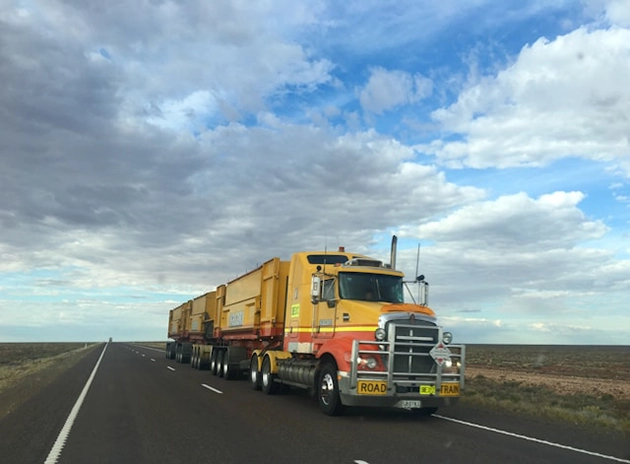
Commercial trucking moves through the region on a scale that few other American metros match. The Port of Houston anchors a supply chain that runs on container drayage, chemical hauling, and long-haul freight, and the highways feeding it carry a dense mix of heavy vehicles and passenger traffic. A company that runs even a modest fleet here operates inside conditions that punish small maintenance lapses and reward steady discipline.
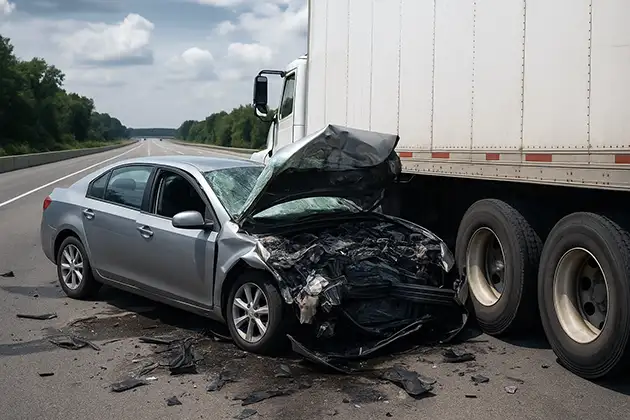
The consequences of failure are not distributed evenly. When a tractor-trailer collides with a passenger vehicle, the occupants of the smaller vehicle absorb almost all of the physical harm, and the resulting claim can involve the driver, the carrier, a shipper, a maintenance provider, and an insurer at the same time. That structure is what separates truck litigation from ordinary collision claims, and it shapes how carriers, brokers, and their insurers manage exposure long before any court filing.
Safety programs tend to be judged by their paperwork until the day they're judged by an event. The distance between those two moments is where most of the real risk lives.
Houston's freight corridors concentrate that risk in ways that inland carriers often underrate. A route that looks routine on a dispatch board can cross three jurisdictions, two construction zones, and a rail intermodal yard before noon, and each of those transitions changes what a driver must anticipate.
Freight volume sets the baseline for collision exposure
The relationship between freight density and crash frequency is close to mechanical. More trucks on a given stretch of roadway means more interactions between heavy vehicles and everything else, and the fatality consequences of those interactions scale with the mass differential.National data collected by the National Highway Traffic Safety Administration consistently shows that occupants of smaller vehicles bear the overwhelming share of deaths in crashes involving large trucks. That pattern isn't a commentary on fault. It's a physical reality that shapes how claims, damages, and investigations develop after a serious collision.
For carriers, the practical implication is that exposure isn't evenly spread across a fleet's operating map. A terminal that dispatches into dense urban freight corridors carries more collision risk per mile than one running open interstate lanes, even when the equipment and driver pool are identical. Route planning, delivery window pressure, and load scheduling all feed into that asymmetry.
Insurance underwriters notice. Premiums in high-density freight markets tend to reflect the loss history of the region, which means Houston-based carriers often pay more for the same coverage than operators in less congested areas. That cost pressure can push fleets toward thin margins on maintenance or driver hours, which is exactly the wrong direction.
Federal rules create the documentation trail that matters later
Motor carrier operations sit inside a regulatory framework that requires recordkeeping far beyond what most businesses maintain. Hours-of-service logs, driver qualification files, maintenance records, and drug testing documentation all exist as a condition of operating authority.The Federal Motor Carrier Safety Administration administers those standards, and the records they generate become the primary factual record in any serious collision investigation. Electronic logging devices have made hours-of-service data far more precise than the paper logs they replaced, which cuts both ways for carriers. The same precision that demonstrates compliance can just as easily document a violation.
That's why the quality of a safety program shows up in how well records are maintained, not just in whether violations exist. A carrier with a clean inspection history and complete files is in a materially different position than one with gaps, even when the underlying safety culture is similar.
Electronic data recorders add another layer. These devices capture speed, braking, and engine data in the seconds before impact, and investigators treat them as close to authoritative. A fleet that understands what its own equipment will show tends to make better decisions about driver coaching and vehicle maintenance.
Records don't prevent collisions. They determine what a company can prove about itself afterward, and that distinction matters enormously.
Houston's industrial diversity multiplies the parties involved
A collision involving a truck hauling hazardous material or refinery equipment in the Houston area rarely involves only a driver and a carrier. Load brokers, shipping agents, maintenance contractors, and cargo owners can all carry some portion of responsibility depending on how the load was arranged and who controlled the vehicle at the time.That layering complicates everything downstream. Insurance carriers for each party may dispute coverage. Contracts between shippers and carriers often contain indemnification clauses that shift responsibility in ways the driver never sees. A company that assumes its own policy will absorb the loss may find that a contractual provision assigns liability elsewhere.
The Occupational Safety and Health Administration maintains workplace safety standards that bear on loading, unloading, and terminal operations, and violations in those areas can surface during litigation as evidence of broader operational neglect. For businesses with mixed industrial and transportation operations, safety compliance isn't a single department's concern.
Leadership teams that treat transportation risk as a purely insurance matter tend to discover late that their contracts, safety records, and vendor agreements each represent an independent exposure point.
Litigation dynamics differ from ordinary collision claims
Truck collision cases move through a different procedural landscape than standard auto claims. Discovery involves corporate records, deposition testimony from dispatchers and safety managers, and expert reconstruction analysis that can cost more than the underlying claim in a minor case.For a business that becomes a party to that process, the operational disruption is often more costly than the legal fees. Managers who oversee dispatch, maintenance, or compliance can expect to spend substantial time preparing for depositions and producing documents. Smaller carriers without in-house counsel or dedicated risk staff often find the discovery burden disproportionately heavy.
Some defendants address this by consulting specialized representation early, before claims formalize. Working with the best houston truck accident lawyer can help a company understand how a specific collision is likely to be investigated and what records will be requested. The value sits in early clarity rather than in any promised result, and the operational decisions that follow remain with company leadership.
Timing compounds the pressure. Texas generally allows a two-year window for negligence-based truck accident lawsuits, and evidence degrades quickly. Electronic data can be overwritten, driver recollections fade, and maintenance records can be misplaced. Fleets that preserve their own documentation promptly keep more options open, regardless of how a claim eventually resolves.
Insurance coverage rarely closes every gap
Commercial auto policies carry limits, and catastrophic truck collisions can exceed those limits by a wide margin. When damages exceed coverage, the excess exposure lands on the business itself, which is why umbrella coverage and contractual risk transfer get serious attention from experienced risk managers.Coverage disputes also arise between carriers and their insurers over whether a driver was operating within the scope of employment, whether the load was properly secured, and whether the vehicle was maintained according to schedule. Each of those questions depends on records that must exist before the collision, not after.
Some carriers assume that a clean loss history translates into predictable renewals. In practice, a single severe claim can change underwriting posture for years, affecting premiums across an entire fleet rather than just the specific vehicle involved.
Free settlement alerts
Get notified when new class actions open to claims
Join thousands of readers who get the latest class action settlements you may qualify for — delivered straight to your inbox.
Vendor and contractor relationships carry hidden liability
Most carriers outsource portions of their operation. Maintenance, driver staffing, load brokerage, and terminal services frequently involve third parties whose performance affects safety outcomes without appearing on the carrier's own balance sheet.A maintenance contractor that skips a brake inspection creates liability that may flow back to the carrier under federal maintenance standards, since the operating carrier remains responsible for vehicle condition regardless of who performed the work. Similarly, a staffing agency that places an underqualified driver can expose the carrier that accepted the assignment.
Contract language matters here, but so does verification. Indemnification clauses are only as valuable as the counterparty's ability to pay, and small vendors in competitive markets often carry minimal insurance. Periodic review of vendor insurance certificates and safety records is a routine obligation that many carriers treat as a formality until it becomes a problem.
Preparedness shapes outcomes more than any single policy
Companies that manage transportation risk well tend to share a set of habits. They preserve records aggressively. They review contracts periodically rather than at signing. They train dispatchers and safety managers on what documentation will matter after an incident, not just on compliance thresholds.None of those practices prevent collisions from happening. They change what a company can demonstrate about itself when a collision is investigated, and demonstration is what most of the process actually depends on.
The underlying principle is that transportation risk is cumulative and slow to surface. A missed inspection, an unclear contract clause, or a thin maintenance record may sit unnoticed for years before a single event gives them meaning. Businesses that treat those details as ongoing obligations rather than back-office formalities tend to face investigations with more options and less improvisation.
Nothing guarantees a favorable outcome in a severe collision case, and no program eliminates exposure entirely. What tends to last is the discipline of maintaining accurate records, clear contracts, and attentive vendor oversight, because those habits serve a business long after any single claim has been resolved.
About This Page
OpenClassActions.com is a consumer news and information site, not a law firm. This article is general information about commercial truck safety programs and collision liability in the Houston area. It is not legal advice, and reading it does not create an attorney-client relationship.
For more class actions keep scrolling below.