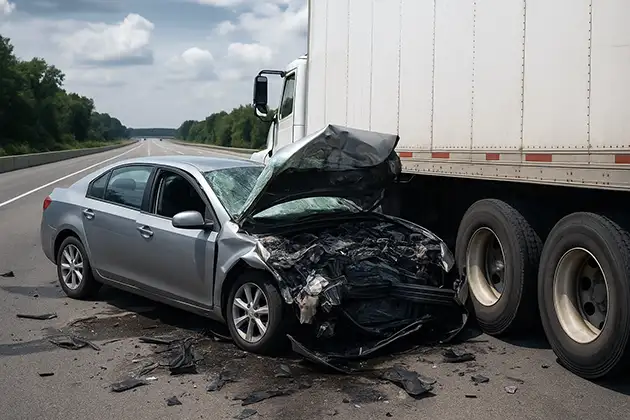
Drivers hurt in a crash with an 18-wheeler in Texas lose any right to damages if a jury finds them more than 50% responsible, and lose a matching share of their damages below that line. Where the percentages land depends heavily on logging, engine and video records that carriers are not required to keep for long.

What the 51% rule says
Texas divides fault in injury cases under Chapter 33 of the Civil Practice and Remedies Code, the state’s proportionate responsibility law. A jury assigns every party a percentage of responsibility for the crash, and the percentages have to total 100. Two consequences follow. A claimant’s damages are reduced by the claimant’s own percentage, and a claimant whose percentage is greater than 50 recovers nothing.That second rule is why the system is usually called a 51% bar. It is one version of modified comparative negligence, and the line falls at a single point: a driver found 50% responsible still recovers half, while a driver found 51% responsible recovers nothing. On a hypothetical $500,000 award, the outcomes look like this:
• 0% responsible: $500,000
• 20% responsible: $400,000
• 50% responsible: $250,000
• 51% responsible: $0
Why the line matters more in truck crashes
A loaded tractor-trailer can weigh up to 80,000 pounds on an interstate, many times the weight of a passenger car, and the injuries in these collisions tend to be severe. Higher damages raise the value of every percentage point. In a minor fender-bender the gap between 50% and 51% might be a few thousand dollars. In an 18-wheeler case it can be the difference between a substantial recovery and none.That gives carriers and their insurers a clear reason to argue the other driver’s share above the line. Common defense themes include a car cutting in too close in front of a truck, lingering in a blind spot, speeding, or a distracted driver. The injured side’s themes usually run the other way: hours-of-service violations, driver fatigue, worn brakes, improper load securement, or a truck traveling too fast for traffic or weather.
More than two parties can share the percentages
Chapter 33 is not limited to the two drivers. A jury can assign responsibility to the motor carrier, a shipper or loader, a maintenance shop, a parts manufacturer, another motorist and the injured person. Under Section 33.004, a defendant can also ask the court to designate a “responsible third party” — someone who was never sued — and that person’s share is counted when the percentages are set.How the 100% gets divided affects who pays. A defendant found more than 50% responsible can be held jointly and severally liable, meaning it can be made to pay the full damages and seek contribution from others. A defendant at 50% or below generally pays only its own share. Any settlements the claimant reaches with other parties are credited against what the remaining defendants owe. Freight hubs with long supply chains, such as Houston’s port and refinery corridors, tend to produce crashes with more parties in the room.
The records that move the numbers
Because commercial trucks operate under the Federal Motor Carrier Safety Regulations, a crash involving one usually generates far more data than a crash between two cars. The records that most often shift fault percentages include:• Electronic logging device data, which shows whether the driver stayed within federal hours-of-service limits, including the 11-hour driving cap inside a 14-hour on-duty window.
• Engine control module and event data, which can show speed, braking and throttle position in the seconds before impact.
• Forward- and driver-facing camera video, increasingly common in commercial fleets.
• Driver qualification, drug and alcohol testing, inspection and maintenance files kept by the carrier.
• The Texas Peace Officer’s Crash Report (Form CR-3), available through the Texas Department of Transportation’s Crash Records Information System.
• Scene photos, witness statements and phone records for both drivers.
The data does not wait
Federal rules require motor carriers to keep drivers’ records of duty status and supporting documents for six months. Camera systems often record over older footage on a rolling basis, and engine data can be overwritten when the truck goes back into service. Once those records are gone, the fault argument relies on memory and reconstruction.Texas courts can respond when evidence is lost. In Brookshire Brothers v. Aldridge (2014), the Texas Supreme Court set the framework for when a jury may be told that a party failed to preserve evidence it should have kept. Requests to preserve logs, video and engine data are a routine part of how Texas truck accident lawyers handle these cases, because the percentage a jury assigns so often turns on those records.
The filing deadline runs alongside all of this. Section 16.003 generally gives two years to bring a personal injury or wrongful death lawsuit in Texas, and claims against government entities carry their own notice requirements.
How commercial vehicle trials are structured
Since September 2021, Texas law has given employers sued over commercial motor vehicle crashes a procedural option that ordinary defendants do not have. Under Subchapter B of Chapter 72 of the Civil Practice and Remedies Code, the employer can ask the court to split the trial into two phases. The first phase decides liability and compensatory damages. The second, if needed, addresses exemplary damages.The same law limits when certain evidence about the employer’s own conduct, such as hiring and training practices, comes in during the first phase. The practical effect is that the first-phase fight is concentrated on what happened on the road — the same ground on which the fault percentages are set.
Insurance limits and the percentages
Federal rules require for-hire carriers hauling general freight across state lines to carry at least $750,000 in liability coverage, with higher minimums for certain hazardous materials. Many carriers carry more. When damages approach or exceed the available coverage, the percentages decide not just whether a claimant recovers but how the money that exists gets divided among everyone who was hurt.Free settlement alerts
Get notified when new class actions open to claims
Join thousands of readers who get the latest class action settlements you may qualify for — delivered straight to your inbox.
Frequently Asked Questions
What is the 51% rule in Texas?
Under Chapter 33 of the Texas Civil Practice and Remedies Code, a claimant whose percentage of responsibility for an injury is greater than 50% cannot recover damages. A claimant at 50% or less can recover, but the award is reduced by the claimant’s own percentage.
Can someone partly at fault for a crash with an 18-wheeler still recover in Texas?
Texas law allows recovery as long as the jury puts the person’s share of responsibility at 50% or less. The damages are reduced by that share, so a driver found 20% responsible recovers 80% of the damages the jury awards.
How long is the deadline to file a truck accident lawsuit in Texas?
Texas generally allows two years for personal injury and wrongful death lawsuits under Section 16.003 of the Civil Practice and Remedies Code. For wrongful death, the two years usually run from the date of death. Some situations shorten or extend the period, such as claims against government entities.
Who can share fault for an 18-wheeler crash in Texas?
A jury can assign responsibility to the truck driver, the motor carrier, a shipper or loader, a maintenance contractor, a parts manufacturer, another motorist and the injured person. Defendants can also ask the court to designate responsible third parties who were never sued, and their share is counted too.
How long do trucking companies keep driver logs?
Federal rules require motor carriers to keep records of duty status and supporting documents for six months. Other data, such as dashcam video, is often recorded over on a rolling basis and may be kept for a shorter time.
Sources
• Texas Civil Practice and Remedies Code, Chapter 33 — Proportionate Responsibility• Texas Civil Practice and Remedies Code, Chapter 16 — Limitations
• Texas Civil Practice and Remedies Code, Chapter 72 — Commercial Motor Vehicle Actions
• 49 CFR Part 395 — Hours of Service of Drivers
• 49 CFR 387.9 — Financial Responsibility, Minimum Levels
• Brookshire Brothers, Ltd. v. Aldridge, 438 S.W.3d 9 (Tex. 2014)