
Olinsky & Associates Data Breach Settlement — $40 Automatic

Muscatine Power and Water Data Breach Settlement — $525K

Fort Wayne Medical Education Program Data Breach Settlement

Highland Health Systems Data Breach Settlement — ~$85 or Up to $5,000

On Q Financial Data Breach Settlement
FinWise Bank Data Breach Settlement — Up to $5,000
 HOT
HOT
ConnectOnCall Data Breach Settlement

University of Hawaii Data Breach Settlement

Modernizing Medicine (ModMed) Data Breach Settlement

Furniture Mart USA Data Breach Settlement

Southern Graphics Data Breach Settlement

Summit Medical Group Data Breach Settlement
YES Communities Data Breach Settlement
 HOT
HOT
SitusAMC Data Breach Settlement

Twin Cities Pain Clinic Data Breach Settlement — $55 or Up to $4,500

Peco Foods Data Breach Settlement

Valley Oaks Health Data Breach Settlement — $40 or Up to $5,000
Communications Data Group Data Breach Settlement — $45 or Up to $5,000
International Shoppes Data Breach Settlement

American Vision Partners Data Breach Settlement

Susan B. Allen Hospital Data Breach Settlement

Autobell Car Wash Data Breach Settlement
Jefferson County Health Center Data Breach Settlement — $150 or Up to $300
CUSO Financial Services Data Breach Settlement — Up to $599

California Casualty Data Breach Settlement
Brevard Skin & Cancer Center Data Breach Settlement
OneTouchPoint Data Breach Settlement

Regional Urology & Ochsner LSU Health Data Breach Settlement

Albany College of Pharmacy Data Breach Settlement

Mental Health Association Data Breach Settlement
Carter Credit Union Data Breach Settlement
Mortgage Investors Group Data Breach Settlement
La Jolla Group Data Breach Settlement

Vasindas' Around the Clock Care Data Breach Settlement
 HOT
HOT
Planned Parenthood Lab Data Breach Settlement (Laboratory Services Cooperative)

Fujifilm Diosynth Data Breach Settlement

CPAP Medical Supplies Data Breach Settlement — Up to $5,000
Finastra Data Breach Settlement — Pro Rata Cash or Up to $2,500

Jack’s Family Restaurants Data Breach Settlement

Hire Velocity Data Breach Settlement — $40 or Up to $2,000

Texas Retina Data Breach Settlement — $45 or Up to $4,000
Holt Group Data Breach Settlement — $50 or Up to $5,080

PARS Data Breach Settlement — Automatic Cash

Steel Warehouse Data Breach Settlement
GeoTek Data Breach Settlement — $25 or $75 Cash, or Up to $2,000

IHRS Data Breach Settlement — $45 or Up to $2,000

Seattle & Federal Way Schools Carruth Data Breach Settlement — Up to $599

Safe Fleet Data Breach Settlement — $50 or Up to $2,500

Inotiv Data Breach Settlement

Pillsbury Law Firm Data Breach Settlement — Cash + Up to $3,000

Wayne Memorial Hospital Data Breach Settlement
Baptist Health Drew County Data Breach Settlement — Up to $4,000
Brockton Neighborhood Health Center Data Breach Settlement

McLean Mortgage Data Breach Settlement
Kimco Staffing Data Breach Settlement
Fairmont Federal Credit Union Data Breach Settlement — $150 or Up to $7,500

Auxilio Mutuo Hospital Data Breach Settlement — $25 or Up to $2,500

Telmate / ViaPath Data Breach Settlement — $4.225M
Innovative Renal Care Data Breach Settlement — $100 or Up to $5,000
Etairos Health Data Breach Settlement — $75 or Up to $4,500
ECSI $6.5M Data Breach Settlement — $100 or Up to $5,000
Benworth Capital Data Breach Settlement — $50 or Up to $5,000

Electronics for Imaging (EFI) Data Breach Settlement — $75 or Up to $5,000

TRC Staffing Data Breach Settlement — Up to $200 or $5,000 Documented
Jefferson-Blount-St. Clair Mental Health Authority Data Breach Settlement

CBIZ Data Breach Settlement — Est. $100 or Up to $5,000

Antigo Construction Data Breach Settlement — $100 or Up to $3,000

Chimienti & Associates $650K Data Breach Settlement — Up to $100 or $5,000
Arizona Labor Force Data Breach Settlement — About $25 With No Proof

Kelly Benefits Data Breach Settlement — Est. $50 or Up to $5,000
Covenant Health $2M Data Breach Settlement — ~$75 or Up to $5,000
Roseland Community Hospital Data Breach Settlement — $50 or Up to $5,000
$6.44M AMCA Sonic Healthcare Data Breach Settlement — $50 or Up to $5,000

Riverside Resort & Casino Data Breach Settlement — $50 or Up to $3,000

ARcare $3.9M Data Breach Settlement — $100 or Up to $5,000

Washington Gastroenterology Data Breach Settlement

Hampton Regional Medical Center Data Breach Settlement — Est. $20 or Up to $5,000
Blue Ridge Rural Water Data Breach Settlement — $50 or Up to $2,500

Vida Y Salud $500K Data Breach Settlement — $50 or Up to $3,580
Kisco Senior Living $1.8M Data Breach Settlement — Cash, $250 CA, Up to $10,000
DaVita $10M Ransomware Data Breach Settlement — ~$50 or Up to $2,500
Warner Music Group $1.25M Data Breach Settlement — Est. $50, $100 in California

Canada CRA & GCKey Breach Settlement — Up to $5,200 CAD

Wyatt Detention Facility Data Breach Settlement — Up to $5,000
Bath Fitter Employee Data Breach Settlement — ~$75 or Up to $4,000
Columbia University $16.1M Data Breach Settlement — ~$100 or Up to $8,500
Capital One Canada Data Breach Settlement — $35M CAD

Academy Mortgage Data Breach Settlement
Recently Closed Data Breach Settlements
Claim deadlines for these data breach settlements have passed. They are kept here for reference only — you can no longer file a claim. Claims Closed
Equinox Data Breach Settlement
Claims Closed
Palomar Health Medical Group Data Breach Settlement
 Claims Closed
EFS Advisors & Aviben Data Breach Settlement
Claims Closed
Highlands Oncology Data Breach Settlement
 Claims Closed
Americold Data Breach Settlement
 Claims Closed
Lands’ End Data Breach Settlement
 Claims Closed
Dartmouth Oracle EBS Data Breach Settlement — $75 or Up to $5,000
Claims Closed
DAP Health Data Breach Settlement
 Claims Closed
Anixter Center Data Breach Settlement — $50 or Up to $5,000
 Claims Closed
WPM Pathology & Salina Regional Data Breach Settlement
 Claims Closed
Globe Life & American Income Life Data Breach Settlement
 Claims Closed
Community Dental Care Data Breach Settlement
 Claims Closed
MCNA Dental Data Breach Settlement
 Claims Closed
Docketwise Data Breach Settlement — $50 With No Proof
 Claims Closed
Tift Regional Health System & Southwell Data Breach Settlement
 Claims Closed
Dairy Farmers of America (DFA) Data Breach Settlement
 Claims Closed
Crossroads Trading Data Breach Settlement — $25 With No Receipts
 Claims Closed
Sansone Group Data Breach Settlement
 Claims Closed
Doxim Data Breach Settlement
 Claims Closed
AIS InfoSource Data Breach Settlement — Up to $5,000
 Claims Closed
Urban One Data Incident Settlement
 Claims Closed
EY & Bank of America MOVEit Data Breach Settlement
 Claims Closed
Arrowhead Regional Computing Consortium (ARCC) Data Breach Settlement
 Claims Closed
EisnerAmper Data Breach Settlement
 Claims Closed
OnePoint Patient Care Data Breach Settlement
 Claims Closed
Bradford-Scott Data (Sharetec) Data Breach Settlement
 Claims Closed
Stockpile Data Breach Settlement
 Claims Closed
Community Connections Data Breach Settlement
 Claims Closed
Heritage South Credit Union Data Breach Settlement
 Claims Closed
Coleman Professional Services Data Breach Settlement
 Claims Closed
Albany Gastroenterology Consultants Data Breach Settlement
 Claims Closed
Total Vision Data Breach Settlement
 Claims Closed
Healthcare Services Group Data Breach Settlement
 Claims Closed
NJ Lenders Data Breach Settlement
 Claims Closed
First Baptist Church of Hammond Data Breach Settlement
Claims Closed
Clay-Platte Family Medicine Data Breach Settlement
Claims Closed
ApolloMD Data Breach Settlement
 Claims Closed
HCF Management Data Breach Settlement
Claims Closed
Physicians' Primary Care of Southwest Florida Data Breach Settlement
 Claims Closed
ABC Legal Services Data Breach Settlement
 Claims Closed
System Pavers Data Breach Settlement
Claims Closed
Central Maine Healthcare Data Breach Settlement
 Claims Closed
Pierce County Library System Data Breach Settlement
 Claims Closed
Central Valley Meat Data Breach Settlement
 Claims Closed
Community Realty Management (CRM) Data Breach Settlement
Claims Closed
Drug and Alcohol Treatment Services (DATS) Data Breach Settlement
 Claims Closed
700Credit Data Breach Settlement
 Claims Closed
Excel Fitness Data Breach Settlement
 Claims Closed
Naper Grove Vision Care Data Breach Settlement
 Claims Closed
American Consumer Credit Counseling (ACCC) Data Breach Settlement
Claims Closed
Aspire Health Alliance Data Breach Settlement
 Claims Closed
Vector Security Data Breach Settlement
Claims Closed
Western Montana Clinic Data Breach Settlement
 Claims Closed
Lighthouse Electric Data Breach Settlement
 Claims Closed
Schuster Company Data Breach Settlement
 Claims Closed
Comcast Xfinity Data Breach Settlement
 Claims Closed
Dohman, Akerlund & Eddy Data Breach Settlement
 Claims Closed
STIIIZY Data Breach Settlement
 Claims Closed
True World Holdings Data Breach Settlement
 Claims Closed
Lemonade Data Disclosure Settlement
Claims Closed
Lucent Health Data Breach Settlement
Claims Closed
Okanogan Behavioral Healthcare Data Breach Settlement
Claims Closed
GRIPA MOVEit Data Breach Settlement
 Claims Closed
Labcorp AMCA Data Breach Settlement
 Claims Closed
Circle K (Gas Express) Data Breach Settlement
 Claims Closed
ZOLL Medical Data Breach Settlement
 Claims Closed
Crimson Wine Group Data Breach Settlement
Claims Closed
Serviceaide Data Breach Settlement
Claims Closed
Family Medicine Centers (FMC) Data Breach Settlement
 Claims Closed
Berman & Rabin Data Breach Settlement
Claims Closed
Henderson & Walton Women's Center Data Breach Settlement
 Claims Closed
KYB Americas Data Breach Settlement
Claims Closed
Hillcrest Convalescent Center Data Breach Settlement
Claims Closed
Lakeview Health Data Breach Settlement
Claims Closed
McKenzie Health Data Breach Settlement
 Claims Closed
Compex Legal Services Data Breach Settlement
 Claims Closed
Lee University Data Breach Settlement
Claims Closed
Mt. Baker Imaging & Northwest Radiologists Data Breach Settlement
Claims Closed
Ciuni & Panichi Data Breach Settlement
Claims Closed
Datavant (Ciox Health) Data Breach Settlement
 Claims Closed
GeoLogics Corporation Data Breach Settlement
 Claims Closed
Alta Resources Data Breach Settlement
Claims Closed
EMM Loans Data Breach Settlement
 Claims Closed
Oak View Group Data Breach Settlement
Claims Closed
Mission Community Hospital (Deanco Healthcare) Data Breach Settlement
 Claims Closed
Flagstar Bank Data Breach Settlement
 Claims Closed
Onsite Mammography Data Breach Settlement
Claims Closed
Triage Staffing Data Breach Settlement
Claims Closed
Oglethorpe Data Breach Settlement
 Claims Closed
Motility Software Solutions Data Breach Settlement
 Claims Closed
LA Financial Credit Union Data Breach Settlement
 Claims Closed
Robbie D. Wood Data Breach Settlement
 Claims Closed
Fitzgerald Wealth Management Data Breach Settlement
Claims Closed
Esse Health Data Breach Settlement
 Claims Closed
Bray International Data Breach Settlement
Claims Closed
Belle Tire Distributors Data Breach Settlement
 Claims Closed
Fidelity Investments Data Breach Settlement
 Claims Closed
Thompson Coburn Data Breach Settlement
Claims Closed
Alpine Ear, Nose & Throat Data Breach Settlement
 Claims Closed
SAG-AFTRA Health Plan Data Breach Settlement
Claims Closed
Gándara Mental Health Center Data Breach Settlement
Claims Closed
American International College Data Breach Settlement
 Claims Closed
Enroll Confidently Data Breach Settlement
 Claims Closed
Union Bank and Trust (UBT) MOVEit Data Breach Settlement
 Claims Closed
First Financial Security Data Breach Settlement
 Claims Closed
The Gill Corporation Data Breach Settlement
 Claims Closed
New River Electrical Data Breach Settlement
 Claims Closed
Cross Valley FCU Data Breach Settlement
 Claims Closed
Maxar Space Systems Data Breach Settlement
 Claims Closed
TRISTAR Insurance Group Data Breach Settlement
Claims Closed
AGC America Data Breach Settlement
Claims Closed
Chattanooga Heart Institute Data Breach Settlement
 Claims Closed
Concord Orthopaedics Data Breach Settlement
 Claims Closed
Anne Arundel Dermatology Data Breach Settlement
Claims Closed
BMS CAT Data Breach Settlement
 Claims Closed
QPharma Data Breach Settlement
 Claims Closed
Pawn America Data Breach Settlement
Claims Closed
Alabama Ophthalmology Associates Data Breach Settlement
Claims Closed
Dove Healthcare Management Services Data Breach Settlement
Claims Closed
South Texas Oncology and Hematology Data Breach Settlement
 Claims Closed
LastPass Data Breach Settlement
Claims Closed
Cardiovascular Consultants Data Breach Settlement
Claims Closed
Illinois Bone and Joint Institute Data Breach Settlement
 Claims Closed
E Benefit Solution Data Breach Settlement
Claims Closed
Endue Software Data Breach Settlement
 Claims Closed
Alera Group Data Breach Settlement
Claims Closed
Bell Ambulance Data Breach Settlement
Claims Closed
EMS LINQ Data Breach Settlement
Claims Closed
Mount Kisco / Ambulatory Surgery Center of Westchester Data Breach Settlement
 Claims Closed
Evening Post Publishing Data Breach Settlement
Claims Closed
$500K Whitman Hospital Data Breach Settlement
 Claims Closed
Krispy Kreme Data Breach Settlement
 Claims Closed
Alpha Baking Co. Data Breach Settlement
 Claims Closed
Avis Rent A Car Data Breach Settlement
 Claims Closed
Absolute Dental Data Breach Settlement
Claims Closed
Complete Payroll Solutions Data Breach Settlement
Claims Closed
SouthState Bank Data Breach Settlement
 Claims Closed
MN Orthodontics Data Breach Settlement
 Claims Closed
Cadence Bank MOVEit Data Breach Settlement
Claims Closed
Rebound Orthopedics & Neurosurgery Data Breach Settlement
Claims Closed
Proliance Surgeons Data Breach Settlement
 Claims Closed
PharMerica Data Breach Settlement — Payments Issued
Claims Closed
Phil Smith Automotive Group Data Breach Settlement
 Claims Closed
Gryphon Healthcare Data Breach Settlement — Payments Issued
Claims Closed
Numotion Data Breach Settlement
 Claims Closed
Sequoia Data Breach Settlement — Payments Issued
Claims Closed
Alabama Cardiovascular Group Data Breach Settlement
Claims Closed
Contra Costa County Data Breach Settlement
Claims Closed
Omni Family Health Data Breach Settlement
 Claims Closed
Ruger Firearms Data Breach Settlement — $1.5M Fund
 Claims Closed
Cash App Data Breach Settlement
Related Privacy & Tracking Class Actions
Website tracking, pixel, BIPA (biometric) and VPPA (video privacy) cases involve compromise of similar categories of personal information. Currently open on OpenClassActions.com:
Concord Hospital Website Pixel Tracking Privacy Settlement
Allina Health System Website Pixel Tracking Privacy Settlement
Fairchild Medical Center Website Pixel Tracking Privacy Settlement
 HOT
HOT
Wellstar Health System Website & Patient Portal Pixel Tracking Privacy Settlement
HOT
MDLIVE Patient Portal Tracking Privacy Settlement
Penn Medicine (myPennMedicine) Website Pixel Tracking Privacy Settlement
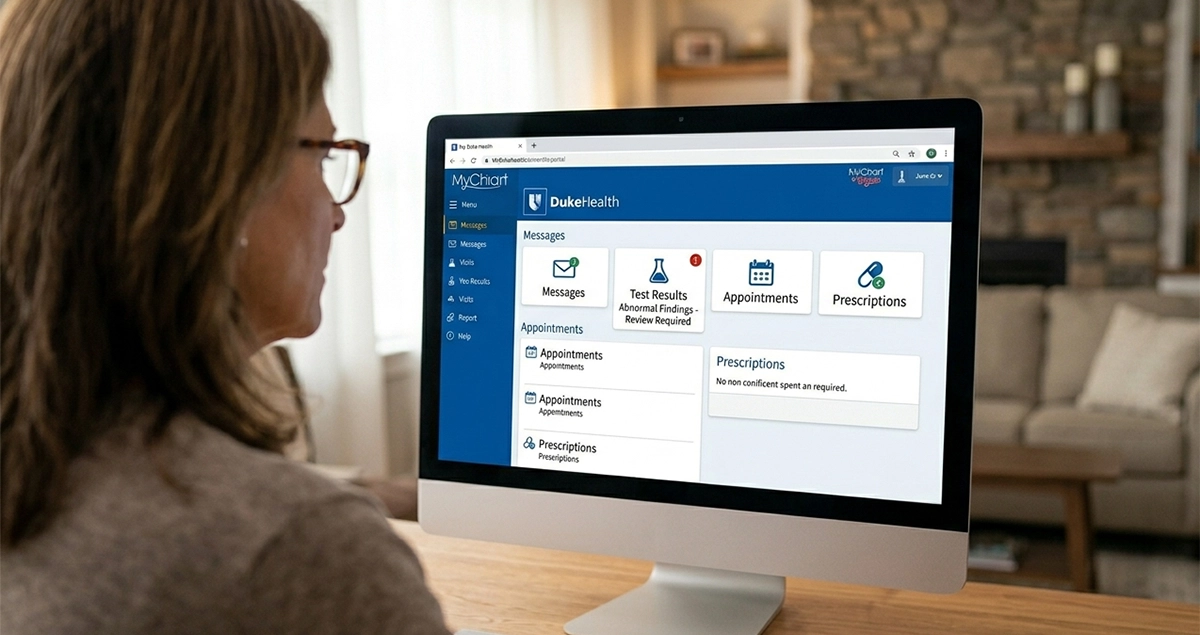
Duke Health MyChart Patient Portal Meta Pixel Privacy Settlement
What Is a Data Breach Class Action?
A data breach class action is a civil lawsuit brought on behalf of every person whose personal information was exposed in the same incident. Plaintiffs typically allege the company that held the data — the “defendant” — failed to use reasonable cybersecurity safeguards (negligence), breached its own privacy promises (breach of contract or implied contract), or violated a state statute such as the California Consumer Privacy Act (CCPA), the Illinois Biometric Information Privacy Act (BIPA), or a state data breach notification law.Most data breach class actions resolve in settlement rather than trial. A typical settlement provides a tiered cash payment (a flat-rate or pro-rata cash payment with no proof, plus a higher reimbursement tier of $2,500–$10,000 for class members who can document out-of-pocket losses such as fraud, credit-monitoring fees, or unreimbursed time), free credit monitoring for one to three years, and additional statutory payments for residents of states with strong consumer-privacy laws (notably the $100 CCPA payment for California residents on multi-state settlements). The settlement is paid by the company that suffered the breach (or its cybersecurity insurer) into a court-supervised fund administered by an independent settlement administrator. For a deeper walkthrough of the benefit tiers, the proof rules, and the standing fight that decides which breaches become lawsuits, see our guide to how data breach class actions work.
I Received a Data Breach Notice — What Now?
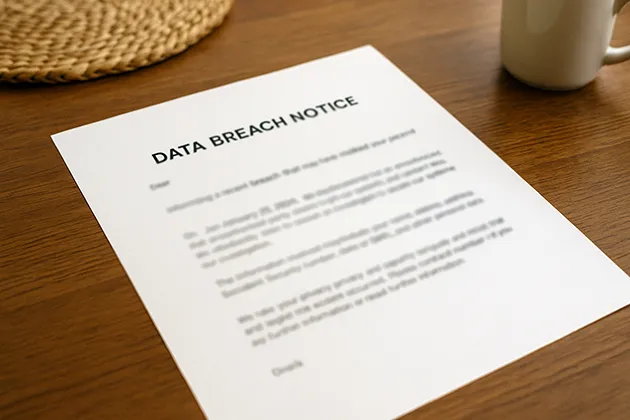
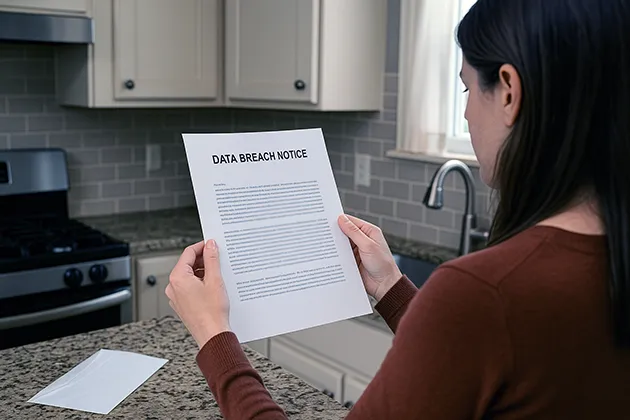
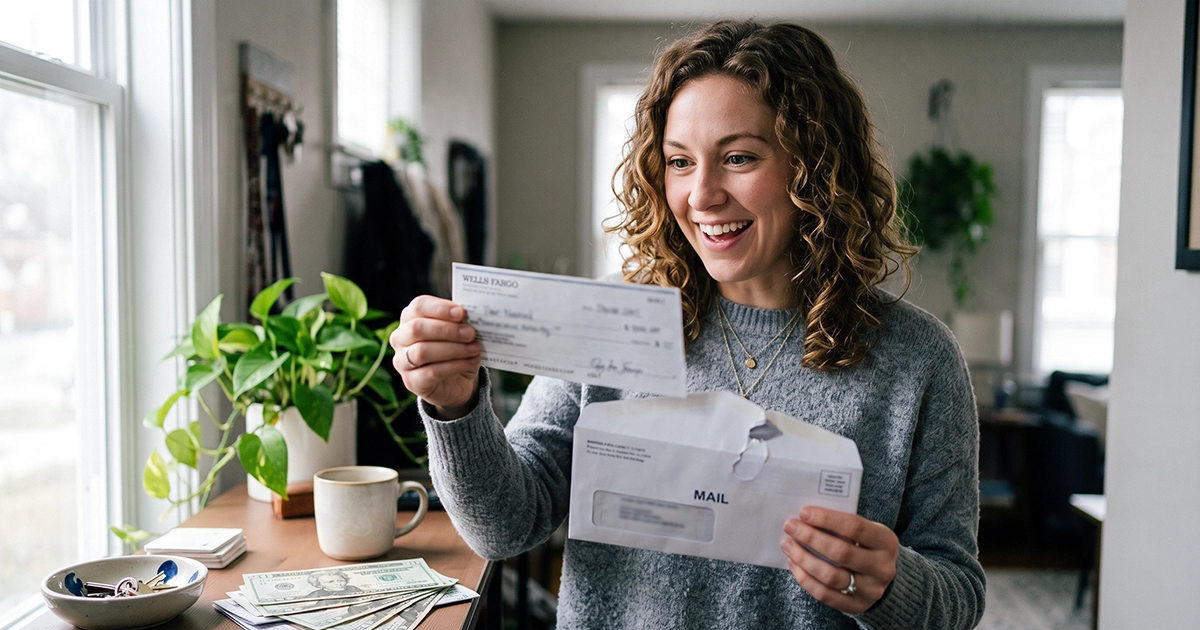
Millions of Americans have been receiving data breach notices in their mail or their email inbox like the one below. If so, you may be entitled to significant compensation as part of data breach class action settlements.
The following personally identifiable or protected healthcare information may have been exposed in these data breaches:
• Names,
• Social Security Numbers,
• Dates of Birth,
• Health Insurance Information,
• Medical Information,
• Diagnosis Information,
• Health Insurance Group and Policy Numbers,
• Subscriber Numbers,
• Prescription Information.
Data breaches are serious matters that can cause long term damage. Hackers break into networks so that they can steal your personal information to sell it on the dark web, commit identity theft, financial theft or other types of fraud.
How to Verify Your Data Breach Notice Is Real (Not Phishing)
Scammers send fake “data breach notices” that look identical to real ones, hoping you'll click a link, hand over a Social Security Number, or pay a bogus “identity protection fee.” Real breach notices and real settlement administrators never charge a fee, never ask for a wire transfer or gift cards, and never pressure you to act in the next 24 hours.Use this checklist before clicking anything:
• Verify the breach exists. Cross-check the breached company's name against the U.S. Department of Health and Human Services Office for Civil Rights HIPAA Breach Portal (for healthcare breaches), the California Attorney General's data breach list, the Maine Attorney General data breach notifications, or the Washington State Attorney General data breach directory. Real breaches show up in at least one of these public registries.
• Verify the settlement administrator. Real settlement administrators in the U.S. are typically Kroll, Epiq, A.B. Data, Angeion, Atticus, JND Legal, Verita, Postlethwaite & Netterville, or Settlement Services Inc. The official settlement website almost always uses a dedicated domain naming the case (e.g., maxarsettlement.com, krispykremesettlement.com) — never a generic “claim center” or shortened-URL link.
• Look up the case on PACER or the court website. Every legitimate class action has a docket with the federal court (PACER, free state-court equivalents) under a real case number. If a notice cites a case number, it is verifiable.
• Read OpenClassActions. If a settlement is real, we cover it on a dedicated page with the class definition, claim form link, deadlines, and proof requirements. If you cannot find the breach in our list above, search the company name on this site before submitting any information.
• Report suspected scams. Forward suspected phishing notices to ReportFraud.ftc.gov and to your state attorney general. The FTC also operates IdentityTheft.gov for recovery assistance if you've already been victimized.
How Settlement Payouts Are Calculated
Most data breach settlements use a tiered payout structure. Understanding which tier you qualify for is usually the difference between a $30 check and a $5,000 reimbursement.Tier 1 — Flat-rate or pro-rata cash (no proof). Every class member who submits a timely valid claim gets a flat-rate payment (typically $30–$100) or a pro-rata share of whatever's left in the fund after fees, administration, and Tier 2 reimbursements. Pro-rata means the per-person amount depends on the total number of valid claims filed; if claim volume is low, this tier can be larger than the flat rate. You usually need only a Class Member ID printed on your mailed/emailed notice. Across 305 data breach settlements we analyzed, the median no-documentation payment was $50, against a median advertised maximum of $5,000 — the full breakdown is in how much data breach settlements pay per person.
Tier 2 — Documented out-of-pocket losses. Class members who can document expenses or losses caused by the breach — unreimbursed fraud, credit-monitoring you paid for, lost time at $20–$25 per hour, professional fees — can claim reimbursement up to a per-class-member cap (typically $2,500–$10,000). This tier requires receipts, statements, or sworn affidavits.
Tier 3 — Statutory state-law payments (overlay). Several recent settlements include a California Consumer Privacy Act (CCPA) payment of approximately $100 for California residents (on top of Tier 1 / Tier 2), and Illinois residents sometimes receive elevated amounts under the Biometric Information Privacy Act (740 ILCS 14). Eligibility for these is automatic if you reside in the relevant state during the class period.
Tier 4 — Credit monitoring (in-kind). Most settlements offer one to three years of free credit monitoring with $1M in identity-theft insurance. This is in addition to cash, not instead of, and claiming it does not reduce your other payments.
What Credit Monitoring Covers (and Doesn't)
Credit monitoring is the most commonly offered non-cash settlement benefit, and it is meaningful — but it is not identity-theft insurance in the way most consumers assume.What credit monitoring does: alerts you when a new account is opened in your name, when there is a hard inquiry on your credit file, or when significant changes occur (address change, late payment, collections action). The included “up to $1M identity-theft insurance” reimburses out-of-pocket recovery costs (legal fees, lost wages, postage, notarization), not the underlying loss itself.
What it does not do: credit monitoring does not prevent identity theft. It does not unfreeze stolen tax refunds, recover stolen Medicare or Medicaid benefits, undo synthetic-identity fraud against relatives, or stop SIM-swap attacks on your phone number. For comprehensive protection after a breach, the FTC's recommended steps are to place a free credit freeze with all three nationwide credit bureaus (Equifax, Experian, TransUnion), file your taxes early, and enroll in the IRS Identity Protection PIN program if you are eligible.
Current Data Breach Patterns
Recent breach litigation frequently involves stolen credentials, exploited vulnerabilities, ransomware, third-party vendors, and human error. The mix changes from year to year, and a reported incident does not automatically produce a class action or settlement. The Verizon Data Breach Investigations Report provides a regularly updated industry-wide view of incident patterns and contributing factors.Why Large Breaches Do Not Always Produce Claims
A breach notice, lawsuit, and settlement are three different stages. A company may report an incident without facing a class action; a complaint may be dismissed or sent to arbitration; and a settlement may define a class more narrowly than the original breach population. The Chick-fil-A data breach class action is a recent example of that gap: a complaint over the June 2026 credential-stuffing attack on Chick-fil-A One loyalty accounts was filed in July 2026 and voluntarily dismissed six weeks later, before the company ever answered, leaving nothing to claim. Size does not speed things up either: the DentaQuest data breach lawsuits, over a May 2026 incident the company reported as affecting 15 million people, were consolidated in July 2026 and are still at the pleading stage with no settlement. The NFM Lending data breach lawsuits show the earliest stage of all: at least five proposed class actions were filed in Maryland federal court in September 2026, within days of a ransomware group's claim that it took mortgage borrowers' data, and the complaints allege the lender had not yet sent breach notices. The Paylogix data breach lawsuits show the opposite timing: the benefits billing company says files were copied in November 2025, but its notice letters went out in August 2026, and the first suits followed within weeks. The Upbound and Acima data breach lawsuits followed a similar path: the Rent-A-Center parent says files were taken in early July 2026, mailed notices on September 23, and was sued in Texas a week later. The Southern Company data breach lawsuits moved just as fast: Southern Company disclosed on October 5, 2026 that an intruder had reached customer-portal account data for about 400,000 Georgia Power, Alabama Power and Mississippi Power customers, and the first proposed class action was filed in Atlanta federal court two days later. The Quest Diagnostics data breach lawsuits came faster still: Quest told the SEC on October 22, 2026 that an unauthorized party had accessed patient records in its Quanum lab ordering system, and the first proposed class action was filed in New Jersey federal court that same day. Use the open-settlement grid above to identify current claim opportunities, then confirm the class definition and deadline on the official administrator website linked from the dedicated case page.People Most Affected By Data Breaches
The most frequently breached sectors in the USA for 2025 included:• Healthcare
• Education
• Finance
• Government
• Technology
• Cybersecurity Trends
Ransomware remains a significant threat, with damages expected to reach $265 billion annually by 2031. Supply chain attacks and third-party breaches continue to be a growing concern, adding to inflation worries since the post-Covid era in the United States. There has also been an increasing focus on protecting against vulnerabilities and addressing the human element in cybersecurity, and how consumers can redress and mitigate identity theft and financial damage due to the massive prevalnce and acceleration of data breach incidents. Read below to learn how you can be owed cash and what to do to avoid data breaches resulting in damage to your financial and well-being.
What to Do If Your Data Was Breached
If you've received a data breach notice, the FTC and CISA recommend the following steps to limit damage and preserve your eligibility for any class action settlement. The earlier you act, the easier it is to document harm later. For a fuller response plan organized by exposed Social Security numbers, passwords, payment cards, medical information and driver's licenses, use our step-by-step data breach notice guide.- Confirm the breach is real. Cross-check the company name against the HHS HIPAA Breach Portal, the California Attorney General's data breach list, or Maine AG breach notifications. Real breaches show up in at least one public registry. If yours doesn't, treat the notice as suspect.
- Keep the original notice. Don't throw it away or delete the email. Most settlements require a Class Member ID, Notice ID, or PIN printed on it — without it, the administrator's lookup process is harder. Save a copy (photo, scan, or screenshot) before doing anything else.
- Change passwords for affected accounts. Use unique, randomly generated passwords stored in a reputable password manager. Reusing the same password across sites is what turns one breach into many.
- Enable two-factor or multi-factor authentication (2FA/MFA). Prefer an authenticator app (Google Authenticator, Authy, 1Password) or a hardware security key over SMS-based codes, which are vulnerable to SIM-swap attacks.
- Place a free credit freeze with all three bureaus. A freeze is the single most effective measure to prevent new-account identity theft, and it's free under federal law at Equifax, Experian, and TransUnion. A freeze does not affect your credit score.
- Enroll in the IRS Identity Protection PIN. Tax-refund identity theft is one of the most common post-breach harms. The IRS IP PIN program blocks anyone without your six-digit PIN from filing a return in your name.
- Monitor your accounts and credit reports. Pull free reports at AnnualCreditReport.com and scan for accounts you don't recognize, unfamiliar inquiries, or address changes you didn't authorize.
- Document any losses or unreimbursed time. Save bank statements, fraud-resolution call logs, notarization fees, mileage to the bank or police station, and time spent on remediation. These records are what unlock the documented-loss tier (typically $2,500–$10,000) of most data breach settlements.
- Watch for phishing tied to the breach. Breach disclosures predictably trigger a wave of scam calls, texts, and emails. Forward suspicious messages to ReportFraud.ftc.gov and to your state attorney general; if you've already been victimized, start the recovery plan at IdentityTheft.gov.
- File the class action claim before the deadline. The comparison table at the top of this page tracks every open data breach settlement with its deadline, fund, payout tiers, and direct link to OpenClassActions' page for that case. Most claim forms take five to fifteen minutes.
How Do I Qualify for Compensation?
Qualifying for a data breach class action settlement comes down to three things, and they're the same across virtually every settlement on this page:- You received a data breach notice from the defendant company (by mail or email), or you used the company's products or services during the class period defined in the settlement. Either path can establish class membership.
- You can supply your Class Member ID, Notice ID, Claim ID, or PIN. Lost it? The settlement administrator can look you up by name, last four of SSN, or email on file via the official settlement website — we link the official site on each settlement's page.
- You file a valid claim form by the deadline. Late claims are not paid. Use the comparison table at the top of this page to see which deadlines are coming up.
Every settlement linked from the open settlements table above has a dedicated OpenClassActions page that spells out that settlement's specific class definition, payout tiers, proof requirements, and direct link to the official claim portal — bookmark this page and check back as new settlements are added each month.
Free settlement alerts
Get notified when new class actions open to claims
Join thousands of readers who get the latest class action settlements you may qualify for — delivered straight to your inbox.
Attorney Advertising - This page may contain attorney advertising. The information on OpenClassActions.com is for general informational and advertising purposes. No attorney-client relationship between reader and any law firms is created by submitting forms linked from here. While we try to complete the forms accurately and timely, we cannot guarantee the accuracy or completeness of the information contained in the linked pages. The information provided on OpenClassActions.com is not legal advice, OpenClassActions.com is not a law firm and the information contained on OpenClassActions.com is not legal advice.
Frequently Asked Questions
What is a data breach class action settlement?
A court-supervised resolution of a class action lawsuit alleging that a company's failure to safeguard your personal information caused harm. The settlement creates a fund used to pay flat-rate cash, pro- rata cash, documented out-of-pocket reimbursement, statutory state-law payments (e.g., $100 CCPA for California), and credit monitoring to class members. You typically need to file a claim by the deadline using a Class Member ID printed on your mailed or emailed notice.
Do I need proof of harm to file a data breach claim?
Proof requirements vary by settlement. Some basic cash options require only the identifiers in a settlement notice, while other claims require documentation. Requests for reimbursement of documented losses generally need records connecting the expense or loss to the incident.
How do I know if I'm eligible?
A breach notice alone does not establish eligibility for a later settlement. Compare the company, incident, and dates in your notice with the court-approved class definition. A separate settlement notice may include a Class Member ID or Notice ID for filing.
How long do data breach settlements take to pay out?
There is no fixed payment timetable. Distribution can depend on final approval, appeals, claim validation, deficiency reviews, and a court order authorizing payment. The official settlement website is the best source for a case-specific distribution update.
Will filing a claim affect my credit score?
No. Filing a class action claim has no effect on your credit. Accepting the included credit monitoring also has no effect — it's a soft pull only.
Is there a cost to file a claim?
No. Class action claim forms are always free. If anyone asks for a fee, processing charge, or “release fee” to claim a settlement, it is a scam. Report it at ReportFraud.ftc.gov.
What if I lost my notice and don't have my Class Member ID?
Contact the settlement administrator through the official settlement website. Most administrators will look up your ID by name, last four of SSN, or email on file. The settlement page on this site links to the official administrator for each case.
Can I sue separately if I opt out of the settlement?
Yes. Every class action settlement includes an opt-out (exclusion) deadline. Class members who properly opt out keep the right to sue the company individually for the same conduct. Once the opt-out deadline passes, your right to file a separate lawsuit is permanently released.
Sources & Government References
Primary federal and state-government sources used to verify breaches, settlement administrators, and class definitions on this page:- U.S. Department of Health and Human Services, Office for Civil Rights: HIPAA Breach Notification Portal — the official federal database of healthcare data breaches affecting 500+ individuals.
- U.S. Federal Trade Commission: IdentityTheft.gov — federal recovery plan for victims of identity theft, plus ReportFraud.ftc.gov for reporting suspected breach-related scams.
- Federal Trade Commission — Consumer Advice: Credit Freeze FAQs and Data Breach: What to Do.
- Cybersecurity and Infrastructure Security Agency (CISA): Identity Management & Cybersecurity Best Practices — federal guidance on protecting personal information and recognizing breaches.
- California Attorney General: Searchable Data Security Breach Database and California Consumer Privacy Act (CCPA) information.
- Maine Attorney General: Data Breach Notifications List — Maine receives breach notifications affecting any Maine resident, making this list one of the most comprehensive U.S. registries.
- Washington State Attorney General: Data Breach Notifications Directory.
- Illinois General Assembly: Biometric Information Privacy Act, 740 ILCS 14 — the statutory basis for biometric privacy class actions (BIPA).
- Internal Revenue Service: Identity Protection PIN program — federal protection against tax-refund identity theft for breach victims.
- Verizon Business: Data Breach Investigations Report (DBIR) — widely cited annual cybersecurity research used by federal agencies and Fortune 500 CISOs.